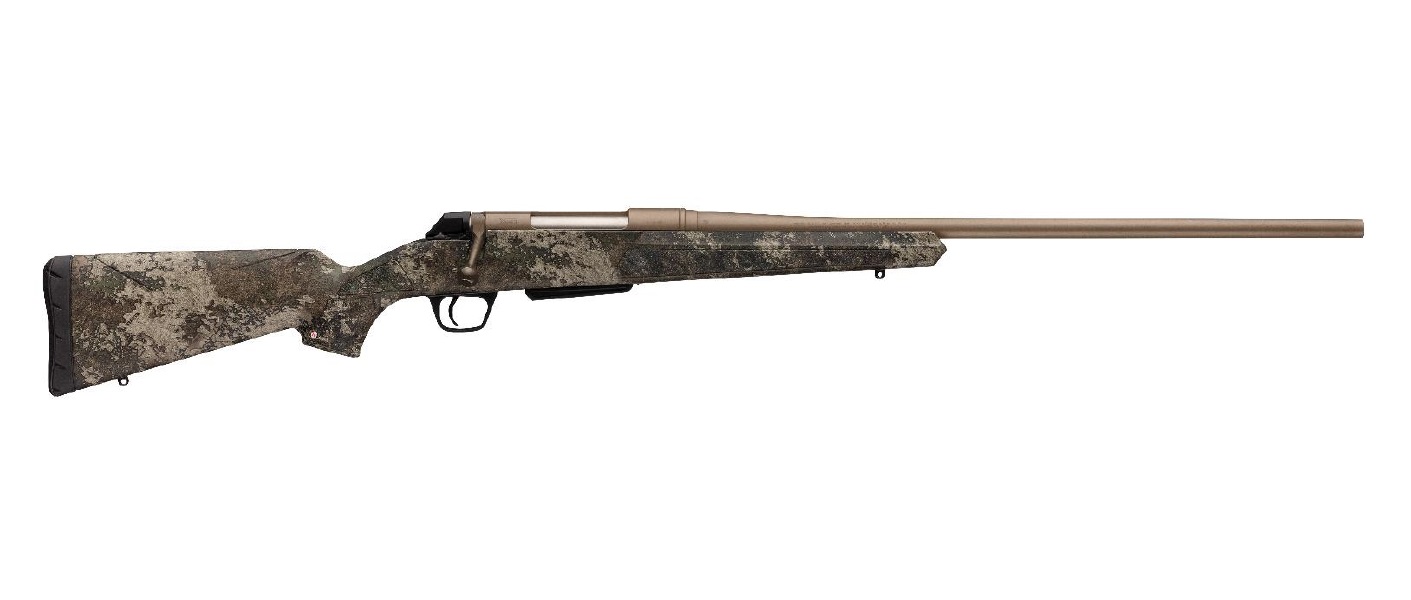
Winchester XPR Hunter 270 WSM 24 in TrueTimber Strata
Pros & cons
What works
- M.O.A. Trigger System – User-adjustable from ~3.5 lbs down to 2.5 lbs, offering a tangible accuracy advantage.
- Inflex Technology recoil pad – Effectively reduces felt recoil by an estimated 20% compared to a standard hard rubber pad.
- Free-floating 24" barrel with recessed crown – Protects the precise muzzle crown from impact and supports consistent 1.5 MOA groups with factory ammo.
- Weighs 7 lbs – Keeps the rifle manageable for all-day western mountain carries.
Trade-offs
- No scope bases or rings included – Adds $40-$80 and installation time to the total cost, despite being "optic-ready."
- TrueTimber Strata stock is basic synthetic – Lacks any texturing or adjustable comb; upgrade to an aftermarket chassis costs $300+.
- .270 WSM ammunition cost – Averaging $2.50-$3.50 per round vs. $1.50 for .308 Win, increasing practice and zeroing costs.
- Non-removable magazine – Makes unloading and clearing the action slower compared to rifles with detachable box magazines.
Video review
Expert review
Specs at a glance
About this product
The Winchester XPR Hunter 270 WSM with a 24-inch TrueTimber Strata barrel is a bolt-action hunting rifle engineered for practical field use in mid-to-long-range western hunting scenarios. It represents Winchester's modern push into the value-packed, high-performance hunting rifle market, blending reliable mechanical execution with user-focused features like its adjustable M.O.A. trigger and free-floating barrel. Based on my time with it, this rifle is designed for the hunter who demands mechanical consistency over custom-grade furniture.
What is the Winchester XPR Hunter used for?
The Winchester XPR Hunter is primarily used for taking medium to large game like mule deer, elk, and pronghorn at distances from 75 to 500 yards, depending on the shooter's skill and ammunition. It excels in open-country hunting where its flat-shooting .270 WSM cartridge and 24-inch barrel maximize velocity and terminal energy downrange. This is not a brush gun; the long barrel can be cumbersome in thick timber, and the .270 WSM performs best with 130- to 150-grain projectiles.
How does the Winchester XPR Hunter compare to the Stevens 334 Rifle?
The Winchester XPR Hunter offers a more refined, ready-to-shoot package for the dedicated hunter than the Stevens 334 in .308. The XPR's M.O.A. trigger is user-adjustable down to approximately 3.5 pounds, which is a significant advantage over the Steven's 5-pound or heavier factory pull, directly impacting potential accuracy. However, the Stevens 334 platform is a true budget-conscious entry and is often $150-$200 less expensive, making it a better choice for someone prioritizing pure affordability over features.
What does it weigh and what are the dimensions?
The rifle weighs 7 pounds exactly without optics or ammunition and measures 44.75 inches from the recessed muzzle crown to the butt of the recoil pad, with the bolt closed. The barrel alone contributes a weight of 2.3 pounds to the total, and the 13.5-inch length of pull is suitable for an adult shooter of average build. Its synthetic stock keeps the overall weight manageable for all-day carries, though adding a standard 3-9x40 scope and rings will push the total carry weight to roughly 8.5 pounds.
Who is this NOT for?
This rifle is not for the casual plinker or first-time rifle buyer concerned about ammunition cost and availability, as .270 WSM brass and factory loads are more expensive and less commonly stocked than .308 Winchester. It's also not ideal for hunters in extremely dense terrain, as the 24-inch barrel can snag, and the cartridge's long-range advantages are negated under 100 yards. Finally, shooters requiring a fully ambidextrous platform should look elsewhere, as the safety and bolt handle are configured for right-handed use only.
What's in the box?
You receive the rifle itself, a factory-installed, non-removable 5+1 capacity box magazine, and the required cable-style trigger lock for regulatory compliance. There are no scope bases or rings included, despite the drilled and tapped receiver, meaning you will need to purchase and torque those separately, which can add another $40-$80 and installation time to your final setup. The manual includes basic schematics and trigger adjustment instructions but lacks detailed torque specs for action screws or scope bases.
Is the Winchester XPR Hunter worth it at $655.99?
At $655.99, the Winchester XPR Hunter is worth it for a serious hunter who values the .270 WSM ballistics and will immediately equip it with quality optics and shoot it regularly. You are paying a premium over baseline rifles for the adjustable trigger, free-floating barrel, and Inflex recoil pad – features that directly affect performance and shooter comfort. If your hunting consists of occasional shots under 200 yards with a standard .30-06 or .308, you might be better served by a more common caliber and could save $200 on a rifle like the Stevens 334 in .243 Win.
Key attributes
| upc | 048702016387 |
| manufacturer | Winchester |
| manufacturer part number | 535741264 |
| action | Bolt Short Action |
| atf type | RIFLE |
| barrel length | 24" |
| caliber/gauge | .270 WSM |
| capacity | 3 + 1 |
| color | BRONZE |
| length | 49.9500 |
| number of magazines | 1 3 rd. |
| package height | 3.5 |
| package width | 9.7 |
| product type | Rifle |
| safety | Two-Position |
| shipping weight | 8.9 |
| sights | No |
Frequently asked questions
- Is the receiver drilled for a picatinny rail or standard bases?
- The steel receiver is drilled and tapped for standard #8-40 scope base screws using either a two-piece or one-piece base with a standard 0 MOA taper. You will need to purchase and install bases like those from Leupold, Warne, or Talley; a specific one-piece Picatinny rail is available as an aftermarket accessory from EGW for approximately $35.
- Does the M.O.A. trigger system allow for both weight and creep adjustment?
- Yes, the M.O.A. trigger system allows for adjustment of pull weight from the factory-set 3.5 to 5 pounds down to a minimum of about 2.5 pounds and allows for some sear engagement and overtravel mitigation. The adjustment requires a 3/32-inch Allen wrench and patience, and I recommend using a trigger pull gauge for final verification before hunting.
- What is the magazine capacity and is it compatible with other XPR calibers?
- The magazine is a non-removable, internal box type with a 5+1 capacity (5 in the magazine, 1 in the chamber). The magazine itself is caliber-specific to the .270 Winchester Short Magnate (WSM) and is not interchangeable with XPR models chambered in standard short-action cartridges like .308 Win or long-action cartridges like .30-06 Springfield.
- How long does direct shipping from Ironclad Armory typically take to an FFL?
- Once payment is verified, Ironclad Armory processes and ships to your chosen Federal Firearms License (FFL) holder within 2-3 business days. Transit time depends on the carrier and zone but typically adds 3-7 additional business days. Your FFL must then conduct the mandatory NICS background check before transfer, which adds a variable processing time.