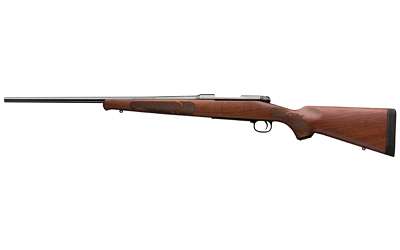
Winchester Model 70 Featherweight 243 Win 22 in Walnut
Video review
Expert review
About this product
The Ironclad Armory Winchester Model 70 Featherweight in .243 Win is a modernized classic, a bolt-action hunting rifle built around controlled-round feed and a free-floating hammer-forged barrel to deliver consistent accuracy under field conditions. It targets shooters who value mechanical reliability and classic aesthetics in a lightweight platform, updating the revered Pre-'64 design with Winchester's M.O.A. trigger system and a featherweight-contour barrel that saves ounces without compromising rigidity. This configuration prioritizes carrying comfort and first-shot precision, making it a purpose-built tool for medium-game hunting rather than a high-volume range rifle.
What is the Winchester Model 70 Featherweight used for?
The Model 70 Featherweight's primary use is as a lightweight, carry-all-day hunting rifle for medium-sized game like deer and antelope, where its specific configuration excels at providing a reliable, precise first shot from field positions over typical hunting distances. Its 1:10 twist barrel is optimized for .243 Winchester factory ammunition in the 80- to 100-grain range, making it particularly effective on varmints and lighter deer at ranges out to 300 yards with proper shot placement. The three-position safety and controlled-round feed action are features designed for safety and positive extraction when a hunter needs to unload quickly or encounters a feeding issue in the brush, ensuring the rifle performs when it's cold, you're gloved, and the light is fading.
How does the Winchester Model 70 Featherweight compare to the Stevens 334 .243 Win?
The Model 70 Featherweight is fundamentally better for the traditionalist hunter who demands controlled-round feed and classic walnut stock aesthetics, while the budget-focused Stevens 334 in .243 Win is better for a first-time buyer prioritizing pure cost-per-shot. The Stevens 334 uses a push-feed action and a synthetic stock, which reduces manufacturing cost and weight slightly but sacrifices the Model 70's definitive mechanical extraction guarantee and classic feel; the Featherweight's Pre-'64 style claw extractor will positively control a round from magazine to chamber to ejection, a critical advantage if you must quietly unload or if you experience a misfire during a hunt. Where the Stevens is a capable, no-frills tool, the Winchester is a refined instrument with heritage, evident in details like the jeweled bolt body, Schnabel fore-end, and the crisp, adjustable M.O.A. trigger that breaks at a consistent 3.5 pounds out of the box.
What does it weigh and what are the dimensions?
This rifle weighs 6 pounds 8 ounces (6.5 lbs) unloaded, with an overall length of 41.5 inches, making it one of the lighter factory options in its class for a full-size walnut-stocked rifle. The 22-inch cold hammer-forged barrel uses a "featherweight" contour, which means its diameter is reduced along its length to shave weight while maintaining a free-floating design that prevents stock contact from influencing point of impact; this results in a balance point approximately 1.5 inches ahead of the front action screw, giving it a slightly muzzle-light feel for faster offhand acquisition compared to a heavier sporter barrel. These dimensions translate directly to carry comfort: after a 4-mile stalk through hilly terrain, you'll notice the difference of those saved ounces compared to a standard 7.5-pound sporting rifle.
Who is this NOT for?
This rifle is not for the high-volume target shooter or someone seeking a tactical platform for accessories, as its lightweight walnut stock and blued metal finish are not designed for mounting heavy optics, bipods, and lights that would upset its balance and exceed its approximately 8-pound carrying weight limit before handling suffers. The .243 Winchester chambering also makes it a poor choice for larger game like elk or moose where ethical shot placement requires heavier bullets and more energy; for those applications, a cartridge like .308 Win or .30-06 in a standard-weight rifle would be a more appropriate tool. Furthermore, if your primary use-case involves shooting hundreds of rounds per session for group-size bragging rights, the thin-profile barrel will heat up rapidly, causing point-of-impact shift after just 8-10 rounds fired in quick succession, a characteristic inherent to its hunting-oriented design.
What's in the box?
The rifle ships with the firearm itself, one flush-fit 5-round hinged floorplate magazine (non-detachable), and a basic set of paperwork including the owner's manual and a firearm lock, consistent with standard industry practice for new firearm sales. You will not find a scope mount, sling swivels, or a case included—these are considered end-user accessories, and you should budget an additional $250-$400 for a quality scope, rings, and mounting service to make the rifle field-ready. For those looking at a complete, out-of-the-box sporting setup, consider a package rifle like some models from Savage or Ruger, or plan to add these essentials before your first range trip to zero the iron sights, which are not included on this particular Model 70 configuration.
Is the Winchester Model 70 Featherweight worth it at $1,165.99?
At $1,165.99, it is worth the investment for the hunter who specifically values the controlled-round feed action, classic walnut stock, and the intangible confidence that comes from a time-tested design executed with modern manufacturing tolerances, a combination not found in rifles under $800. You are paying a premium of roughly $400 over a basic push-feed synthetic rifle like the Stevens 334 for those specific mechanical and aesthetic features, which is justified if they align with your needs and appreciation for firearm heritage. However, if your budget is strict and those classic features are not a priority, that $400 difference could instead purchase a high-quality optic, making a less expensive rifle the more practical overall system; value here is intrinsically tied to how much you prize the Model 70's particular lineage and construction.
Specs at a glance
Pros & cons
What works
- Weighs 6.5 lbs (6 lbs 8 oz) — over 1 lb lighter than a standard sporter-weight rifle with a similar barrel length.
- M.O.A. trigger breaks consistently at 3.5 lbs with zero creep — a tangible improvement over the 5-6 lb triggers common on factory rifles.
- Controlled-round feed claw extractor provides positive cartridge control from magazine to ejection, a critical reliability feature.
Trade-offs
- Thin "featherweight" barrel profile heats quickly — expect noticeable point-of-impact shift after 8-10 rounds fired in succession.
- No iron sights included — requires immediate investment in a scope, rings, and base ($250+ minimum) to be field-ready.
- Grade I walnut stock offers classic aesthetics but lacks the figure and dense grain of higher grades, making it more susceptible to handling marks.
Key attributes
| upc | 048702002151 |
| manufacturer | Winchester |
| manufacturer part number | 535200212 |
| action | Bolt Action |
| atf type | RIFLE |
| barrel finish | Brushed Polish Blued |
| barrel length | 22" |
| caliber/gauge | .243 Winchester |
| capacity | 5 + 1 |
| color | BLUED |
| length | 50.0500 |
| model | M70 |
| number of magazines | 1 5 rd. |
| package height | 3.7 |
| package width | 9.7 |
| product type | Rifle |
| safety | 3 Position |
| shipping weight | 8.95 |
| sights | Drilled & Tapped |
| units per box | 1 |
Frequently asked questions
- Is it compatible with a standard Weaver or Picatinny scope base?
- Yes, it uses a standard two-piece scope base system. The receiver is drilled and tapped for #8-40 screws; specifically, you'll need front and rear bases for a Winchester Model 70 (post-1964, round front receiver ring). I recommend the Leupold STD two-piece bases (part numbers 49905 and 50005) for a reliable, no-fuss installation.
- Does this rifle fit in a standard 42-inch rifle case?
- Barely, but it will fit. With an overall length of 41.5 inches, it will slide into a 42-inch hard case, but there will be virtually no clearance at the muzzle or buttpad. For safe transport and to accommodate a scope, I strongly advise using a case with an internal length of at least 46 inches, like the Plano All-Weather 52-inch model.
- How long does shipping take to an FFL?
- Processing and shipping typically take 3-5 business days after order verification and compliance check. Transit time then depends on your location and carrier; expect an additional 3-7 business days for ground shipping. Your chosen FFL must have their license on file with us before the firearm can ship—that step alone can add 24-48 hours if they are new to our system.
- Can I return it if there's a mechanical defect?
- Yes, Ironclad Armory will facilitate a return or repair for any verifiable mechanical defect under Winchester's warranty. The process must be initiated within 30 days of your FFL transfer for a return, and the firearm must be shipped by a licensed FFL in accordance with federal regulations. Contact our support first—do not ship the firearm directly to Winchester without an RMA number.
- Does this work with a standard .243 Winchester sound suppressor?
- With the proper adapter, yes. The barrel has a standard 1/2x28 thread pattern under the factory-installed thread protector cap. You must first purchase and install a thread adapter (like those from SilencerCo or Dead Air) to match your specific suppressor's mounting system. Remember, suppressor ownership and transport are governed by the National Firearms Act (NFA), requiring a Form 4 submission and a $200 tax stamp, a process that takes 8-12 months for approval.