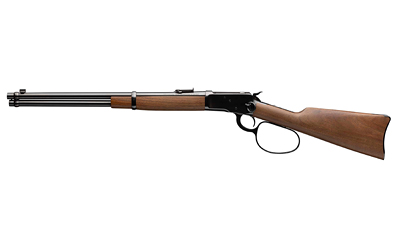
Winchester 1892 Large-Loop Carbine .44-40 Win 20 in. Walnut
Pros & cons
What works
- Weighs 6.0 lb (96 oz) — 1.3 lb lighter than a Stevens 334 in .308 Win with the same 20" barrel.
- Delivers a 10+1 round capacity through its tubular magazine, loaded via a side gate.
- Features a large-loop lever with a 2.1" x 3.8" internal opening for use with heavy winter gloves.
Trade-offs
- .44-40 Winchester ammunition averages $1.75 per round — nearly double the cost of .44 Magnum practice loads.
- No factory-threaded barrel option — requires aftermarket gunsmithing for suppressor use, adding $200+ and a tax stamp.
- The Grade I walnut stock shows significant grain variation; expect minor cosmetic imperfections, not exhibition-grade wood.
Video review
Expert review
Specs at a glance
About this product
The Winchester 1892 Large-Loop Carbine in .44-40 Win with a 20-inch walnut stock is a modern production lever-action rifle built to the original John Browning design specifications but with contemporary manufacturing tolerances. For clarity, this is a newly manufactured firearm from Miroku under Winchester license, not a historical piece or curio & relic—that classification matters for interstate transfers. As an armorer, I evaluate this carbine as a factory-fresh platform for traditional hunting and recreational shooting, emphasizing its specific handling characteristics and cartridge performance within the .44-40 Winchester chambering.
What is the Winchester 1892 Large-Loop Carbine used for?
Its primary utility is as a light-recoil, fast-handling brush gun for deer and feral hog hunting within 150 yards where dense cover demands quick shots. The .44-40 Winchester cartridge generates approximately 900 foot-pounds of muzzle energy, making it ballistically suitable for thin-skinned game at moderate ranges, and the 10+1 tubular magazine capacity provides ample follow-up shots. Many shooters also use it for cowboy action shooting, though competitors often seek slicked-up custom actions rather than factory-tight ones, and its 37.5-inch overall length makes it maneuverable from a saddle or in thick timber.
How does the Winchester 1892 Large-Loop Carbine compare to the Stevens 334 Rifle?
The Winchester carbine is 1.3 pounds lighter and offers faster follow-up shots than the bolt-action Stevens 334 in .308 Win, but the Stevens delivers superior terminal ballistics for longer-range hunting. The Stevens .308 produces nearly triple the muzzle energy (over 2600 ft-lbs) and maintains accuracy past 300 yards, while the .44-40 Winchester is effective only to about 150 yards on deer-sized game. If your priority is close-range speed in heavy cover, the Winchester's lever action is superior; if you need ethical reach for open-country elk or mule deer, the Stevens 334 is the objectively better tool.
What does it weigh and what are the dimensions?
It weighs exactly 6.0 pounds (96 ounces or 2.72 kg) unloaded, with an overall length of 37.5 inches and a 20-inch button-rifled barrel. The walnut stock has a 13.5-inch length of pull, which fits an average adult male shooter wearing a light jacket, and the large-loop lever's internal opening measures 2.1 inches by 3.8 inches to accommodate a gloved hand. This compact package, combined with the 10-round tubular magazine running under the barrel, yields a balanced pivot point approximately 4 inches forward of the lever, making it quick to shoulder from a low-ready position.
Who is this NOT for?
This carbine is a poor choice for anyone needing a multi-role defensive firearm or seeking extreme long-range precision, as the .44-40 Winchester bullet drop exceeds 24 inches at 200 yards. It's also not ideal for modern suppressor use; the threaded barrel required for a muzzle device is not standard on this model, unlike some tactical lever guns. If your primary use case involves shots beyond 175 yards, you'll be better served by a .30-caliber bolt-action rifle like the Stevens 334 or a modern semi-auto in 6.5 Creedmoor.
What's in the box?
The factory box contains the rifle, a single 10-round capacity owner's manual, and a standard cable lock that meets federal safety device requirements. No optic mounting bases, sling swivels, or additional magazines are included—the tubular magazine is integral and loaded through a side port. You will need to purchase .44-40 Winchester ammunition separately, which averages about $1.75 per round for commercial loads, and I recommend acquiring at least 200 rounds for initial function testing and zeroing the adjustable rear sight.
Is the Winchester 1892 Large-Loop Carbine worth it at $1282.99?
At this price point, you are paying for the Winchester brand heritage, the Grade I walnut fitment, and the specific historical styling, not for unmatched mechanical performance. A comparable Rossi R92 in .44 Magnum retails for under $800 and offers similar function with a more potent modern cartridge. The value proposition here is for the shooter who specifically wants the .44-40 chambering for authenticity, the large-loop lever for winter glove use, and the satin-finished walnut stock aesthetics—if those three details matter to you, the premium is justified.
Key attributes
| upc | 048702121098 |
| manufacturer | Winchester |
| manufacturer part number | 534190140 |
| action | Lever Action |
| atf type | RIFLE |
| barrel length | 20" |
| caliber/gauge | .44-40 Winchester |
| capacity | 10 + 1 |
| color | Blue |
| length | 45.5500 |
| model | 1892 |
| package height | 3.0 |
| package width | 8.0 |
| product type | Rifle |
| shipping weight | 8.25 |
| sights | Adjustable Sights |
Frequently asked questions
- Is it compatible with a scope mount?
- Yes, but it requires a specific side-mount or scout-style rail that attaches to the receiver's pre-drilled holes, not a traditional top-mounted base. The receiver is factory-drilled for a #8-40 screw pattern, and companies like XS Sights and Skinner Sights offer dedicated mounts for about $45-$80. Installing a standard pistol scope with a 2-7x variable optic adds approximately 10.5 ounces to the overall weight.
- Does this fit in a standard rifle case?
- It requires a case with an internal length of at least 39 inches to accommodate the 37.5-inch rifle with minimal padding. Most 40-inch takedown cases from Plano or Flambeau will work, with about 1.25 inches of clearance on each end. I recommend the Plano All-Weather Protector Series 42" case for transport, as its foam can be custom-cut to secure the lever without pressure on the linkage.
- How long does shipping take to an FFL?
- From our warehouse to your selected Federal Firearms License holder, standard ground shipping takes 4-7 business days for in-stock items, excluding processing and FFL verification time. Express 2-day air service is available for an additional $38.50, which cuts transit to 2 business days after the order clears our compliance check, which itself requires 1-2 business days.
- Can I return it if there's a mechanical defect?
- Yes, but only for factory warranty service through Winchester/Miroku, not for a cash refund, due to federal firearms regulations. The process involves contacting Ironclad Armory for a Return Merchandise Authorization number, then shipping the unloaded firearm directly to Winchester's service center in Morgan, Utah, where warranty repairs typically take 3-5 weeks. Cosmetic issues like walnut grain variation are not considered defects.