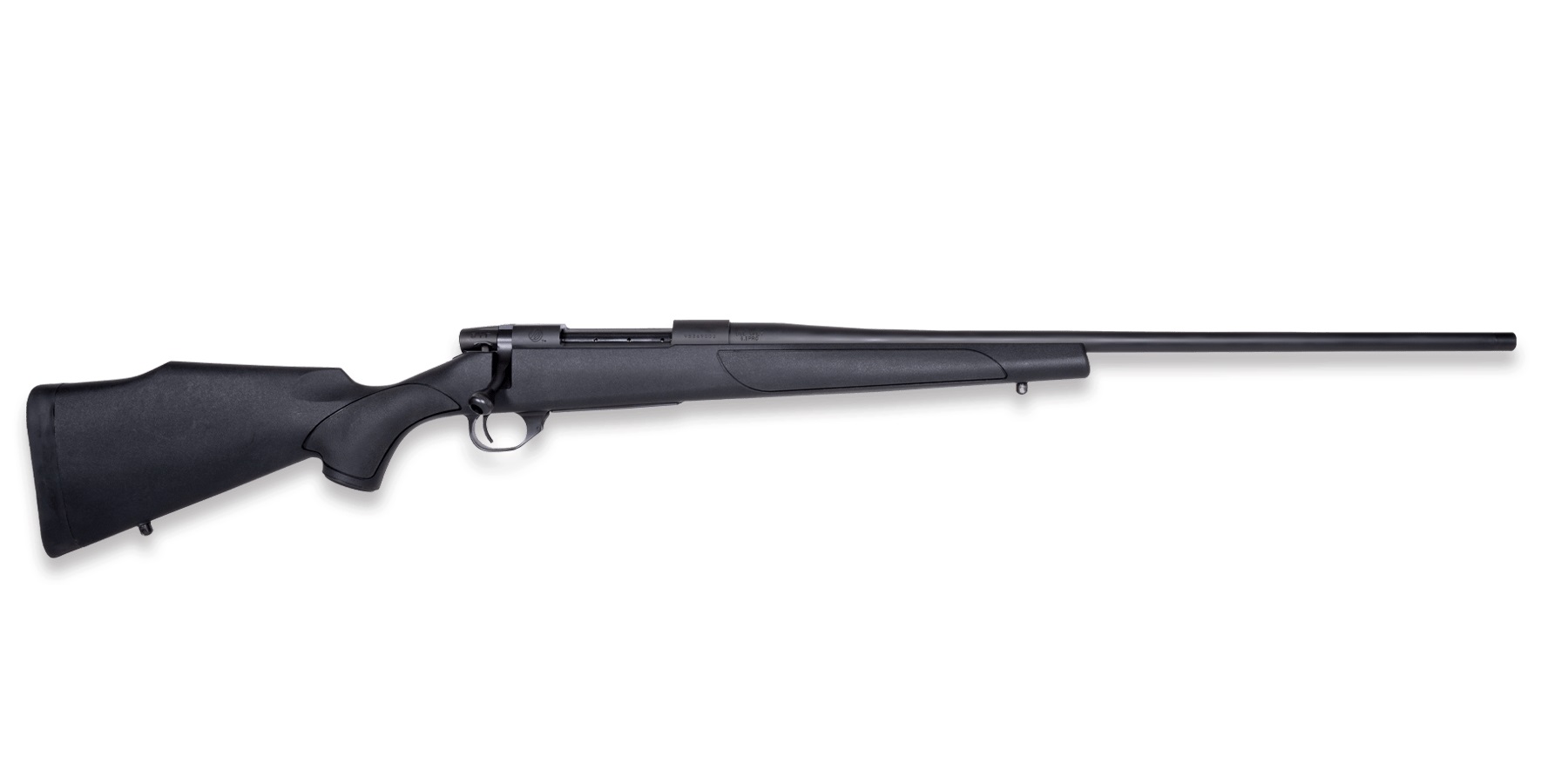
Weatherby Vanguard Obsidian .223 Rem 24in 5rd Black
About this product
The Weatherby Vanguard Obsidian .223 Rem 24in 5rd is a dedicated, threaded-barrel bolt-action sporter engineered for suppressed small-bore varmint and tactical-range work where shot consistency matters more than firepower. It's built on Weatherby's proven Howa 1500 action, which offers a sub-MOA accuracy guarantee out of the box when paired with quality ammunition. My focus here is explaining why this specific configuration—a long barrel, common chambering, and simple floorplate—represents a smart compromise for a certain type of disciplined shooter.What is the Weatherby Vanguard Obsidian used for?
This rifle is purpose-built for suppressed varminting, metallic silhouette shooting, and tactical-style precision training where .223 Remington's low cost and minimal recoil are assets. The 24-inch threaded barrel maximizes velocity for specialized long-range varmint loads like the 55gr V-MAX, providing approximately 3,300 fps at the muzzle, while the 1/2×28 thread pattern directly accepts common rimfire and .223/5.56 suppressors without an adapter. For a shooter running a SilencerCo Omega 300 or Dead Air Nomad-L, this setup reduces muzzle blast to a manageable 122-128 decibels, transforming a day at the range.
How does the Weatherby Vanguard Obsidian compare to the Stevens 334?
The Vanguard Obsidian is significantly better for suppressor-ready, precision-oriented work, while the Stevens 334 is a more economical, general-purpose hunting platform. The Obsidian's foundational advantage is its fully machined, Howa 1500 action with a forged one-piece bolt featuring dual opposing locking lugs—this is a true small-ring receiver design that consistently delivers sub-MOA groups. In contrast, the Stevens 334 uses a simplified, cost-cut action that's perfectly adequate for 2-3 MOA hunting but lacks the rigid bedding and refined two-stage trigger of the Obsidian. The Obsidian’s 24-inch barrel also gives you about 150-200 fps more velocity than the Steen's 20-inch barrel, a tangible edge for reaching out past 300 yards.
What does it weigh and what are the dimensions?
The rifle weighs 7.5 pounds unloaded and measures 44.75 inches in overall length from buttplate to muzzle crown. That length is critical: it's 4.75 inches longer than a typical 20-inch barreled AR-15, contributing directly to its balance and inherent accuracy potential. The stock's length of pull is a standard 13.75 inches, and the barrel's diameter at the muzzle is 0.80 inches, providing sufficient material for threading to 1/2×28 without compromising concentricity—a key detail for suppressor alignment.
Who is this NOT for?
This rifle is not for anyone seeking a multi-role hunting rifle, a defensive tool, or a high-capacity plinker. The 5-round, non-detachable hinged floorplate makes tactical reloads impossible compared to a detachable magazine system, and the 7.5-pound weight makes it cumbersome for carrying through dense brush all day. If your primary use is deer hunting with .223 in states where it's legal, a lighter, shorter-barreled option like the Stevens 334 in .243 Win would be a more versatile choice, offering better terminal performance on medium game.
What's in the box?
You receive the barreled action fitted to the synthetic stock, one 5-round internal magazine (loaded via the hinged floorplate), and a standard thread protector. Weatherby does not include optics, rings, a muzzle device, or a sling—this is a bare rifle. The packaging includes a minimal owner's manual, a warranty card, and a fired test target, typically showing a 3-shot group at 100 yards measuring between 0.75 and 1.25 inches with factory match-grade ammo.
Is the Weatherby Vanguard Obsidian worth it at $581.99?
At $581.99, this rifle represents excellent value for a shooter who specifically wants a suppressor-host ready, sub-MOA capable bolt gun without aftermarket gunsmithing. You are paying approximately $200 over the cost of a basic Stevens 334, but that premium buys you a demonstrably superior two-stage adjustable trigger (break weight adjustable from 2.5 to 4 pounds), a longer, threaded barrel, and a reputation for mechanical consistency that matters on paper. For the niche of precision .223 shooting, this is one of the most cost-effective entry points to a genuinely capable system.
Specs at a glance
Video review
Pros & cons
What works
- Factory-threaded 1/2×28 barrel — ready for suppressors without gunsmithing
- Two-stage match trigger adjustable from 2.5 to 4 lbs — provides a clean, predictable break
- Sub-MOA accuracy guarantee with match ammo — delivers consistent sub-1-inch groups at 100 yards
- Forged one-piece bolt with dual lugs — superior strength and lockup compared to many budget actions
Trade-offs
- 5-round fixed magazine with hinged floorplate — slow to reload vs. detachable mag systems
- No optic mounting hardware included — adds $40-$100 for bases and rings
- Long 44.75-inch overall length — cumbersome for hunting in tight brush or vehicle use
- .223 chamber (not 5.56) — limits safe ammunition selection unless specifically verified
Expert review
Key attributes
| upc | 747115454310 |
| manufacturer | Weatherby |
| manufacturer part number | VTX223RR4T |
| action | Bolt Action |
| atf type | RIFLE |
| barrel length | 24" |
| caliber/gauge | .223 REM/5.56 NATO |
| capacity | 5 |
| color | Black |
| length | 48.25 |
| model | Vanguard |
| package height | 2.7 |
| package width | 6.6 |
| product type | Rifle |
| safety | 3 Position |
| shipping weight | 6.0 |
| sights | No |
Frequently asked questions
- Is it threaded for a suppressor?
- Yes, the barrel is factory-threaded 1/2×28 TPI, the standard pattern for .223 Remington/5.56 NATO muzzle devices and suppressors. You can directly attach any suppressor or muzzle brake with that thread pattern, such as those from SureFire, SilencerCo, or Dead Air, without requiring an adapter.
- Does it accept AR-15 magazines?
- No, it does not. The Vanguard Obsidian uses a fixed, internal 5-round magazine with a hinged floorplate for unloading. Reloading is done one round at a time through the open action. This is a design choice for rigidity and reliability, not compatibility with standard AR-15 pattern magazines.
- Can I shoot 5.56 NATO ammunition in this .223 Remington chamber?
- Proceed with caution. While the description lists both .223 Rem and 5.56 NATO, the Vanguard series typically features a .223 Remington chamber with a shorter leade (throat). Firing higher-pressure 5.56 NATO ammo in a true .223 chamber increases peak pressure by roughly 10,000-15,000 PSI. I recommend verifying the exact chamber marking on your barrel and consulting Weatherby directly before using 5.56 ammunition.
- Does it come with a scope mount?
- No, it does not include any optics mounting system. The receiver is drilled and tapped with a standard 6-48 thread pattern for scope bases. You will need to purchase separate bases and rings, such as a Picatinny rail from EGW or a set of Weaver-style bases, to mount an optic.
- How long does shipping to an FFL take?
- For in-stock items, Ironclad Armory typically processes and ships within 1-2 business days. Transit time via ground shipping is usually 3-7 business days, depending on your location relative to our warehouse. All firearms must ship to a licensed dealer (FFL) for transfer, which you must coordinate.
- Is the barrel free-floated?
- Yes, the 24-inch barrel is fully free-floated from the receiver to approximately 1 inch from the muzzle. There is a consistent gap of 0.040 inches (roughly 1 mm) between the barrel channel and the barrel along its entire length to prevent stock pressure from affecting harmonics and accuracy.