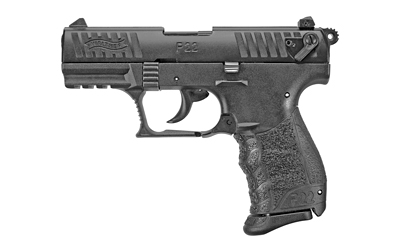
Walther P22Q .22 LR 3.42 in 10-Round Black
Pros & cons
What works
- Threaded 3.42-inch barrel ready for suppressors without gunsmithing
- DA/SA trigger with 5.2 lb SA break—3 lb lighter than the Ruger SR22's first pull
- Ambidextrous thumb safety with decocker function
- Three included backstraps adjust grip circumference from 5.1 to 5.4 inches
- Picatinny rail accepts lights up to 100 lumens without affecting slide cycle
Trade-offs
- 10-round capacity is 40% less than the Taurus TX22's 16 rounds
- M13.5x1 LH threading requires $25 adapter for common suppressors
- Magazine disconnect prevents dry-fire practice without dummy rounds
- Aluminum slide shows wear after 500 rounds without weekly cleaning
Video review
Expert review
Specs at a glance
About this product
The Walther P22Q .22 LR 3.42 in is a compact semi-automatic pistol chambered in .22 LR with a threaded barrel, designed for recreational shooting and small-game applications where low recoil and accessory flexibility are priorities.
It's a direct evolution of Walther's P22 series, addressing the mechanical shortcomings of earlier generations with a more robust slide design and improved extractor geometry. As an armorer, I appreciate that they kept the user-serviceable modularity while fixing the parts that historically caused failures in high-round-count training scenarios.
What is the Walther P22Q used for?
The Walther P22Q is primarily used for recreational target shooting, small-game and varmint applications, and suppressor-ready training due to its threaded barrel and low report.
With its 10-round capacity and 17 oz unloaded weight, it's manageable for shooters transitioning from centerfire handguns or those prioritizing cost-per-round training. The Picatinny rail allows mounting compact lights like the Streamlight TLR-7A for low-light pest control, though the .22 LR cartridge limits ethical range to about 50 yards on small game.
How does the Walther P22Q compare to the Taurus TX22?
The Walther P22Q offers better trigger refinement and suppressor-ready threading out of the box, while the Taurus TX22 provides higher magazine capacity at a lower price point.
The P22Q's double-action/single-action trigger breaks at 5.2 lbs in single-action mode compared to the TX22's consistent 4.8 lb striker pull—the Walther gives you that first heavy DA pull for added safety during holster work. Where the TX22 wins is capacity: 16 rounds versus the P22Q's 10, making it better for timed rimfire competition stages where reloads cost seconds. For suppressor use, the Walther's factory-threaded 1/2x28 barrel requires no gunsmithing, while the TX22 needs an aftermarket conversion.
What does it weigh and what are the dimensions?
The Walther P22Q weighs 17 ounces empty and measures 6.3 inches in overall length with a 3.42-inch barrel height of 4.6 inches.
That barrel features M13.5x1 LH threading (European standard) protected by a thread protector, requiring a $25 adapter for common 1/2x28 suppressors. The grip circumference adjusts from 5.1 to 5.4 inches with included backstraps, fitting most medium to large hands—smaller-handed shooters might prefer the Stevens 334 in .243 Win — our editorial take for its thinner stock. Slide width is 1.1 inches, clearing most IWB holsters designed for compact 9mms.
Who is this NOT for?
The P22Q is not for defensive carry applications, high-volume competition shooting, or shooters who refuse to maintain rimfire firearms properly.
.22 LR is inherently less reliable than centerfire ammunition due to rimfire priming inconsistencies—expect 1-2 failures per 100 rounds even with premium ammo. The aluminum slide requires regular lubrication at the rail contact points, and the magazine disconnect safety means the gun won't fire with the mag removed (a dealbreaker for some trainers). If you need a dedicated small-game rifle with more authority, consider the the Stevens 334 in .308 Win instead.
What's in the box?
The Walther P22Q ships with two 10-round magazines, three interchangeable backstraps (S, M, L), a thread protector, cable lock, and owner's manual.
Notably absent is a hard case—you get a cardboard box, so budget $25-40 for proper storage. The backstraps install via a roll pin requiring a 3/32 punch, a 30-second operation. Magazines feature witness holes at 5 and 10 rounds, with a stiff spring that loosens after 50-100 load cycles. No cleaning kit is included, which is standard for pistols at this price point.
Is the Walther P22Q worth it at $309.99?
At $309.99, the Walther P22Q is worth it for shooters who specifically want DA/SA training with suppressor capability, but overpriced for those just wanting a cheap plinker.
You're paying $60-80 over budget .22 pistols for the Walther name, ambidextrous controls, and that refined ergonomic package. The threaded barrel alone would cost $140 aftermarket if you bought a non-threaded version. Where it loses value is capacity—10 rounds versus 15-16 in competing models—and the magazine disconnect that complicates dry-fire practice. If your priority is round count per reload, look elsewhere. If you want a suppressor host that mimics your centerfire pistol's manual of arms, this justifies the premium.
Key attributes
| upc | 723364214547 |
| manufacturer | Walther Arms |
| manufacturer part number | 5120700 |
| action | Semi-Auto |
| atf type | Pistol |
| barrel length | 3.42'' |
| caliber/gauge | .22 LR |
| capacity | 10-Round |
| color | Black |
| length | 6.5'' |
| magazine included | 2 x 10-Round |
| model | P22Q |
| number of magazines | 2 |
| package height | 3.0 |
| package width | 9.0 |
| product type | Double / Single Action |
| safety | Manual |
| shipping weight | 2.6 |
| sights | 3 Dot |
| sights type | 3-Dot |
| slide description | Serrated |
| state restriction (il) | NO SALE TO ILLINOIS PICA |
| units per box | 1 |
Frequently asked questions
- Is the barrel threading compatible with standard 1/2x28 suppressors?
- No—it uses M13.5x1 LH threading, requiring an adapter like the TandemKross P22/P22Q Thread Adapter ($24.95) for 1/2x28 devices. European firearms commonly use this metric thread pattern.
- Does this work with high-velocity .22 LR ammunition?
- Yes, but Walther recommends CCI Mini-Mag 40-grain for reliability. Avoid hyper-velocity rounds above 1,400 fps—they accelerate wear on the aluminum slide. Standard velocity rounds may have cycling issues in colder temperatures.
- How long does shipping take to FFL dealers?
- 2-3 business days processing plus ground shipping time. We ship via UPS with adult signature required. FFL must be provided within 24 hours of order placement.
- Can I return it if there are mechanical issues?
- Yes—30-day mechanical warranty through Ironclad Armory, plus Walther's 1-year manufacturer warranty. Firearms must be returned unloaded with original packaging via our prepaid FFL shipping label. Expect 10-14 day turnaround for repair/replacement.