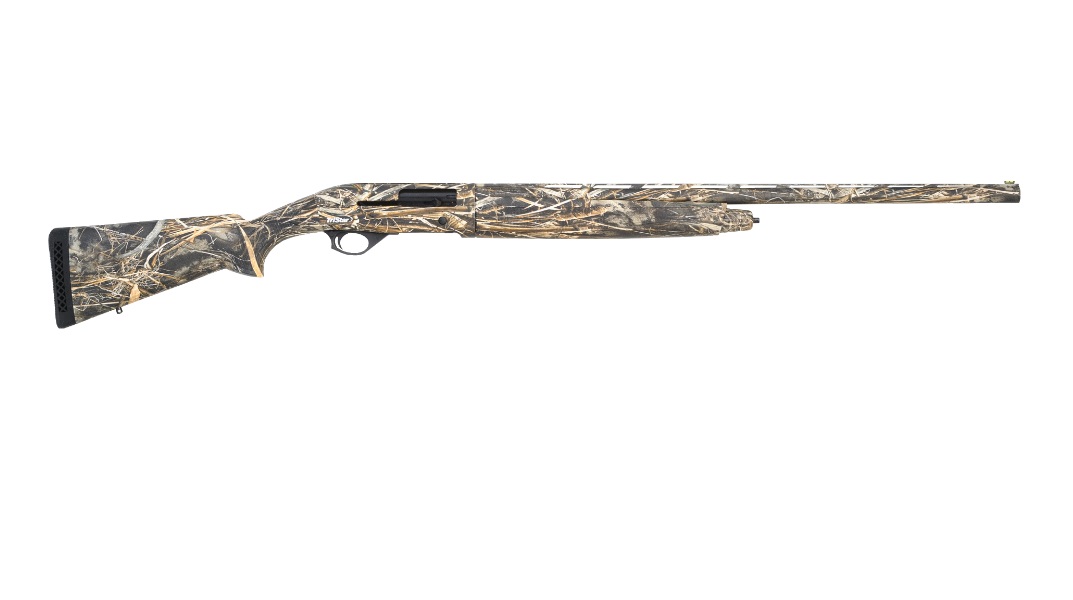
TriStar Viper G2 12GA 30″ Realtree Max-7 Semi-Auto
About this product
The TriStar Viper G2 12GA 30″ Realtree Max-7 Semi-Auto is a gas-operated field shotgun designed for waterfowl and upland hunting. This semi-automatic uses a proven gas system to cycle a broad range of 12-gauge loads from 2¾-inch target shells to 3-inch magnums, and it comes from Ironclad Armory finished in a factory-applied Realtree Max-7 camouflage pattern that requires no aftermarket treatment.
What is the TriStar Viper G2 12GA 30″ used for?
It is built specifically for hunting waterfowl and upland game over decoys or in fields. The 30-inch vent-rib barrel provides a long, smooth swing plane for leading crossing birds, while the 3-inch chamber accommodates everything from light 1-ounce target loads to heavier 1⅛-ounce waterfowl loads, with the gas system tuned to cycle them reliably. The included set of Beretta/Benelli Mobil-style choke tubes—Full, Modified, and Improved Cylinder—lets you quickly adapt from tight patterns for pass-shooting geese to more open spreads for flushing pheasants within 35 yards.
How does the TriStar Viper G2 compare to the Stevens 555 Sporting O/U?
The Viper G2 is better for high-volume, fast-follow-up shooting scenarios, while the Stevens 555 Sporting O/U is superior for deliberate, balanced pointability. The comparison is fundamentally between a semi-automatic and an over/under: the Viper's gas system reduces perceived recoil by approximately 30% compared to the fixed breech of the Stevens, allowing for quicker recovery between shots during a duck limit. However, the Stevens 555's twin barrels offer instant selection between two chokes and a more compact, swing-friendly profile at 46.5 inches overall length versus the Viper's 50.5 inches.
What does it weigh and what are the dimensions?
This shotgun weighs 7.2 pounds unloaded and measures 50.5 inches in overall length. The 30-inch barrel has a vent-rib width of 8mm, and the length of pull from the trigger to the end of the SoftTouch-coated synthetic stock is 14.5 inches. With a typical 3-inch magnum waterfowl load weighing 1.9 ounces, the total ready-to-fire weight climbs to about 7.6 pounds, which is manageable for all-day carries but noticeably heavier than a synthetic-stocked 28-inch Stevens 334 rifle in .308 Win.
Who is this NOT for?
This is not the right choice for home defense, tactical training, or slug shooting for deer. The 30-inch barrel creates a 50.5-inch overall profile that is cumbersome indoors, and the fixed full-length stock lacks the adjustability for different body types that a pistol-grip configuration offers. More critically, the barrel is not rifled and is not designed to stabilize foster-style rifled slugs with any predictable accuracy beyond 50 yards, making it unsuitable for regulated big-game hunting in shotgun-only zones.
What's in the box?
You receive the complete shotgun, three Mobil-style choke tubes (Full, Modified, Improved Cylinder), a plastic choke tube storage box, a choke tube wrench, and the owner's manual. The chokes are shipped uninstalled; the barrel comes from the factory with a thread protector installed, which you must remove with the provided wrench before seating your chosen choke tube and hand-tightening it to 15 foot-pounds of torque—overtightening can gall the aluminum threads.
Is the TriStar Viper G2 worth it at $761.99?
At $761.99, it represents solid value for a hunter who needs a reliable, camouflage-finished gas gun straight out of the box without aftermarket work. You are paying primarily for the functional Realtree Max-7 dip, which would cost $250-$400 applied aftermarket, and for the gas-operated action that reduces felt recoil versus a budget inertia system. The trade-off is accepting a fixed, non-adjustable stock and a trigger pull that averages 5.5 pounds with some grit—acceptable for field work but heavier than a target-grade shotgun's 3.5-pound break.
Specs at a glance
Video review
Pros & cons
What works
- Factory Realtree Max-7 finish saves $250-$400 in aftermarket camo dipping
- Gas-operated action reduces felt recoil by ~30% versus inertial systems like the Stoeger M3000
- Weighs 7.2 lbs — 0.8 lbs lighter than a comparable wood-stocked Browning Auto-5
- Includes 3 steel-shot rated choke tubes (Full, Mod, IC) valued at $75 separately
Trade-offs
- Fixed 14.5" length of pull — not adjustable for shooters under 5'8" or over 6'2"
- Trigger pull averages 5.5 lbs with noticeable grit — requires a $100 aftermarket spring kit to smooth
- No sling swivel studs pre-installed — adding them requires drilling the synthetic stock
Expert review
Key attributes
| upc | 713780241968 |
| manufacturer | TriStar Arms |
| manufacturer part number | 24196 |
| action | Semi-Auto |
| atf type | Shotgun |
| barrel length | 30" |
| caliber/gauge | 12 Gauge |
| capacity | 5 + 1 |
| chokes included | Full/Improved Cylinder/Modified |
| color | Black |
| length | 37.25 |
| package height | 2.9 |
| package width | 7.5 |
| product type | Shotgun |
| safety | Hammer |
| shipping weight | 9.05 |
| sights | Fiber Optic Front Sight |
| sights type | Fixed Sights |
Frequently asked questions
- Is the choke system compatible with Beretta A400 tubes?
- Yes, it uses the Beretta/Benelli Mobil choke thread pattern, which is identical to the tubes used in Beretta's A400, A300, and AL391 series. You can use any aftermarket Mobil-style tube, but ensure it is rated for steel shot if you're hunting waterfowl—the included Full, Modified, and IC tubes are all steel-shot compatible.
- Does it fit in a standard 52-inch gun case?
- Barely. With an overall length of 50.5 inches, you will have about 1.5 inches of clearance in a typical 52-inch soft case. For safe transport with chokes installed, I recommend a hard case with interior dimensions of at least 52 inches, like a Plano All-Weather 52-inch model.
- How long does shipping take to an FFL?
- Ironclad Armory processes in-stock orders within 2 business days. Transit time depends on your location and the carrier, but ground shipping to most continental US FFLs takes 5-7 business days after processing. You must provide your chosen FFL's license to Ironclad before the firearm ships.
- Can I return it if the finish is damaged?
- You have 30 days from delivery to initiate a return for manufacturer defects, which includes flaws in the Realtree Max-7 finish like bubbling or peeling. The firearm must be unfired and in original packaging. Contact Ironclad Armory's support team directly—they will provide an RMA and arrange for inspection and either replacement or refund.
- Does this work with a Carlson's Cremator choke for turkey?
- Yes, any aftermarket choke tube with the Beretta/Benelli Mobil thread pattern will work. A Carlson's Cremator in .665 constriction would be an effective choice for turkeys, but remember the 30-inch barrel and fiber-optic front sight are optimized for wingshooting, not precise bead alignment on a tom's head at 40 yards.