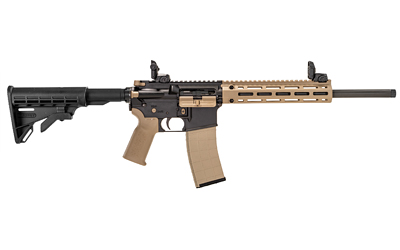
Tippmann Arms M4-22 16″ 22 LR 25+1 FDE
Pros & cons
What works
- Forged 7075 aluminum receivers—1.8 pounds heavier and more durable than polymer .22 LR AR alternatives
- True mil-spec buffer tube accepts any AR-15 stock—compatible with six-position collapsible stocks to fixed rifle stocks
- 1/2x28 threaded barrel ready for suppressors—reduces report by 25-30 decibels with proper rimfire can
- Flip-up sights provide immediate 50-yard zero—iron sight picture identical to standard AR-15 front post/rear aperture
Trade-offs
- Magazines cost $35 each—75% more expensive than Smith & Wesson M&P15-22 magazines at $20
- No last-round bolt hold open—requires manual charging handle manipulation after final round
- Limited aftermarket dedicated .22 LR optics mounts—requires spacer or shim with standard AR-15 scope rings
- Bolt release is non-functional decoration—doesn't actually lock bolt back like centerfire AR-15
Video review
Expert review
Specs at a glance
About this product
What is the Tippmann Arms M4-22 rifle? It's a semi-automatic .22 LR AR-pattern rifle built with aluminum receivers that retains the controls and accessory compatibility of a full-size M4 platform for lower-cost training. This specific 16″ model features a threaded barrel, flip-up sights, and a collapsible stock. The flat dark earth finish and 25-round magazine capacity make it a practical choice for shooters who want an AR-style rimfire that handles like its centerfire counterparts without breaking the bank on ammunition.
What is the Tippmann Arms M4-22 16″ used for?
You'll use this rifle primarily for high-volume, low-cost AR-15 familiarization and marksmanship training. The .22 LR chambering allows for extended range sessions—I've put 500 rounds through one in an afternoon for less than $50 in ammo costs. It's also effective for small-game hunting within 75 yards and casual steel-plate competitions where shot placement matters more than recoil management. The threaded 1/2x28 barrel makes suppressor use straightforward, cutting report by roughly 25-30 decibels with a quality rimfire can.
How does the Tippmann Arms M4-22 compare to the Smith & Wesson M&P15-22?
The Tippmann is mechanically superior where it counts: it uses forged 7075 aluminum receivers instead of polymer, giving it a more authentic 5.5-pound heft compared to the M&P15-22's 4.7-pound plastic feel. Where the Smith & Wesson wins is magazine cost—its 25-round magazines typically run $20 versus Tippmann's $35—and aftermarket support for dedicated .22 LR optics mounts. For shooters who value metal-on-metal fit and plan to mount heavier accessories like IR lasers, the Tippmann's receiver threads and buffer tube compatibility justify the premium.
What does it weigh and what are the dimensions?
The rifle weighs 5 pounds empty and measures 34.5 inches at full stock extension, collapsing to 31.25 inches for transport or storage. The 16-inch barrel has a 1:16 twist rate optimized for standard-velocity 40-grain .22 LR rounds. The magazine adds 0.4 pounds when fully loaded with 25 rounds, bringing the operational weight to 5.4 pounds—noticeably lighter than the 7.3-pound Stevens 334 Rifle in .308 Winchester, which makes for easier offhand shooting sessions. The 6.75-inch length of pull on the collapsible stock accommodates most adult shooters without adjustment.
Who is this NOT for?
Don't buy this if you need a dedicated precision small-bore competition rifle—the 2.5-3 MOA accuracy with bulk ammo won't compete with purpose-built bolt-actions like the CZ 457. It's also a poor choice for home defense where terminal ballistics matter; the .22 LR lacks reliable stopping power compared to shotgun loads like those fired by the Stevens 555 Sporting O/U 12 Gauge (our review). Finally, if you want a lightweight backpacking survival rifle, the 5-pound aluminum construction is heavier than many dedicated .22 LR takedown models by nearly 2 pounds.
What's in the box?
You'll receive the complete rifle with one 25-round magazine installed, flip-up front and rear sights pre-mounted, and a collapsible six-position M4 stock. Tippmann includes a basic owner's manual and warranty card, but no case, cleaning kit, or additional magazines. The threaded barrel comes with a standard 1/2x28 thread protector that should be removed immediately if you plan to use a suppressor or compensator to prevent carbon lock.
Is the Tippmann Arms M4-22 worth it at $474.95?
At this price point, yes—if your priority is metal-receiver construction and true mil-spec accessory compatibility. You're paying approximately $150 more than polymer .22 LR AR alternatives, but that gets you aluminum upper and lower receivers that won't crack under stress from mounted lights or foregrips. Compared to converting an existing AR-15 with a .22 LR drop-in kit (which typically runs $200-300 plus labor), this dedicated platform offers more reliable feeding and doesn't wear your centerfire barrel. The investment pays off within 2,000 rounds of ammunition savings versus shooting 5.56 NATO.
Key attributes
| upc | 850050173373 |
| manufacturer | Tippmann Arms |
| manufacturer part number | A101224 |
| action | Semi-Auto |
| barrel length | 16" |
| caliber/gauge | .22 LR |
| capacity | 25 |
| color | Black, Flat Dark Earth |
| model | M4-22 |
| product type | AR |
| safety | Two-Position |
| sights | Front/Rear Flip Sights |
Frequently asked questions
- Is it compatible with standard AR-15 handguards?
- Yes, the upper receiver uses a standard mil-spec barrel nut that accepts any AR-15 free-float or drop-in handguard system. The 16-inch barrel provides clearance for most 15-inch rails without interfering with the gas block—I've successfully installed Midwest Industries and Aero Precision rails without modification.
- Does the barrel accept AR-15 muzzle devices?
- Absolutely—the 1/2x28 threaded muzzle accommodates any .22 caliber or 5.56mm flash hider, compensator, or suppressor with matching threads. Just verify your suppressor's bore diameter is rated for .22 LR; many 5.56mm cans have minimum bore diameters of .224 inches versus the .22 LR's .223-inch projectile.
- How many magazines does it come with?
- It ships with one 25-round magazine. Additional magazines are available separately for approximately $35 each direct from Tippmann Arms or through authorized dealers like Brownells. I recommend purchasing at least three extra for practical shooting drills.
- Can I use CCI Stinger ammunition in this rifle?
- Not reliably—the fixed ejector and chamber dimensions are optimized for standard-velocity .22 LR rounds. High-velocity ammunition like CCI Stingers occasionally cause extraction issues and increased wear. Stick with 40-grain round nose ammunition at 1,050-1,200 fps for best function.
- What's the warranty period?
- Tippmann Arms provides a limited lifetime warranty to the original purchaser against defects in materials and workmanship. Warranty service typically takes 10-14 business days from receipt at their Fort Wayne, Indiana facility, excluding shipping time.
- Does it work with binary triggers?
- No—the hammer and disconnector geometry is specific to the .22 LR blowback operation and won't interface properly with aftermarket binary trigger systems designed for centerfire AR-15s. The factory single-stage trigger breaks at a consistent 5.5-6 pounds of pull weight.