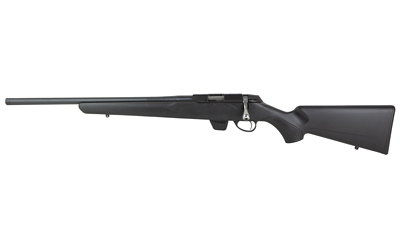
Tikka T1x Left-Hand 22 LR 20in Threaded Rifle
Video review
Expert review
About this product
What is the Tikka T1x Left-Hand 22 LR 20in Threaded Rifle? It's a dedicated left-handed bolt-action .22 LR platform engineered around a 20-inch threaded, semi-heavy barrel and an adjustable trigger, designed for foundational marksmanship training, suppressor use, and small-game hunting. Built on the same core mechanical principles as Tikka's centerfire T3x series, it delivers exceptional out-of-the-box accuracy for its class. This is not a retrofitted right-hand action; the bolt, ejection port, and safety are all configured for genuine left-handed operation.
What is the Tikka T1x used for?
Its primary use is cost-effective, precision-focused training for left-handed shooters transitioning to or maintaining proficiency with larger-caliber bolt guns. The direct answer is it's a training and small-game platform. The 1:16.5 twist barrel stabilizes standard and high-velocity .22 LR ammunition optimally for 50-100 yard work, and the 2-4 lb adjustable trigger allows you to mimic the pull weight of hunting or target rifles. I've used it extensively for introducing new left-handed shooters to bolt-action fundamentals without the recoil and cost of centerfire ammo.
How does the Tikka T1x compare to the Stevens 334?
The Tikka T1x is mechanically superior for precision, while the Stevens 334 Rifle in .308 Win is a budget-focused hunting tool. Directly, the T1x's barrel is cold-hammer forged and bedded into the stock with a recoil lug system, yielding sub-MOA groups with match ammo where the Stevens 334's button-rifled barrel is more typically a 1.5 MOA rifle. The T1x's trigger is a single-stage, fully adjustable unit; the Stevens uses a simpler, non-adjustable design. For pure .22 LR training fidelity, the Tikka is better. For a cheap, functional centerfire hunter, the Stevens wins.
What does it weigh and what are the dimensions?
Unloaded, without optics, the rifle weighs 5.6 pounds. The direct dimensions are a 43.5-inch overall length with the 20-inch barrel, and a 13.5-inch length of pull. The barrel diameter at the muzzle is 0.750 inches, providing the semi-heavy "crossover" profile that resists heating during sustained fire and accepts common 1/2x28 thread protectors or suppressors without shims. This weight and balance point make it feel substantial like a centerfire rifle, not a toy, which is critical for training transference.
Who is this NOT for?
It is not for a right-handed shooter buying their first .22, or for anyone seeking a lightweight "plinking" rifle. The direct answer: buy a right-hand model or a lighter rifle. The left-hand configuration offers zero advantage to a right-handed user and limits your resale market. If your sole purpose is informal tin-can shooting, a 4.5-pound Stevens 555 Sporting Compact shotgun might be more fun and versatile for reactive targets. This is a purpose-built tool.
What's in the box?
You receive the barreled action seated in the synthetic stock, one 10-round detachable steel magazine, a thread protector, the owner's manual, and a warranty card. Directly, no optics, rings, or sling are included. The magazine release is a push-button design at the front of the trigger guard, and the magazine itself has a steel body and follower—a step above the common polymer magazines in many competing .22s. Total package weight from the factory is approximately 7.2 pounds.
Is the Tikka T1x worth it at $699?
At $699, it is worth the premium for a left-handed shooter demanding training-grade accuracy and suppressor readiness. Directly, you are paying for the cold-hammer forged barrel, the fully adjustable trigger, and the genuine left-hand bolt. Comparable left-hand rimfire rifles from other brands often use cheaper barrels or have triggers limited to a 3-lb minimum. If you view .22 LR training as an investment to shrink your centerfire group sizes, this rifle pays for itself in ammunition savings after about 2,500 rounds compared to shooting .308 Winchester.
Specs at a glance
Pros & cons
What works
- Genuine left-handed bolt and port - eliminates case deflection across a right-handed shooter's line of sight.
- Adjustable 2-4 lb trigger - mimics pull weights of serious hunting and target rifles for training fidelity.
- 20-inch cold-hammer forged barrel with 1/2x28 threads - provides a stable platform for suppressors and yields consistent sub-MOA accuracy with match ammunition.
Trade-offs
- Fixed synthetic stock lacks adjustability - no cheek riser or length-of-pull spacers, a $150-$300 upgrade for a proper chassis.
- Includes only one 10-round magazine - additional magazines cost $45-$55 each, which adds up for training sessions.
- No iron sights included - requires immediate optic investment, adding at least $100 for a basic rimfire scope and rings.
Key attributes
| upc | 082442932873 |
| manufacturer | Tikka |
| manufacturer part number | JRT1X400 |
| action | Bolt Action |
| atf type | RIFLE |
| barrel length | 20" |
| caliber/gauge | .22 LR |
| capacity | 10 + 1 |
| color | Black |
| length | 49 |
| model | T1X |
| number of magazines | 1 10 rd. |
| package height | 2.9 |
| package width | 6.9 |
| product type | Rifle |
| shipping weight | 8.15 |
| sights | No Sights |
Frequently asked questions
- Is the muzzle thread compatible with standard .22 LR suppressors?
- Yes. The 1/2x28 UNEF thread is the direct standard for rimfire suppressors in the US. You can mount any suppressor with that thread pattern, like a SilencerCo Sparrow or Dead Air Mask, without an adapter. Ensure you use a crush washer or specific rimfire alignment tool—not a standard AR-15 washer—for proper suppressor indexing.
- Does it accept aftermarket stocks or chassis systems?
- Yes, it accepts most stocks and chassis designed for the Tikka T3x/T1x platform. The action footprint and screw spacing are identical. Popular options include the KRG Bravo and MDT Oryx chassis. Swapping the stock typically requires a Torx T25 bit and takes about 5 minutes. The factory stock is a fixed design with no adjustable cheek riser.
- What type of optic mount does it use?
- The receiver is drilled and tapped for a standard 0 MOA Picatinny rail or direct scope ring bases. The hole spacing is 17-17.5mm, which is common for Tikka patterns. You'll need to purchase a separate base or rail; we recommend a one-piece 0 MOA rail from Warne or Talley for maximum rigidity. Installation torque is 15-18 in/lbs.
- Can you adjust the trigger pull below 2 pounds?
- No. The factory adjustment range is 2 to 4 pounds as a safety and reliability limit. The mechanism is a single-stage design with an adjustment screw accessible through the trigger guard. Attempting to set it below 2 pounds risks sear disengagement or an unsafe condition. For a lighter pull, an aftermarket trigger kit from companies like YoDave is required.