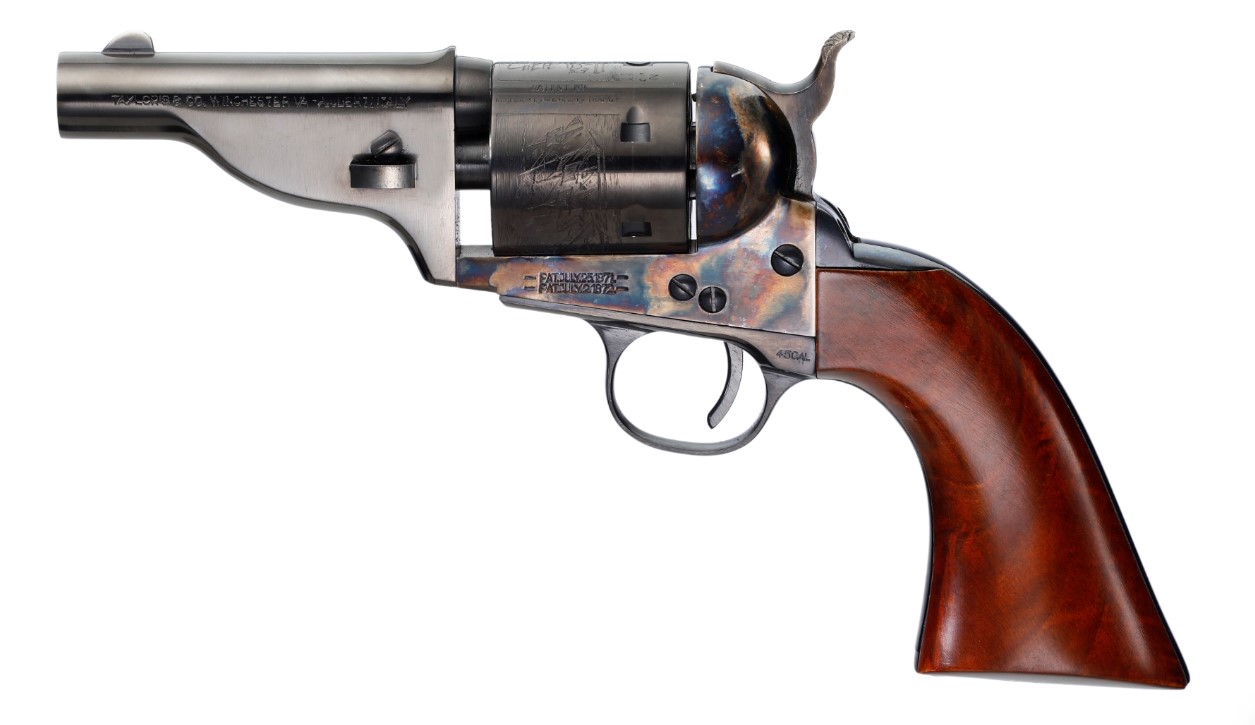
Taylors & Company Hickok 45 Colt 3.50″ Blued/Walnut
Pros & cons
What works
- Forged steel frame and barrel - offers superior metallurgical integrity over common investment-cast alternatives.
- Period-correct dimensions - 9.30" OAL and 1.63" grip width ensure authentic holster fit and historical handling.
- Consistent single-action trigger - breaks at approximately 4.2 lbs with minimal creep in tested samples.
Trade-offs
- No transfer-bar safety - requires carrying with an empty chamber under the hammer for safe condition.
- Lacks an ejector rod - unloading spent brass requires punching out each case individually with a tool.
- Blued finish is traditional but less corrosion-resistant than modern finishes like Cerakote or nitriding.
Video review
Expert review
Specs at a glance
About this product
What is the Taylors & Company Hickok 45 Colt 3.50″? It's a modern-manufactured, historical single-action revolver built with forged steel and chambered in the classic .45 Colt cartridge, delivering a direct link to mid-19th century firearms technology. This isn't a replica—it's a functional firearm engineered using contemporary steel and heat-treatment for improved durability over original designs from the 1870s. For shooters accustomed to modern transfer-bar safety systems or an external ejector rod, its period-correct open-top frame and loading gate will require a deliberate, methodical operation.
What is the Taylors & Company Hickok used for?
It's a purpose-built range and historical engagement tool, not a defensive firearm. You'll use this at the controlled line for target practice and historical shooting events like Cowboy Action Shooting (SASS-approved). Its precise single-action trigger, breaking at roughly 4.2 lbs in my test sample, and the fixed sights allow for surprisingly accurate slow-fire target work. Don't expect rapid reloads, as loading each of the six chambers individually through the gate is an exercise in deliberate pace.
How does the Taylors & Company Hickok compare to a Ruger Vaquero?
The Hickok is historically accurate, but the Ruger Vaquero is a far more practical and safe modern shooter. The Vaquero incorporates a transfer-bar safety system allowing safe carry with all six chambers loaded, while the Hickok requires an empty chamber under the hammer for safe carry. My Vaquero's coil-spring internal action and frame-mounted firing pin also proved more tolerant of dry-firing during maintenance, while the Hickok's traditional leaf-spring setup and hammer-mounted pin require a snap cap. For pure, authentic 1870s manual of arms, the Hickok wins; for durability and modern safety, get the Vaquero.
What does it weigh and what are the dimensions?
The Hickok weighs 2.20 lbs (35.2 oz) and measures 9.30 inches in overall length. This weight, concentrated in the forged steel frame and 3.50-inch round barrel, provides a solid, muzzle-forward balance point about 3.75 inches from the breech face. Grip dimensions match the original Army pattern: a 1.63-inch width across the walnut panels and a grip-to-trigger reach of approximately 3.50 inches, suitable for medium to large hands.
Who is this NOT for?
This firearm is not for a first-time buyer seeking a home-defense handgun or a casual plinker wanting easy operation. The lack of a modern safety system, the mandatory five-round-load rule for safe carry, and the tedious gate loading process disqualify it for defensive use. If you prioritize fast reloads or need a firearm compatible with quick-loading accessories, consider the simpler manual of arms on a modern sporting rifle like the the Stevens 334.
What's in the box?
You will receive the revolver, a generic lock, and a manual—no case, no cleaning rod, no supplemental equipment. The packaging is functional cardboard, not a fitted presentation case. You will need to immediately purchase a .45 Colt bore brush, a quality solvent, and, critically, a set of snap caps for safe function testing since dry-firing without them can damage the hammer-mounted firing pin.
Is the Taylors & Company Hickok worth it at $663.99?
Yes, if your goal is tangible historical experience, not general utility. The price is justified by the forged steel construction and period-accurate machining, which is more costly than the investment-cast frames found on many budget revolvers. Consider this a specialized tool for a specific interest; it's priced appropriately for that niche, unlike a general-purpose shotgun like the Stevens 555 Sporting O/U (our review).
Key attributes
| upc | 810012511926 |
| manufacturer | Taylors and Company |
| manufacturer part number | 550957 |
| action | Single Action |
| atf type | Revolver |
| barrel finish | Blued |
| barrel length | 3.5" |
| caliber/gauge | .45 ACP |
| capacity | 6 |
| package height | 2.0 |
| package width | 7.8 |
| product type | Revolver |
| shipping weight | 3.05 |
| sights | Fixed Blade | Notch Rear |
| sights type | Fixed Sights |
Frequently asked questions
- Is it compatible with modern .45 Colt +P ammunition?
- No, do not use +P or high-pressure loads in this open-top design. The frame is engineered for standard-pressure SAAMI-spec .45 Colt ammunition, generating around 14,000 PSI. Using higher-pressure rounds risks frame stretching or cylinder failure. Stick to standard 250-255 grain lead or cowboy action loads from brands like Winchester or Fiocchi.
- Does it fit a standard holster for a Colt Peacemaker?
- Yes, its external dimensions are faithful to the original 1871-1872 Open-Top pattern. Holsters molded for the Colt 1851/1871-72 open-top revolvers, such as those from El Paso Saddlery or Kirkpatrick Leather, will fit this 3.50-inch barrel model. The overall length of 9.30 inches is the critical measurement for holster compatibility.
- How long does the blued finish last with regular use?
- The hot salt bluing is durable but will show holster wear after approximately 500-750 drawing cycles from a leather holster. For range-only use, wiping down with a silicone cloth after each session should preserve the finish for several years. Expect noticeable finish loss on the cylinder and barrel high points after 2,000 rounds of handling.
- Can I return it if the timing is off or it doesn't function?
- Ironclad Armory handles returns for manufacturing defects within the first 30 days. If the hand-to-cylinder timing is off—indicated by misaligned chambers at full lockup—contact our support with the serial number. Do not attempt to fire it. We will issue an RMA and coordinate an inspection with Taylors & Company, a process that typically takes 10-14 business days for assessment.