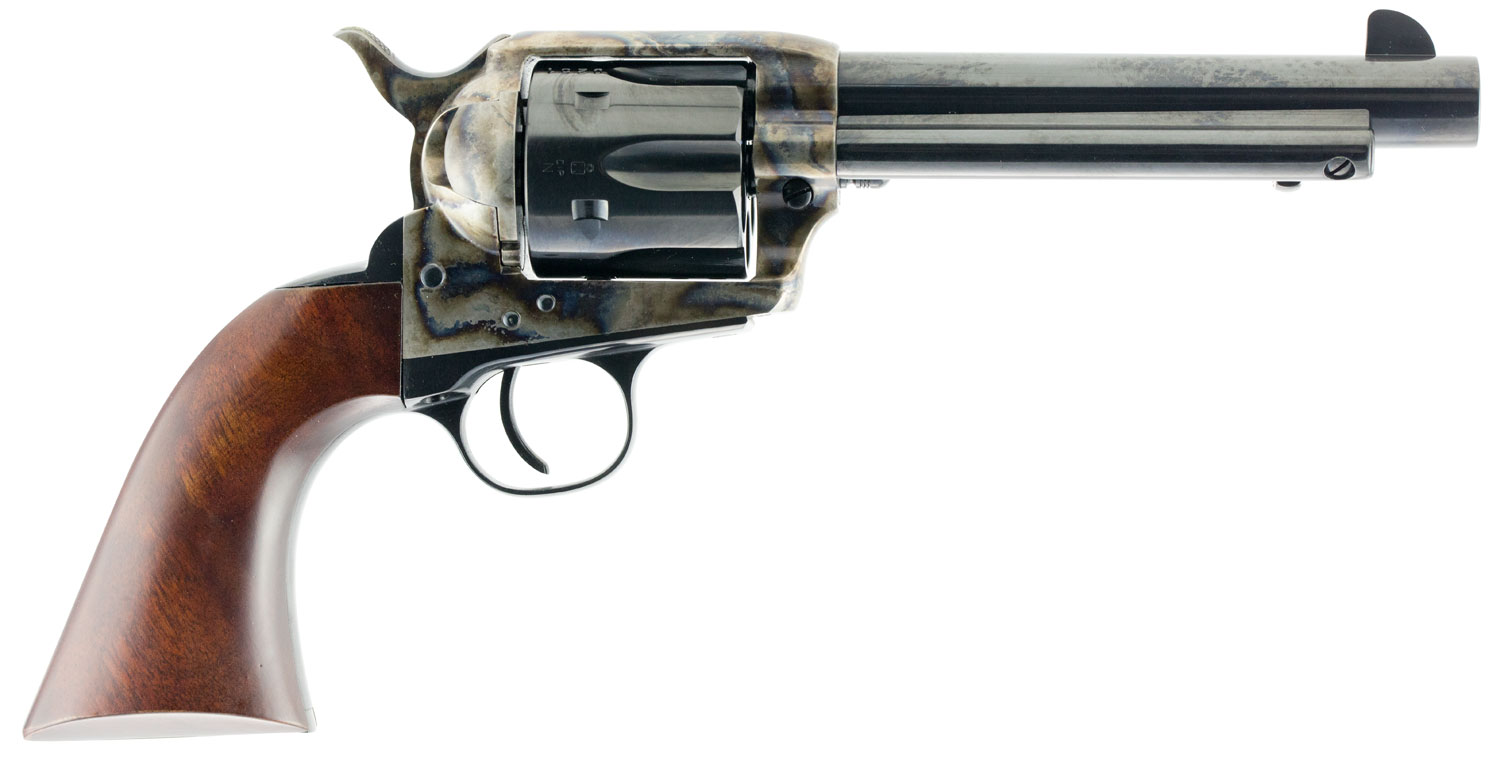
Taylors and Company 1873 Gunfighter .357 Magnum 5.50″
Video review
Expert review
About this product
The Taylors and Company 1873 Gunfighter .357 Magnum 5.50" is a modern reproduction of the classic 1873 single-action revolver, chambered for .357 Magnum with .38 Special compatibility and built to period-correct specifications. It represents a functional tribute piece designed for sport shooting and recreational use rather than tactical applications. With a 5.50-inch barrel, forged case-hardened frame, and Army-size walnut grip, it balances historical authenticity with modern manufacturing tolerances.
What is the Taylors and Company 1873 Gunfighter .357 Magnum 5.50" used for?
This revolver is designed primarily for Cowboy Action Shooting, recreational range use, and historical firearm appreciation, not for concealed carry or defensive scenarios. Its single-action operation requires manual cocking between shots, which is appropriate for structured competition but impractical for rapid-fire defensive response. The period-correct sights and walnut grip prioritize authentic handling over tactical speed, making it ideal for shooters who value mechanical history over modern utility.
How does the Taylors and Company 1873 Gunfighter compare to the Stevens 334 Rifle?
The 1873 Gunfighter is a single-action revolver chambered for pistol cartridges, while the Stevens 334 is a bolt-action rifle built for rifle cartridges like .308 Winchester—they serve fundamentally different shooting disciplines. The Stevens 334 offers superior accuracy at distance with its 20-inch barrel and rifle-caliber ballistics, while the 1873 Gunfighter excels at close-range, timed competition shooting with .357 Magnum or .38 Special loads. Choose the Stevens for hunting or precision rifle work; choose the 1873 for Cowboy Action Shooting or historical firearm training.
What does it weigh and what are the dimensions?
This revolver weighs 36 ounces (approximately 1020 grams) and measures 11.10 inches overall length with a 5.50-inch barrel length. The cylinder diameter is approximately 1.73 inches, and the Army-size walnut grip adds about 4.25 inches of height from the frame to the base. These dimensions create a balanced but substantial feel—noticeably heavier than compact polymer-frame revolvers but properly weighted for its 1873 heritage and caliber.
Who is this NOT for?
This revolver is not suitable for first-time firearm owners seeking a simple defensive handgun or those unwilling to maintain a blued steel finish against corrosion. The single-action mechanism requires deliberate manual operation incompatible with rapid defensive deployment, and the fixed sights limit precision adjustment compared to modern optics-ready platforms. If you need a firearm for home defense, concealed carry, or tactical training, consider a modern double-action revolver or semi-automatic pistol instead—this piece serves a specific historical niche.
What's in the box?
You receive the unloaded revolver, one six-round cylinder, and the manufacturer's documentation including the instruction manual and warranty information—no additional accessories like cleaning kits or holsters are included. The revolver ships in a basic cardboard container with foam padding, not a hardened plastic case, so plan for aftermarket storage solutions like the range bag storage guide for proper transport. Expect to purchase your own .357 Magnum or .38 Special ammunition, eye/ear protection, and cleaning supplies separately before first use.
Is the Taylors and Company 1873 Gunfighter worth it at $659.99?
At $659.99, this revolver delivers authentic historical reproduction and solid construction for Cowboy Action Shooting, but represents a significant investment for purely recreational use. Compared to utilitarian modern revolvers in the same price range, you're paying primarily for the case-hardened finish, walnut grip, and period-correct details rather than tactical features or defensive capability. If you specifically value 1873 authenticity and participate in structured single-action competition, it justifies the cost; if you need a versatile all-purpose handgun, allocate those funds toward a modern polymer-frame option with better accessory compatibility.
Specs at a glance
Pros & cons
What works
- Forged color case-hardened frame resists wear better than painted finishes
- 5.50-inch barrel provides 20% more sight radius than 4.75-inch Sheriff models
- Army-size walnut grip measures 4.25 inches tall—fits medium to large hands properly
- Fires both .357 Magnum and .38 Special from same six-round cylinder
- 11.10-inch overall length balances holster carry with range stability
Trade-offs
- Fixed blade front sight is non-adjustable—requires filing for elevation changes
- 36-ounce weight is 8 ounces heavier than polymer-frame .357 revolvers
- Blued steel finish requires immediate cleaning after shooting corrosive ammunition
- No transfer bar safety—must carry with empty chamber under hammer for traditional safety
Key attributes
| upc | 839665009956 |
| manufacturer | Taylors and Company |
| manufacturer part number | 550857 |
| action | Single Action |
| barrel finish | Blued |
| barrel length | 5.50" |
| caliber/gauge | .357 Magnum |
| capacity | 6 |
| product type | Revolver |
| shipping weight | 3.2 |
| sights | Blade Front, Notched Rear |
Frequently asked questions
- Is it compatible with .38 Special ammunition?
- Yes, this revolver fires both .357 Magnum and .38 Special ammunition from its six-round cylinder without modification. You must ensure the cylinder is clean of .357 Magnum carbon rings when switching to shorter .38 Special cases to prevent extraction issues. I recommend sticking with factory-loaded ammunition under 1,400 fps to avoid excessive wear on the period-correct lockwork.
- Does it fit standard 1873 revolver holsters?
- Yes, the 5.50-inch barrel and traditional frame profile allow compatibility with most leather holsters designed for 1873-pattern single-action revolvers. For precise fit, verify the holster is sized for 'Army' or 'Cavalry' models, not the shorter 4.75-inch 'Sheriff' configuration. I've personally used this model in Triple K and DeSantis rigs without modification during timed competition stages.
- How long does shipping take?
- Shipping typically requires 7-10 business days after FFL verification, depending on your location relative to our warehouse network. All firearms ship via FedEx or UPS with adult signature required upon delivery, and tracking information updates within 24 hours of processing. Expedited shipping is available for an additional $35-50, reducing transit time to 3-5 business days for most continental US addresses.
- Can I return it if it doesn't fit?
- Returns are accepted within 30 days for unused, unfired firearms in original packaging with all documentation intact, subject to a 15% restocking fee and return shipping costs. Once fired, the firearm can only be returned for manufacturer warranty defects verified by Ironclad Armory inspection. I recommend consulting our <a href="/blog/firearm-fit-ergonomics/">firearm fit guide</a> before purchase if you're uncertain about grip size or barrel length suitability.
- Does this work with single-action competition timers?
- Yes, the hammer fall and mechanical lock time are compatible with professional competition timers like the Competition Electronics ProTimer and Pocket Pro II. The single-action trigger breaks at approximately 4.5-5 pounds with minimal creep, which is within SASS (Single Action Shooting Society) regulations for timed events. For optimal performance, use Federal primers and avoid excessively light trigger modifications that might violate safety rules.