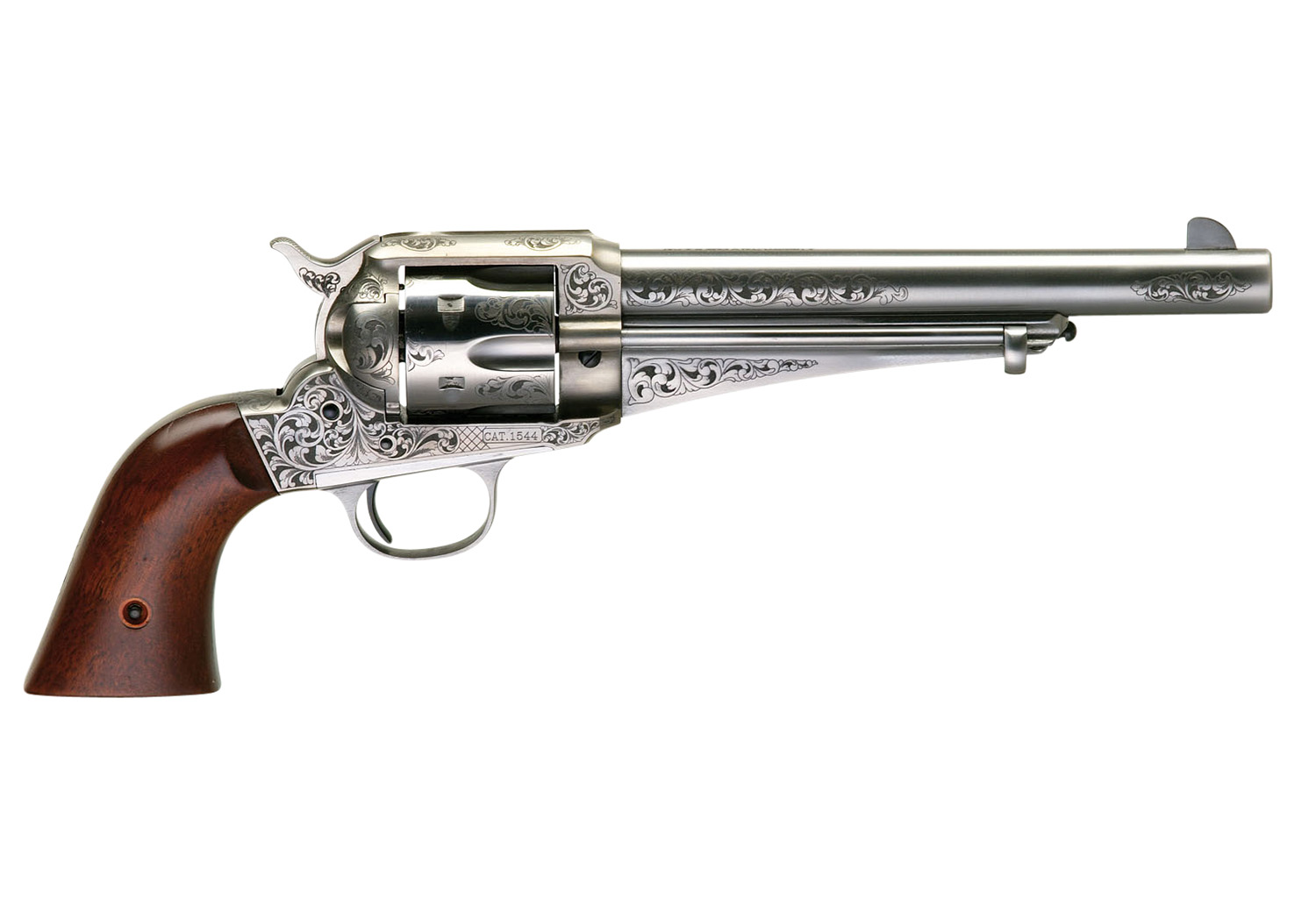
Taylors & Company 1875 Army Outlaw .357 Mag, 7.50″ Barrel
Video review
Expert review
About this product
What is the Taylors & Company 1875 Army Outlaw .357 Mag, 7.50″ Barrel?
The Taylors & Company 1875 Army Outlaw is a single-action reproduction revolver chambered in .357 Magnum with a 7.50-inch barrel and 6-round cylinder that faithfully replicates the mechanical design of late-19th century Remington service revolvers. Built on a solid-frame construction, this model combines historic firearm styling with modern manufacturing precision using white engraved steel finish and two-piece walnut grips. It’s specifically engineered for shooters who demand period-correct ergonomics without sacrificing reliable performance for modern shooting disciplines.
What is the 1875 Army Outlaw used for?
This revolver is designed for single-action shooting competitions, particularly cowboy-action events where historical accuracy and manual operation are required. The 7.50-inch barrel provides excellent sight radius for target work, while the .357 Magnum chambering allows use of milder .38 Special loads for extended practice sessions. With an overall length of 12.80 inches and weight of 2.64 pounds, it balances well for deliberate aimed fire rather than rapid deployment scenarios.
How does the 1875 Army Outlaw compare to the Stevens 334 Rifle?
The Outlaw serves a completely different shooting discipline than the Stevens 334 Rifle, with the revolver being optimized for single-action competition while the bolt-action rifle focuses on hunting accuracy. The Stevens platform delivers consistent 1.5 MOA groups from its 20-inch barrel, whereas the Outlaw's fixed sights limit precision beyond 50 yards. For cowboy-action shooting, the Outlaw is clearly superior, but for hunting applications, the Stevens 334 in .308 Win provides better ballistic performance and practical range.
What does it weigh and what are the dimensions?
The revolver weighs exactly 2.64 pounds (42.24 ounces) with an overall length of 12.80 inches and barrel length of 7.50 inches. The cylinder measures 1.75 inches in diameter with a 1.60-inch chamber spacing, while the walnut grips add approximately 0.75 inches of width at the thickest point. These dimensions create a substantial feel that helps manage .357 Magnum recoil while maintaining the historical proportions collectors expect from this reproduction firearm.
Who is this NOT for?
This revolver is not suitable for concealed carry or tactical applications due to its single-action mechanism and 12.80-inch overall length. The manual cocking requirement between shots makes it impractical for defensive use, and the fixed sights lack the adjustability needed for precision work beyond 75 yards. If you need a modern defensive revolver or a competition firearm for timed events requiring rapid follow-up shots, consider a double-action model instead.
What's in the box?
Each Outlaw ships with the revolver, one 6-round cylinder, and basic documentation covering safety and maintenance procedures. The package does not include a cleaning kit, holster, or additional accessories that are commonly needed for cowboy-action competition. You'll need to budget approximately $150-300 for period-correct leather gear and speed loaders to make this competition-ready.
Is the 1875 Army Outlaw worth it at $1,059?
At $1,059, this represents solid value for serious cowboy-action competitors who require historical accuracy and reliable single-action performance. The manufacturing quality exceeds many import reproductions at lower price points, with proper metallurgy and fitting that ensures longevity under regular .357 Magnum use. However, casual shooters might prefer the more affordable Stevens 555 Sporting shotgun for general range use at nearly half the price.
Specs at a glance
Pros & cons
What works
- 7.50-inch barrel provides excellent 12.80-inch sight radius for precise single-action shooting
- Solid-frame construction handles .357 Magnum pressures reliably with proper metallurgy
- Period-correct white engraved steel finish maintains historical authenticity for collectors
- 2.64-pound weight manages recoil effectively while maintaining balance for competition use
Trade-offs
- Single-action mechanism limits practical rate of fire to approximately 2-3 rounds per second maximum
- Fixed blade-and-notch sights lack windage/elevation adjustment for precision beyond 50 yards
- Requires specialized holsters costing $150-250 due to unique 1875 frame dimensions
- No included accessories beyond basic documentation - competition setup adds significant cost
Key attributes
| upc | 810012511049 |
| manufacturer | Taylors and Company |
| manufacturer part number | 550382 |
| action | Single Action |
| barrel finish | White Engraved |
| barrel length | 7.50" |
| caliber/gauge | .357 Magnum |
| capacity | 6 |
| sights | Blade Front, Notched Rear |
Frequently asked questions
- Is it compatible with .38 Special ammunition?
- Yes, the .357 Magnum chamber safely fires .38 Special ammunition, which produces significantly less recoil and is ideal for extended practice sessions. The shorter cartridge cases may cause some fouling buildup in the chambers that requires more frequent cleaning. For competition use, I recommend running 50-100 rounds of full-power .357 Magnum through the revolver every 500 rounds to maintain proper chamber dimensions.
- Does it fit standard SAA holsters?
- The 1875 Outlaw requires specifically designed holsters due to its unique frame geometry and 7.50-inch barrel length. While similar to Single Action Army dimensions, the Remington-style frame is approximately 0.25 inches wider than comparable Colt reproductions. I recommend ordering from specialty leathersmiths like El Paso Saddlery or Kirkpatrick Leather who offer patterns specifically for the 1875 model.
- How long does shipping take to FFL dealers?
- Standard shipping to your selected FFL dealer typically takes 3-5 business days after order processing and compliance verification. All firearms shipments require signature confirmation and must comply with ATF regulations regarding interstate transfers. During peak seasons or promotional periods, allow an additional 2-3 business days for order processing before shipment.
- Can I return it if there are mechanical issues?
- Ironclad Armory provides a 30-day mechanical warranty covering manufacturer defects, with repairs handled through our certified gunsmith network. Cosmetic issues or normal wear are not covered, and all returns must be initiated within 14 days of delivery. For warranty service, expect a 2-3 week turnaround time including shipping and diagnostic work.