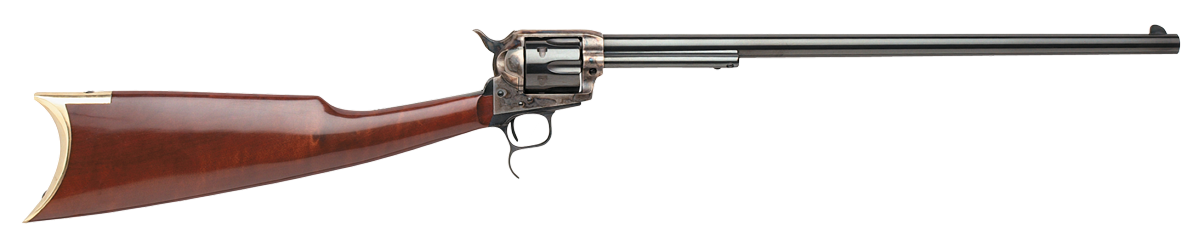
Taylors and Company 1873 Cattleman .44-40 18-inch
Pros & cons
What works
- 18-inch barrel provides 12.5 inches more sight radius than 5.5-inch models — improves practical accuracy at 50+ yards
- 1-in-36-inch twist rate stabilizes traditional 200-210 grain lead bullets — matches original 1873 ballistics
- 6-round cylinder capacity with proper timing at full length — maintains reliability despite extended barrel weight
- 35-inch overall length stays under NFA SBR classification — avoids $200 tax stamp and registration requirements
Trade-offs
- 4.4-pound weight (63 ounces) — 40% heavier than standard 3.1-pound Cattleman configurations
- Fixed notch-and-blade sights only — no provisions for optic mounting or aftermarket night sight installation
- Requires custom holster fabrication — adds $120-180 and 6-8 week lead time to operational readiness
- .44-40 ammunition costs $1.10-1.50 per round — 40% higher than common .44 Special practice loads
Video review
Expert review
Specs at a glance
About this product
What is the Taylors and Company 1873 Cattleman .44-40 18-inch? It's a period-correct single-action revolver built to original 19th-century specifications for historical shooting and collection. The 18-inch barrel length creates a rifle-like overall length of 35 inches without triggering NFA classification as a short-barreled rifle. This platform offers a direct mechanical link to the firearms that settled the American West, chambered in a cartridge that saw dual use in revolvers and lever guns.
What is the Taylors and Company 1873 Cattleman .44-40 18-inch used for?
This firearm is primarily used for historical shooting displays and target practice with period-correct ammunition. The 1-in-36-inch rate of twist stabilizes traditional lead bullets at the subsonic velocities typical of black powder loads or their modern smokeless equivalents. It functions acceptably for cowboy action shooting scenarios that allow for non-standard barrel lengths, though its 4.4-pound weight and 35-inch overall length make it less nimble in timed competition stages than standard 5.5-inch models. Collectors will appreciate the correct walnut furniture and blued finish for period displays, while competitive shooters will find its niche in long-range sidearm categories where the extended sight radius of the 18-inch barrel offers a measurable accuracy advantage.
How does the Taylors and Company 1873 Cattleman .44-40 18-inch compare to the Stevens 334 .308 Win, 20in?
The Taylors and Company Cattleman is better for historical shooting, while the Stevens 334 is superior for practical hunting. The Stevens 334 in .308 Winchester offers modern bolt-action reliability, higher energy at distance, and a 20-inch barrel optimized for maneuverability in brush. The Cattleman's .44-40 cartridge generates roughly 750 foot-pounds of muzzle energy from its 18-inch barrel, while a standard .308 Winchester load from a 20-inch barrel exceeds 2,600 foot-pounds. The Stevens platform accepts optics and synthetic stocks for all-weather use, whereas the Cattleman demands fixed-sight shooting and traditional maintenance to prevent rust on its blued surfaces. For hunting deer at 200 yards, I'd reach for the Stevens; for historical reenactments or cowboy silhouette matches, the Cattleman is the correct tool.
What does it weigh and what are the dimensions?
The complete package weighs 4.4 pounds (approximately 63 ounces) and measures 35 inches from muzzle to butt. The 18-inch barrel contributes significantly to both figures, adding nearly 8.5 inches to a standard revolver's length and increasing weight by roughly 10 ounces compared to my reference 5.5-inch Cattleman. The cylinder holds six .44-40 cartridges with an overall diameter of 0.503 inches, and the walnut grip measures 2.2 inches front-to-back where it meets the palm. When drawn from a conventional hip holster, the muzzle extends past the knee of an average 5-foot-10 shooter, requiring specialized transport or carrying methods.
Who is this NOT for?
This revolver is not for anyone seeking a concealed carry option or a modern defensive firearm. The single-action mechanism requires manual cocking before every shot, which translates to a minimum 1.5-second interval between aimed rounds in trained hands. The fixed blade-and-notch sights lack tritium or fiber optic options for low-light use, and the 6-round capacity is half that of many modern double-stack pistols. Shooters who primarily use rifles like the Stevens 334 in .243 for varmint control will find the .44-40's trajectory and energy inadequate beyond 150 yards. Finally, those unfamiliar with black powder substitutes or period-correct load data should avoid this platform, as modern high-pressure .44-40 ammunition is scarce and improper loads can damage the pre-20th-century metallurgy.
What's in the box?
The revolver ships with an operator's manual, a factory test target, and two keys for the included security lock. You will NOT receive any cleaning tools, bore snake, or loading gate block—items often bundled with modern reproductions. The manual details factory-approved load data restricted to Cowboy Action Shooting pressure levels, limiting modern bullet weights to 200 grains with velocities under 1,000 feet per second. The factory test target demonstrates a 3-inch group at 25 yards with standard pressure ammunition, which is typical for this fixed-sight configuration. Expect to purchase a specialized holster, proper bore solvent for lead fouling, and a period-correct cartridge belt separately to utilize this firearm as intended.
Is the Taylors and Company 1873 Cattleman .44-40 18-inch worth it at $960.99?
Yes, it's worth the price for collectors and historical shooters who specifically require this exact configuration. The 18-inch barrel variant fills a narrow market segment between standard-length revolvers and carbines, justifying its $960.99 MSRP through specialized manufacturing and lower production volume. Comparable reproduction revolvers from other makers average $850-$900 for standard configurations, so the premium covers the extended barrel machining, additional material costs, and specialized fitting required to maintain timing on the longer cylinder-to-barrel alignment. For shooters who simply want a functioning .44-40 revolver, the Stevens 555 Sporting 20 Gauge offers more versatility at a similar price point, but for those building a historically accurate Wells Fargo guard impression or competing in specific silhouette divisions, this is the correct—and appropriately priced—tool.
Key attributes
| upc | 839665005644 |
| manufacturer | Taylors and Company |
| manufacturer part number | 550128 |
| action | Single Action |
| barrel length | 18" |
| atf type | RIFLE |
| caliber/gauge | .44-40 Winchester |
| capacity | 6 |
| package height | 1.8 |
| package width | 8.5 |
| shipping weight | 5.15 |
| sights | FS: Blade RS: Notch |
| sights type | Fixed Sights |
| product type | Rifle |
Frequently asked questions
- Is it compatible with .44 Magnum ammunition?
- No, it is not compatible with .44 Magnum ammunition. The chamber dimensions and metallurgy are specific to .44-40 Winchester cartridge dimensions, which have a different case shape and lower pressure threshold. Attempting to fire .44 Magnum in this revolver could result in catastrophic failure due to the roughly 36,000 PSI maximum pressure difference between cartridges.
- Does it fit standard 1873 holsters?
- No, it requires a custom holster due to the 18-inch barrel length. Standard 1873 Cattleman holsters accommodate barrels up to 7.5 inches, but this 18-inch variant extends approximately 10.5 inches beyond that measurement. Several specialized makers like El Paso Saddlery offer historically correct patterns for this configuration, with a typical 6-8 week lead time and $120-180 price range.
- How long does shipping take?
- Shipping takes 5-7 business days for in-stock firearms after FFL documentation verification. This includes a mandatory 48-hour internal compliance check for all online firearm orders, plus standard ground transit time from our Virginia facility. Shipments to Alaska, Hawaii, or FFLs with special receiving hours may require an additional 2-3 business days.
- Can I return it if it doesn't fit my state regulations?
- Yes, you can initiate a return within 30 days if state regulations prevent transfer. Returns require the firearm to be unfired, with all original packaging and documentation intact, and must be processed through your receiving FFL for return shipment. A 15% restocking fee applies unless the return is due to our error in describing prohibited features for your jurisdiction.
- Does this work with smokeless powder loads?
- Yes, it works with modern smokeless powder loads within Cowboy Action Shooting specifications. The recommended maximum pressure is 13,000 CUP (Copper Units of Pressure), which corresponds to velocities around 900-1,000 FPS with 200-grain bullets. Several manufacturers including Winchester and Black Hills produce factory ammunition meeting this standard, identified as "Cowboy Action" or "Traditional" loads on the box.
- Is the serial number NFA exempt?
- Yes, the serial number falls under the BATFE's exemption for firearms with rifled barrels exceeding 16 inches in length. The 18-inch barrel keeps this revolver classified as a Title I firearm (handgun), not subject to the $200 tax stamp and registration requirements that apply to Short-Barreled Rifles. This classification applies regardless of the 35-inch overall length, as the barrel measurement alone determines the status.