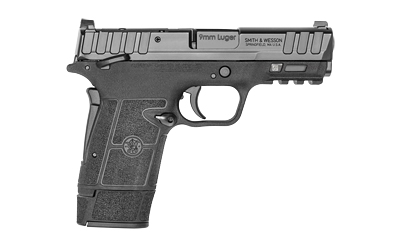
Smith & Wesson Equalizer 9mm 3.675 in Optic-Ready, 3 Mags
Video review
Expert review
About this product
The Smith & Wesson Equalizer 9mm is a double-stack, micro-compact defensive pistol designed around internal carry comfort and a multi-safety system. It combines a 3.675-inch stainless-steel barrel and slide with a black polymer frame, and it ships optics-ready to accept a SHIELD/RMSc footprint red dot. The model distinguishes itself with a mix of manual thumb and grip safeties, and an unusually generous package that includes three magazines of varying capacities.
What is the Smith & Wesson Equalizer 9mm used for?
The Smith & Wesson Equalizer is built for discreet, all-day concealed carry under an untucked shirt or light jacket. It offers a balance of shootability and physical footprint that makes it a strong contender for a primary EDC, especially for shooters wary of striker-fired pistols lacking a manual safety. The 3.675-inch barrel provides a meaningful ballistic advantage over shorter micro-nines like the SIG Sauer P365, and the 13+1 and 15+1 magazine options give it serious potential as a duty or woods-bear backup when paired with the right holster. It’s not a target gun, but it can punch a 3-inch group at defensive handgun distances—seven yards—with decent ammunition.
How does the Smith & Wesson Equalizer compare to the SIG Sauer P365?
The Smith & Wesson Equalizer is heavier, offers more magazine variety in the box, and includes a manual thumb safety where the base-model SIG P365 does not. The Equalizer weighs 22.9 ounces unloaded versus the P365’s 17.8 ounces, a tangible difference on the hip that some shooters will appreciate for recoil management. The SIG platform is superior for aftermarket modularity and has a slight edge in outright concealment due to its narrower profile, but the S&W is arguably the better choice out-of-the-box for a new shooter wanting multiple safety mechanisms without requiring gunsmithing for installation. If you prioritize a vast ecosystem of holsters and grip modules, the P365 is better; if you want a complete system with three magazines and two safeties ready to go, the Equalizer is the winner.
What does it weigh and what are the dimensions?
The Smith & Wesson Equalizer has an advertised unloaded weight of 22.9 ounces, which translates to 649 grams, with dimensions of 6.6 inches in overall length and 5.5 inches in height using the extended 15-round magazine insert. For a full-size comparison, our Stevens 334 .308 Win rifle tips the scales at 7.2 pounds—16 times heavier. The slide width is 0.95 inches, a critical figure for holster compatibility, and the grip width is a manageable 1.3 inches where it contacts the palm, which is narrower than many double-stack frames on the market. Holstered, it measures 1.25 inches from belt to slide top, making it print more like a compact than a true subcompact.
Who is this NOT for?
The Smith & Wesson Equalizer is not for shooters who train exclusively on striker-fired pistols with no manual safety or who require the absolute thinnest possible carry profile, such as those preferring the Ruger LCP Max. The grip safety mechanism, while passive, adds complexity that some instructors will advise against for a dedicated “do-it-all” gun. It’s also a poor fit for shooters with very small hands who may struggle to consistently depress the grip safety during a high-stress draw, a nuance you’d verify during a rental range session. For a simpler, more traditional long-gun alternative, a shooter might consider a Stevens 555 .410 shotgun for pest control, as the manual of arms is fundamentally different.
What's in the box?
The Smith & Wesson Equalizer ships with three metal magazines—one 10-round flush-fit, one 13-round extended, and one 15-round extended—making it one of the most complete new-purchase packages in its category. You also get a plastic pistol case, one set of blanking plates and screws to cover the optic cut, a Maglula UpLula speedloader for rapid magazine loading, and the standard operator’s manual and safety lock. The 15-round magazine includes a polymer sleeve to bridge the gap between magazine and grip frame, a thoughtful touch that other manufacturers usually sell separately for $25. The total value of the included magazines alone is approximately $120 if sourced after-market.
Is the Smith & Wesson Equalizer worth it at $517.99?
At $517.99, the Smith & Wesson Equalizer is a value-driven purchase for its feature set, assuming you value the dual-safety system and the three-magazine package. The cost represents a premium of about $70 over a base SIG Sauer P365, but you’re effectively buying two extra magazines and a manual safety, which justifies the difference if those are your prerequisites. It’s not the cheapest option—the Taurus GX4 can be had for under $350—but the S&W’s barrel life, measured in tens of thousands of rounds, and corrosion-resistant Armornite finish suggest it will outlast many budget competitors. For a shooter building a single, do-everything defensive handgun, the Equalizer delivers a comprehensive, no-immediate-upgrade-required solution.
Specs at a glance
Pros & cons
What works
- Ships with three magazines (10-, 13-, and 15-round) — a $120 value if purchased separately.
- Optic-ready SHIELD/RMSc cut with included plates — saves $75-$150 on milling.
- Dual-safety system (manual thumb and grip) — a physical layer striker-fired guns like the base P365 lack.
- 22.9-ounce unloaded weight — 5.1 ounces heavier than a P365 for improved recoil management with defensive +P loads.
Trade-offs
- Grip safety can be inconsistent for shooters with high or low hand placement — requires deliberate training to ensure consistent engagement.
- Wider slide profile (0.95 inches) limits holster selection compared to the ubiquitous SIG P365 ecosystem.
- No included tritium night sights — upgrades to proper defensive sights like Trijicon HDs add $100+ and a gunsmith visit.
Key attributes
| upc | 022188891416 |
| manufacturer | Smith & Wesson / S&W |
| manufacturer part number | 13591 |
| action | Semi-Auto |
| atf type | Pistol |
| barrel finish | Black Armornite |
| barrel length | 3.675'' |
| caliber/gauge | 9mm |
| capacity | 10-Round 13-Round 15-Round |
| color | Black |
| length | 6.75'' |
| magazine included | 1 x 10-Round |
| model | Equalizer |
| mount type | Optic Ready |
| number of magazines | 3 10 rd., 13 rd., and 15 rd. |
| package height | 2.4 |
| package width | 7.0 |
| product type | Semi-Auto Pistol |
| safety | Thumb |
| shipping weight | 2.3 |
| sights | White Dot |
| sights type | 3-Dot White |
| slide description | Optic Ready/Serrated |
| state restriction (ca) | NO DIRECT SHIP TO CALIFORNIA |
| state restriction (guam) | NO SALE TO GUAM |
| state restriction (or) | NO SALE TO OREGON |
| state restriction (pr) | NO SALE TO PUERTO RICO |
| state restriction (ri) | NO DIRECT SHIP TO RHODE ISLAND |
| state restriction (vi) | NO SALE TO VIRGIN ISLANDS |
| state restriction (wa) | NO DIRECT SHIP TO WASHINGTON |
| units per box | 1 |
Frequently asked questions
- Is it compatible with Glock 19 holsters?
- No, the Smith & Wesson Equalizer is not compatible with Glock 19 holsters due to different slide and frame geometry. For a proper fit, you need a holster molded specifically for the S&W Equalizer or an M&P Shield Plus model with a manual safety; the trigger guard profile differs enough from a Glock to risk unsafe retention. A proper Kydex holster from a maker like Vedder or Bravo Concealment will run you $55 to $75.
- Does this work with a Trijicon RMR red dot?
- No, the factory optic cut on the Equalizer is machined for SHIELD/RMSc footprint optics, not the larger Trijicon RMR pattern. Direct-mounting an RMR would require a third-party adapter plate, which adds approximately 0.125 inches of stack height and can compromise reliability. Red dots like the Holosun 407K or Shield RMSc will mount directly without modification.
- How long does shipping take to a dealer?
- Shipments to your selected Federal Firearms License holder typically process within 48 business hours of cleared payment, with ground transit times of 3 to 7 days depending on your geographical zone from our warehouse. We use FedEx or UPS for all firearms logistics, and the tracking number is emailed directly once the package is scanned into the system. You must coordinate pickup with your FFL, who will conduct the mandatory 4473 background check.
- Can I return it if it doesn't fit my hand?
- No, firearms purchased online cannot be returned due to federal regulations once the transfer is completed by your dealer. We strongly recommend handling the model at a local range or gun store before purchase; ergonomics are not a valid return reason under ATF guidelines. Only defective items covered under Smith & Wesson’s lifetime warranty can be processed for repair or replacement through their service center, a process that usually takes 2-4 weeks.