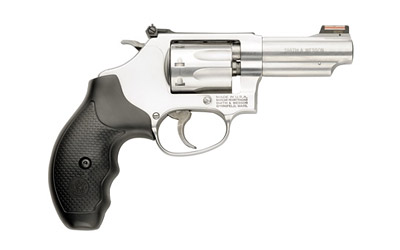
Smith & Wesson Model 63 — .22 LR 3″ 8-Round Satin Stainless
Video review
Expert review
About this product
The Smith & Wesson Model 63 .22 LR 3″ 8-Round is a compact, stainless steel J-frame revolver designed for low-recoil practice, kit use, and discreet everyday carry. It represents a modern execution of S&W's enduring small-frame platform, updated with practical sights for defensive utility while remaining a fundamentally simple mechanical design. This model addresses a specific niche within the wheelgun market, prioritizing corrosion resistance and controllable ballistics over sheer power.
What is the Smith & Wesson Model 63 used for?
This revolver is primarily used for low-cost marksmanship practice, small-game hunting, and as a discreet, low-percussion defensive option. Its .22 LR chambering minimizes recoil and noise, making it ideal for extended training sessions or introductions to revolver mechanics. The 3-inch barrel, a full inch longer than the common J-frame snub-nose, provides a better sight radius for improved accuracy over typical pocket pistols without sacrificing much concealability.
How does the Smith & Wesson Model 63 compare to a Ruger LCR in .22 LR?
The Smith & Wesson Model 63 is built on a traditional, all-steel J-frame, while the Ruger LCR utilizes a polymer frame with a stainless steel fire control housing, resulting in a significant weight difference. The Model 63 weighs 26 ounces, making it nearly 9 ounces heavier than the polymer-framed LCR, which offers a weight advantage for all-day carry but with more perceived recoil due to the lighter platform. For shooters who prioritize the classic solidity and balance of steel, the Model 63 is superior; for those seeking the absolute minimum carry weight, the LCR is the better choice.
What does it weigh and what are the dimensions?
The S&W Model 63 has a specific, tangible physical presence. It weighs 26 ounces (737 grams) unloaded, with an overall length of 7.25 inches and a height of 5 inches from the top of the rear sight to the bottom of the grip. The cylinder holds 8 rounds of .22 LR and measures 1.3 inches in diameter, influencing the revolver's 1.25-inch width at its widest point. These dimensions make it a compact but substantial-feeling sidearm, not a featherweight.
Who is this NOT for?
This is not for anyone seeking a primary defensive firearm chambered in a centerfire caliber for definitive stopping power. The .22 LR rimfire round has inherent limitations in terminal ballistics and reliability compared to modern defensive cartridges like .38 Special or 9mm. It is also not ideal for ultra-deep concealment where every ounce counts—there are polymer revolvers and smaller semi-autos, like our Stevens 334 rifle for a different application entirely, that better serve that role. Think of this as a tool for a specific set of tasks, not a one-size-fits-all solution.
What's in the box?
The factory packaging includes the revolver, one 8-round cylinder (non-removable), a cable-style trigger lock, a basic owner's manual, and a fired casing envelope as required by many jurisdictions. Smith & Wesson does not typically include spare grips, a cleaning kit, or a hard case with this model—expect a cardboard box. The manual covers essential safety, operation, and limited disassembly, which I strongly recommend reviewing before first use.
Is the Smith & Wesson Model 63 worth it at $862.99?
At this price point, you are paying for the durability of a stainless steel frame, the precision of adjustable sights, and the Smith & Wesson brand's longevity in revolver manufacturing. Compared to an entry-level .22 semi-auto pistol, this is a premium investment. The value proposition hinges on your need for a rugged, low-maintenance, and mechanically straightforward .22 revolver that can outlast generations. If your goal is simply the cheapest possible plinking, consider a used rimfire semi-auto; if you want a heirloom-quality trainer or kit gun, this price is justified by its materials and construction, similar to the quality found in our Stevens 555 Sporting shotgun line for its class.
Specs at a glance
Pros & cons
What works
- Weighs 26 oz — provides a stable, dampened shooting platform compared to polymer .22 revolvers.
- Holds 8 rounds of .22 LR — two more than the typical 6-round capacity of many small-frame .22 revolvers.
- Features a 3-inch barrel — offers a 1-inch longer sight radius than snub-nose models for improved practical accuracy.
- Satin stainless steel construction — requires minimal maintenance and resists corrosion far better than blued finishes.
Trade-offs
- No optic-ready frame — cannot be mounted with a modern red dot without irreversible, costly gunsmithing.
- Fixed, non-fluted cylinder — cannot use speed loaders, limiting reload speed compared to models with fluted cylinders.
- Heavier than polymer alternatives — at 26 oz, it is significantly heavier than a Ruger LCR .22 for all-day carry.
Key attributes
| upc | 022188626346 |
| manufacturer | Smith & Wesson / S&W |
| manufacturer part number | 162634 |
| action | SA/DA Revolver |
| atf type | Revolver |
| barrel finish | Satin Stainless |
| barrel length | 3'' |
| caliber/gauge | .22 LR |
| capacity | 8-Round |
| color | Silver |
| length | 7.25'' |
| magazine included | 1 x 8-Round |
| model | 63 |
| package height | 2.3 |
| package width | 7.0 |
| product type | Revolver |
| safety | Internal Lock |
| shipping weight | 2.3 |
| sights | Adjustable Sights |
| sights type | ADJUSTABLE |
| state restriction (guam) | NO SALE TO GUAM |
| state restriction (pr) | NO SALE TO PUERTO RICO |
| state restriction (vi) | NO SALE TO VIRGIN ISLANDS |
| units per box | 1 |
Frequently asked questions
- Is it compatible with a red dot sight?
- No, the Smith & Wesson Model 63's frame is not machined for an optic mounting plate, and the top strap lacks the necessary drilling and tapping. Sighting is limited to its factory-installed adjustable rear and HI-VIZ fiber optic front sights. Mounting an optic would require expensive, gunsmith-level frame modification, which I do not recommend for this platform.
- Does it fit standard J-frame holsters?
- Yes, but with a caveat due to the 3-inch barrel. The Model 63 will physically fit most holsters designed for a 2-inch or 2.5-inch barrel J-frame, but the muzzle will protrude slightly. For a proper fit where the holster fully covers the barrel, seek out a model specifically molded for a 3-inch barrel J-frame, such as those from vendors like Galco or DeSantis.
- Does this work with .22 Long or .22 Short ammunition?
- Yes, the Model 63's cylinder is chambered for .22 LR, which is dimensionally compatible with .22 Long and .22 Short cartridges. You can fire them safely, but expect a significant reduction in velocity and potential cycling issues in the double-action trigger pull due to the shorter cartridge length. I recommend sticking with standard or high-velocity .22 LR for reliable ignition and extraction.
- How long does shipping take to an FFL?
- For standard ground service, expect processing and transit time of 5 to 8 business days from the warehouse to your selected Federal Firearms License (FFL) holder. This timeframe is contingent on your FFL providing their license copy promptly. Expedited shipping options may reduce transit time by 2-3 days.
- Can I return it if I don't like the trigger?
- No, firearms sales are final once transferred through an FFL due to federal regulations and store policy. You cannot return the revolver because of subjective preferences like trigger feel. I advise handling one at a local dealer if possible. The double-action pull is typically around 12 pounds, and the single-action breaks at approximately 4 pounds—these are standard figures for a factory S&W J-frame.