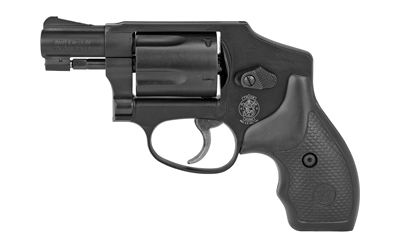
Smith & Wesson Model 442 Centennial Airweight — .38 Special, 5rd
Video review
Expert review
About this product
What is the Smith & Wesson Model 442 Centennial Airweight? It is a double-action-only, .38 Special J-frame revolver designed for discreet, all-day concealed carry. The aluminum-alloy frame keeps its unloaded weight at an easily manageable 14.2 ounces, while the enclosed hammer eliminates potential snag points on clothing. This configuration represents a specific, no-lock variant of a lineage that prioritizes immediate, uncomplicated reliability.What is the Smith & Wesson Model 442 Centennial Airweight used for?
The 442 is a primary or backup defense firearm for discreet everyday carry. Its concealment geometry is direct, with a profile of 1.28 inches in width and 3.25 inches in barrel length designed to disappear under a jacket or in a quality holster like a DeSantis Pocket-Tuk. The double-action-only trigger ensures the revolver cannot be fired unless the trigger is fully depressed, eliminating any external safeties to fumble with under stress.
How does the Smith & Wesson Model 442 compare to the Ruger LCR?
The 442 provides a more traditional all-metal feel versus the polymer-frame design of the Ruger LCR. Where the Smith & Wesson uses a pinned front sight, the Ruger offers a user-replaceable front sight system, a clear advantage for those wanting to customize their sight picture. The Ruger's trigger system often results in a slightly smoother, lighter pull, but the 442's steel-on-steel lockwork offers a different, mechanically precise and crisp tactile feedback.
What does it weigh and what are the dimensions?
Unloaded, the 442 weighs 14.2 ounces (402 grams) due to its aluminum-alloy frame and steel cylinder. Its primary dimensions are a 1.28-inch width, a 6.31-inch overall length, and a 4.75-inch height from the top of the rear sight to the bottom of the grip frame. These figures make it approximately 3 ounces heavier than an all-titanium J-frame but significantly lighter than the all-steel Model 640, which clocks in at over 21 ounces.
Who is this NOT for?
This revolver is a poor choice for a novice shooter's first range session or for someone who prioritizes high-volume, low-cost practice. The lightweight frame and snappy .38 Special recoil make sustained, accurate fire for more than 50 rounds a session challenging for those unaccustomed to it. It also lacks an accessory rail or modern optic-mounting capability, unlike some semi-automatic options covered in our carry optics guide.
What's in the box?
You receive the revolver, one 5-round moon clip for speed loading, a security cable lock, and the standard Smith & Wesson operator's manual and warranty paperwork. Importantly, it does not include a holster, speed loader, or any additional moon clips—these are essential operational accessories you will need to source separately based on your preferred carry method and state regulations.
Is the Smith & Wesson Model 442 worth it at $537.99?
At its MSRP, the 442 justifies its cost through proven mechanical simplicity in a highly concealable package. You are paying for the J-frame's machining tolerances, heat-treated steel components, and a finish built to withstand direct body contact. If your budget is under $400 and your primary goal is home defense, a full-sized option like the Stevens 334 rifle offers more capacity and stability for less money, but lacks the 442's sole purpose of discreet personal carry.
Specs at a glance
Pros & cons
What works
- Weighs 14.2 oz (402g) unloaded — significantly lighter than the all-steel Model 640 (21+ oz).
- Concealed (enclosed) hammer eliminates snag points for pocket or inside-waistband carry.
- Double-action-only operation — no external safeties to manipulate under stress.
Trade-offs
- Recoil with +P ammunition is sharp and can be punishing for extended practice sessions.
- Sights are non-adjustable, fixed channels — precise point-of-aim adjustment requires filing or replacement.
- Five-round capacity is standard for J-frames but low compared to modern micro-compact semi-autos.
Key attributes
| upc | 022188137545 |
| manufacturer | Smith & Wesson / S&W |
| manufacturer part number | 150544 |
| action | DAO Revolver |
| atf type | Revolver |
| barrel finish | Black |
| barrel length | 1.875'' |
| caliber/gauge | .38 Special |
| capacity | 5 |
| color | Black |
| length | 6.31'' |
| magazine included | Cylinder |
| model | 442 |
| package height | 3.1 |
| package width | 8.5 |
| product type | Double Action Only |
| shipping weight | 1.65 |
| sights | Integral Front/Fixed Rear |
| sights type | FIXED |
| state restriction (guam) | NO SALE TO GUAM |
| state restriction (pr) | NO SALE TO PUERTO RICO |
| state restriction (vi) | NO SALE TO VIRGIN ISLANDS |
| units per box | 1 |
Frequently asked questions
- Does this work with .38 Special +P ammunition?
- Yes, the Model 442 is rated for standard pressure and +P .38 Special ammunition. Smith & Wesson specifically frames this model for occasional use of +P loads. For continuous training, I recommend standard pressure rounds to reduce wear on the aluminum frame and shooter fatigue.
- Is it compatible with standard J-frame holsters?
- Absolutely. The 442 shares the exact external dimensions of the Smith & Wesson J-frame series, meaning it will fit any holster molded for a round-butt J-frame with a 1.875-inch barrel. Brands like DeSantis, Galco, and Simply Rugged offer hundreds of options cut precisely for this profile.
- Does it come with a cable lock?
- Yes, a security cable lock satisfying California DOJ requirements is included in the box. It is a simple braided steel cable and lock assembly, similar to those packaged with most major manufacturers' new firearms since 2002.
- How long does a typical NICS check take?
- For most buyers, the FBI's National Instant Criminal Background Check System (NICS) returns a "Proceed" in under 3 minutes. However, delays for common names or additional research can extend this to several hours or, in rare instances, the full 3 business days before a dealer can proceed by default under the Brady Act.