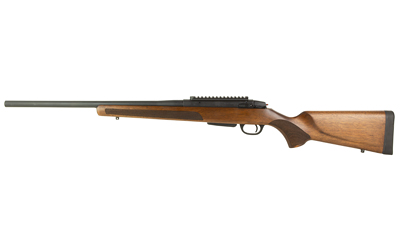
Stevens 334 .308 Win 20 in Walnut Bolt Rifle, 3-Round
Video review
Expert review
About this product
What is the Stevens 334 .308 Win 20 in Walnut Bolt Rifle? It's a traditional-styled, utility-focused bolt action hunting rifle built on a modern, modular action system. This rifle combines a 20-inch, free-floating, button-rifled carbon steel barrel with a Turkish walnut stock, presenting a no-frills entry point into .308 Winchester precision for hunters and sport shooters. It's designed for reliable field performance without the complexity or cost of a custom-built long-range platform.
What is the Stevens 334 .308 Win 20 in Walnut Bolt Rifle used for?
This rifle is used for medium-to-large game hunting at typical woodland and mountain ranges. The .308 Winchester cartridge provides sufficient energy for ethically taking deer, elk, and black bear within 300 yards, while the 20-inch barrel and 7.2-pound weight offer a reasonable balance between maneuverability in thick cover and steady offhand shooting. It’s a practical choice for hunters who want a traditional-format rifle that's ready to mount an optic and hit the field.
How does the Stevens 334 .308 Win compare to a Ruger American in .308 Win?
The Stevens 334 is better for shooters appreciating traditional aesthetics and a proven two-stage trigger system, while the Ruger American often has a slight edge in out-of-the-box accuracy from the bench. The Stevens uses a Turkish walnut stock which adds roughly 1.1 pounds of mass compared to the Ruger's polymer stock, aiding in recoil management. The Ruger American typically uses a lighter, crisp single-stage trigger and may cost $40-$60 less, but the Stevens 334's trigger is adjustable for pull weight and overtravel, offering more user control.
What does it weigh and what are the dimensions?
The rifle weighs 7.2 pounds (approximately 3266 grams) unloaded and without optics. Its overall length is 40.5 inches with the 20-inch barrel, and it has a length of pull of 13.75 inches. The receiver is drilled and tapped for Savage 110-pattern scope bases, which typically have a 6.5-inch span between mounting holes, and the 3-round detachable magazine box measures 2.75 inches in length.
Who is this NOT for?
This rifle is not for competitive PRS/NRL shooters or those demanding sub-MOA guarantees from the factory. The 20-inch barrel and standard contour generate more muzzle rise than a heavier, 24-inch varmint barrel, making rapid follow-up shots less stable. It is also not ideal for left-handed shooters, as the safety and bolt handle are configured exclusively for right-handed operation; they should look at options like the left-hand variant in other calibers if available, or consider a dedicated left-hand model from another brand.
What's in the box?
You receive the barreled action with stock installed, one 3-round detachable magazine, and a set of standard mounting screws for a Picatinny rail. The box does not include a scope base, rings, or a manual trigger-pull gauge for adjusting the two-stage trigger, unlike the Stevens 555 Sporting shotgun, which includes five choke tubes. Expect to spend an additional $30-$80 on a quality Savage 110-pattern rail and rings before you can mount optics.
Is the Stevens 334 .308 Win worth it at $536.99?
At $536.99, it is worth it for a hunter who values the solidity of a walnut stock and the tunability of a two-stage trigger over cost-saving synthetic alternatives. You are paying for a real wood stock, an adjustable trigger system, and a drilled-and-tapped action ready for optics, which provides a functional foundation. If your sole priority is the lowest possible entry cost into a .308 bolt action, you can find synthetic-stocked rifles for about $70-$100 less, but you'll sacrifice aesthetic warmth and some foundational mechanical control.
Specs at a glance
Pros & cons
What works
- Turkish walnut stock adds 1.1 lbs of stabilizing mass versus synthetic stocks
- Two-stage adjustable trigger with a 2.5-5 lb pull weight range
- Free-floating 20" button-rifled barrel reduces point-of-impact shift from stock pressure
- Drilled & tapped receiver accepts Savage 110-pattern rails for immediate optic mounting
Trade-offs
- Muzzle is not threaded (5/8"-24), requiring a $120-$200 gunsmith job for suppressor use
- Proprietary 3-round magazine — not compatible with common AICS or older Savage 10 mags
- Right-hand-only configuration excludes left-handed shooters without modification
Key attributes
| upc | 011356188380 |
| manufacturer | Savage |
| manufacturer part number | 18838 |
| action | Bolt Action |
| atf type | RIFLE |
| barrel finish | MATTE BLACK |
| barrel length | 20" |
| caliber/gauge | .308 / 7.62 NATO |
| capacity | 3 + 1 |
| color | BLUED |
| length | 47.5500 |
| magazine included | 1 x 3-Round |
| model | 334 |
| number of magazines | 1 3 rd. Detachable Box |
| package height | 2.8 |
| package width | 9.1 |
| product type | Rifle |
| safety | 3-Position |
| shipping weight | 9.6 |
| sights | None, Scope Mount |
| units per box | 1 |
Frequently asked questions
- Is the receiver drilled and tapped for optics?
- Yes, the receiver is pre-drilled and tapped for Savage 110-pattern scope bases. The hole spacing is standard for the 110 action, requiring a MIL-STD 1913 Picatinny rail or two-piece bases from manufacturers like EGW, DNZ, or Warne. No adapter plates are necessary for standard mounts.
- Does this rifle work with aftermarket Savage 10/110 magazines?
- No, it uses a proprietary 3-round detachable box magazine specific to the Stevens 334 platform. It is not compatible with AICS-pattern magazines or the older Savage centerfloorplate magazines from the Model 10 or 110. Spare magazines must be sourced specifically for the Stevens 334 model.
- What is the thread pitch on the muzzle?
- The factory barrel is not threaded for a muzzle brake or suppressor. The muzzle is crowned and finished flush. Adding threads would require a gunsmith to cut and thread the barrel, typically for 5/8"-24 threads for .308, which costs approximately $120-$200 plus refinishing.
- Is the trigger pull adjustable?
- Yes, the two-stage trigger is adjustable for pull weight and overtravel. The adjustment range is typically from approximately 2.5 pounds to 5 pounds, controlled by an external screw accessible with a standard hex key. A trigger pull gauge is recommended for precise setting.