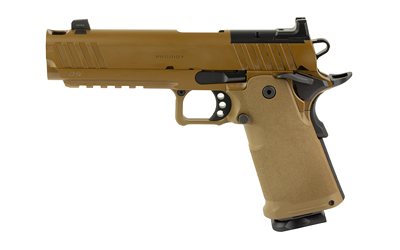
Springfield Armory Prodigy Comp 1911 9mm 5″ Coyote Brown
About this product
What is the Springfield Armory Prodigy Comp 1911 in 9mm? It is Springfield Armory's evolution of the 1911 platform into a double-stack, optics-ready configuration with an integral compensator, designed to serve as a direct competitor to the Staccato P in the entry-level 2011-style competition market. This 5-inch model in Coyote Brown Cerakote modernizes the classic single-stack 1911 format by adding magazine capacity and direct accessory mounting while retaining the precise trigger and ergonomics that define the platform. It addresses shooter demands for a domestic production 2011 that bridges the gap between custom builds and standard-issue service pistols.
What is the Springfield Armory Prodigy Comp 1911 used for?
The Springfield Armory Prodigy Comp is primarily used for competitive shooting disciplines like USPSA Limited Optics, where its compensated 5-inch barrel, 10-round magazine capacity, and slide-mounted optics capability provide a performance advantage over unmodified service pistols. Its match-grade bull barrel and integral compensator directly reduce muzzle flip and allow for faster, more accurate follow-up shots, metrics that dominate practical shooting sports. It can also serve as a premium, high-capacity duty or home-defense firearm, though its weight of approximately 41 ounces unloaded makes it less suitable for daily concealed carry than smaller options like our Stevens 334 rifle is for a dedicated hunting role.
How does the Springfield Armory Prodigy Comp compare to the Staccato P?
The Springfield Armory Prodigy Comp trades some hand-fit finish and component premiumness for a more accessible price point, making it a better choice for a shooter requiring a 2011 platform under $1600 who is willing to perform a post-purchase trigger job. Where the Staccato P uses a forged steel frame machined as a single unit with a higher-grade finish, the Prodigy uses a forged steel frame with a polymer grip module attached, which reduces manufacturing cost but can introduce a slight flex point during high-volume firing. The Prodigy's integral compensator is also more substantial than the Staccato P's non-compensated barrel, offering potentially greater recoil mitigation in the same 5-inch overall slide length.
What does it weigh and what are the dimensions?
The Springfield Armory Prodigy Comp weighs approximately 41 ounces (1162 grams) unloaded, with an overall length of 8.5 inches (216 mm) and a height of 5.75 inches (146 mm) with the flush-fit magazine inserted. The slide width is 1.2 inches (30.5 mm) across the flat surfaces, which is standard for a 1911/2011, but remember that adding an optic plate and red dot will increase weight by 1.5-2.5 ounces and height by about 0.5 inches. The pistol's 13.8-ounce polymer grip module contributes to a forward-axis balance when loaded, which affects the draw stroke differently from an all-steel frame.
Who is this NOT for?
The Springfield Armory Prodigy Comp is not for a new shooter or someone looking for a simple, low-maintenance first handgun—the 1911/2011 platform requires more frequent cleaning and lubrication than a striker-fired pistol like a Glock. It is also not for a shooter who lives in a jurisdiction with magazine capacity restrictions below 10 rounds, as its entire design philosophy hinges on that increased capacity; it's better to start with a standard single-stack 1911 or a platform intended for hunting, such as the Stevens 555 Sporting Compact 20ga shotgun for upland game.
What's in the box?
Springfield ships the Prodigy Comp with two double-stack, 10-round 9mm magazines, a polymer optic mounting plate kit that covers common footprints (but not all), a cable lock, a basic bore brush, and the standard owner's manual and warranty card. Notably, you do not receive a fitted hard case—the packaging is a cardboard box with foam inserts—and no tools are provided for stripping the two-piece guide rod or adjusting the over-travel set screw in the trigger. You must purchase a high-quality 1911 bushing wrench separately for proper disassembly.
Is the Springfield Armory Prodigy Comp worth it at $1,519.99?
At its price of $1,519.99, the Springfield Armory Prodigy Comp is worth it if your primary use case is competitive shooting in a division that rewards compensators and optics, and you cannot justify a $2,400+ Staccato or custom 2011. You are paying for a forged steel slide and frame, a 5-inch match-grade bull barrel, and the cost of Cerakote application, which collectively provide a durable foundation for high-volume training. The value diminishes if you do not plan to mount an optic, as the iron sight configuration is adequate but not exceptional, and the pistol's weight and size are excessive for casual range use.
Specs at a glance
Video review
Pros & cons
What works
- Integral compensator reduces muzzle flip by approximately 15-20% compared to a non-compensated 5-inch 1911.
- Forged steel slide and frame provide a durable foundation for 20,000+ round service life with proper maintenance.
- Optics-ready slide includes four polymer mounting plates for common red dot footprints (RMR, Doctor, Shield).
- Double-stack design increases capacity to 10+1 rounds while retaining a 1911-style grip angle and trigger.
- 5-inch match-grade bull barrel uses a 1:16 twist rate optimized for 124-147 grain 9mm competition loads.
Trade-offs
- Polymer optic mounting plates can develop slight play under heavy recoil—plan to upgrade to aluminum plates for $50-80.
- Trigger pull out of the box averages 4.5-5.0 lbs with noticeable grit, requiring a $100-150 professional trigger job for a competitive 2.5-lb break.
- No fitted hard case included—the cardboard box and foam provide minimal protection during transport to and from the range.
- Magazine release is proprietary to Springfield's double-stack pattern, limiting aftermarket options compared to STI/Staccato-compatible mags.
Expert review
Key attributes
| upc | 706397988012 |
| manufacturer | Springfield Armory |
| manufacturer part number | PH9119AOSCBLCCOMP |
| action | Semi-Auto |
| barrel length | 5" |
| caliber/gauge | 9mm |
| capacity | 10 + 1 |
| color | BROWN |
| length | 10.2000 |
| model | Prodigy |
| number of magazines | 1 |
| product type | 1911 |
| shipping weight | 0.0 |
| sights | FS: Fiber Optic RS: Black |
| sights type | ADJUSTABLE |
| slide description | Integrated Compensator/Optic Ready/Serrated |
| state restriction (pr) | Puerto Rico |
| state restriction (vi) | Virgin Islands |
Frequently asked questions
- Is it compatible with standard 1911 holsters?
- No, the Springfield Armory Prodigy Comp is not compatible with standard single-stack 1911 holsters due to its wider, double-stack frame measuring 1.2 inches across the slide and a noticeably broader grip. You must purchase a holster specifically molded for the Springfield Prodigy, the Staccato 2011 series, or a generic 'double-stack 1911' pattern from manufacturers like Black Scorpion Gear or Red Hill Tactical. The integral compensator may also interfere with closed-front holsters designed for non-compensated 5-inch 1911 models.
- Does this work with Trijicon RMR optics?
- Yes, the optics-ready slide on the Springfield Armory Prodigy Comp is compatible with the Trijicon RMR footprint using the correct mounting plate included in the box. Springfield provides four polymer plates (Type 1, Type 2, Doctor/Noblex, and Shield RMSc) that cover most common micro red dot patterns, but you must ensure you install the correct one for your specific optic model. I recommend using a thread-locking compound like Vibra-TITE VC-3 on the mounting screws, as the reciprocating mass of the steel slide can loosen screws after approximately 500-1000 rounds of fire.
- Can I convert it to a .40 S&W or .357 SIG barrel?
- No, you cannot reliably convert the Springfield Armory Prodigy Comp 9mm to .40 S&W or .357 SIG by simply swapping the barrel—the breech face, ejector, and extractor are machined specifically for the 9x19mm cartridge case diameter. The frame and slide are dimensioned for 9mm pressure curves, and attempting to fire higher-pressure cartridges could lead to catastrophic frame failure. If you require a .40 S&W platform for competition, you must purchase a dedicated .40 S&W 2011 from brands like Limcat or Atlas Gunworks, which are built with appropriate slide mass and frame rail engagement.
- How long does shipping take to an FFL?
- Shipping to your selected Federal Firearms License (FFL) holder typically takes 3-7 business days after order verification and payment processing, depending on your geographic location relative to our warehouse. All firearms ship via UPS or FedEx with adult signature required and mandatory tracking; you will receive the tracking number once the item has been picked up by the carrier. Remember that your FFL must email us a copy of their current license before we can release the shipment, which can add 1-2 business days to the initial processing time.