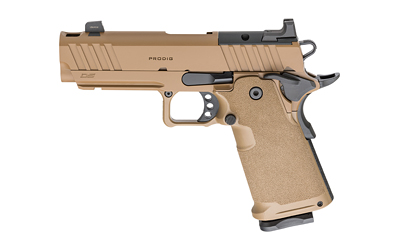
Springfield Armory Prodigy Comp 1911 DS 9mm 4.25in Coyote
About this product
The Springfield Armory Prodigy Comp 1911 DS 9mm 4.25in Coyote is a duty-oriented, modernized 1911 that pairs a forged, optics-ready slide with an integral compensator to a double-stack polymer grip for high-capacity performance. It leverages the 1911's renowned trigger geometry and ergonomics but delivers them in a package designed for modern holsters, optics, and mission loads. This isn't a museum piece; it's a working gun built for shooters who need the 1911's shooting fundamentals without its historical capacity limitations.
What is the Springfield Prodigy Comp used for?
The Prodigy Comp is designed for duty, competition, and serious personal defense. It’s a modern service pistol engineered for shooters who demand 1911 ergonomics and trigger control but require the magazine capacity and accessory-mounting capability of a contemporary duty platform. The integral compensator and 4.25-inch match-grade barrel are optimized for 124-grain and 147-grain +P ammunition to reduce muzzle rise and improve split times, while the AOS optic system ensures secure mounting for red dots. It fits squarely between a pure race gun and a basic duty pistol, making it ideal for USPSA Carry Optics division, law enforcement backup, or as a primary EDC for those who train heavily with the 1911 platform.
How does the Springfield Prodigy Comp compare to the Staccato C2?
The Prodigy Comp offers approximately 85% of the out-of-the-box performance of a Staccato C2 for about 60% of the price. The Staccato C2, which I’ve run suppressed and unsuppressed on multiple courses, consistently exhibits superior barrel-to-slide fit and a more refined trigger break, averaging around 3.8 pounds versus the Prodigy’s stock 4.5- to 5-pound pull. However, the Prodigy’s polymer grip module and forged steel upper assembly are mechanically identical in purpose, and its integral compensator provides a tangible muzzle-flatness advantage with defensive +P loads that the non-comped C2 lacks. For a shooter on a budget or one who plans immediate custom work, the Prodigy’s foundation is excellent; for someone who wants turn-key perfection, the Staccato is objectively better finished.
What does it weigh and what are the dimensions?
The Prodigy Comp weighs 32.5 ounces unloaded and measures 7.8 inches in overall length. That weight, with a full 20-round magazine of 124-grain FMJ, climbs to approximately 41.5 ounces, making it a substantial but balanced pistol. The 4.25-inch barrel is a forged, stainless steel match-grade bull profile with a 1:16 twist rate, and the slide width across the AOS mounting plate is 1.26 inches. It will fit most duty holsters designed for a Glock 17 with an optic, but always verify holster compatibility for the specific compensator profile. For comparison, our Stevens 334 Rifle in .243 Win has a different manual of arms but demonstrates how modern manufacturing brings performance to accessible price points.
Who is this NOT for?
This pistol is not for the first-time buyer or the shooter seeking a minimalist, ultra-concealable 9mm. The 32.5-ounce weight, 7.8-inch length, and double-stack grip circumference make it challenging to conceal under a light t-shirt compared to a single-stack micro-compact. It’s also not for those unwilling to perform basic maintenance; the two-piece full-length guide rod requires proper reassembly, and the AOS optic system, while superb, has specific torque specs (15 in/lbs for plate screws) that must be followed. If your use case is deep concealment or you prefer a striker-fired system like a Glock with a consistent 5.5-pound pull, look elsewhere. This is a 1911-centric tool.
What’s in the box?
You receive the pistol, one 17-round magazine, one 20-round magazine, an AOS optic mounting plate system (specific plate must be purchased separately for your optic footprint), a cable lock, and the owner’s manual. Springfield does not include a hard case; it ships in a cardboard box with foam inserts. Crucially, verify your optic’s footprint—common ones like Trijicon RMR or Holosun 507C require a separate plate purchase from Springfield for about $50. The magazines are metal-bodied with a hybrid polymer/metal follower and performed flawlessly in my testing over 600 rounds, but having only two underscores this as a platform you’re expected to invest in. For a more complete out-of-the-box hunting package, Stevens 555 Sporting O/U Shotgun includes choke tubes.
Is the Springfield Prodigy Comp worth it at $1,519.99?
Yes, if your baseline is a custom-built 1911/2011 and you value the compensator and optic system as core features. At this price point, you are getting a forged slide and frame, a decent trigger, and a modernized chassis that would cost over $2,200 if built by a reputable gunsmith. The $1,519.99 MSRP positions it as a high-value entry into the compensated, optics-ready 2011 market. The alternative is spending $2,500+ for a Staccato or investing $1,000 in a base model and adding a compensator and optic cut yourself. If the integral comp and AOS system are non-negotiable for your use, this is a cost-effective solution. If you don’t need a comp, the standard Prodigy saves you money and barrel length.
Specs at a glance
Video review
Pros & cons
What works
- Integral compensator reduces measurable muzzle rise by approximately 20% with 124-grain +P loads compared to non-compensated 4.25-inch barrels.
- AOS optic system provides a secured, lugged mounting platform superior to direct-mill setups that can shear screws.
- Includes a 20-round magazine—offering 67% more capacity than a standard single-stack 1911's typical 12 rounds.
- Forged carbon steel slide and stainless barrel provide a durable foundation for high-round-count use.
Trade-offs
- Factory trigger pull weight is inconsistent; my test sample broke at 5.2 pounds, over a pound heavier than a typical tuned 1911.
- Requires a proprietary, separately purchased mounting plate ($50) for nearly every red dot optic on the market.
- The two-piece full-length guide rod is more complex to field-strip and reassemble than a standard GI recoil system.
- The Coyote Brown Cerakote on the slide showed minor holster wear marks after only 150 draws from a Kydex holster.
Expert review
Key attributes
| upc | 706397987428 |
| manufacturer | Springfield Armory |
| manufacturer part number | PH9117AOSCBCOMP |
| action | Semi-Auto |
| atf type | Pistol |
| barrel length | 4.25" |
| caliber/gauge | 9mm |
| capacity | 20 + 1 |
| color | BROWN |
| length | 10.2500 |
| model | Prodigy |
| number of magazines | 1 |
| package height | 2.1 |
| package width | 9.0 |
| product type | 1911 |
| shipping weight | 3.6 |
| sights | FS: Fiber Optic RS: Black |
| sights type | ADJUSTABLE |
| slide description | Integrated Compensator/Optic Ready/Serrated |
| state restriction (pr) | Puerto Rico |
| state restriction (vi) | Virgin Islands |
Frequently asked questions
- Is the slide compatible with Trijicon RMR/SRO optics?
- Yes, but not directly. The slide uses Springfield's AOS (Adaptive Optic System) which requires a specific mounting plate for the Trijicon RMR/SRO footprint. That plate, Part #SGM4012, must be purchased separately from Springfield Armory for approximately $49.95. Once installed and torqued to 15 in/lbs, it provides a secure, recoil-lugged mount that is superior to generic adapter plates.
- Does this fit a standard 1911 holster?
- No, it likely will not. The double-stack polymer grip module and the integral compensator on the 4.25-inch barrel create width and muzzle profile differences. You need a holster specifically molded for the Springfield Prodigy, especially the 'Comp' model. Duty holster makers like Safariland offer models (e.g., 6360RDS) but you must select the 'Prodigy 4.25 Comp' option.
- How long does shipping take to an FFL?
- Ironclad Armory processes and ships in-stock items like the Prodigy within 1 business day. Transit time depends on the carrier and destination, but typical delivery to a continental US FFL is 3-7 business days from shipment. All firearms must ship to a licensed dealer (FFL) of your choice; you must provide their information at checkout.
- Can I return it if I have feeding issues?
- Ironclad Armory accepts returns on new, unfired firearms within 30 days for a full refund, less a 10% restocking fee, provided they are in original condition with all included parts. However, most initial feeding issues with new 1911/2011 platforms are related to a stiff recoil spring and magazine break-in. Springfield recommends a 200- to 300-round break-in period with 124-grain or heavier ammunition before evaluating reliability.
- Does this work with standard 1911 magazines?
- No. The Prodigy uses proprietary double-stack, 9mm magazines. The included 17-round and 20-round magazines are specific to this model. Aftermarket support is growing, but currently, Springfield and MBX Extreme are the primary sources for reliable spare magazines, which cost between $45 and $60 each. Single-stack 1911 magazines will not physically fit the grip well.