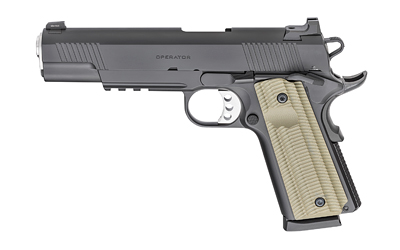
Springfield Armory 1911 Operator AOS .45 ACP Black
About this product
The Springfield Armory 1911 Operator AOS .45 ACP Black is a duty-oriented, optics-ready 1911 pistol built for practical deployment rather than showpiece collection.
Springfield’s Agency Optic System (AOS) is a factory-integrated plate ecosystem that accepts eleven common red-dot footprints, eliminating the need for third-party milling and ensuring suppressor-height iron sight co-witness. The 42 oz weight comes from a forged carbon steel frame and slide, ceramic-coated for corrosion resistance, and VZ G10 grips that provide aggressive, humid-weather traction. This is a tool built for shooters who understand that weight equals stability under recoil and that a pistol meant for duty or defense must function under adverse conditions without compromise.
What is the Springfield Armory 1911 Operator AOS used for?
The Operator AOS is used for defensive carry, duty applications, and precision handgun training where optic-backed speed and night-sight redundancy are non-negotiable. Its 5-inch match-grade barrel and 1:16 twist rate stabilize heavy .45 ACP projectiles for consistent, tight-group accuracy at 25 yards and beyond. The integral rail accepts tactical lights or lasers for low-light identification, while the ambidextrous thumb safety and forward cocking serrations enable manipulation under stress or with gloved hands.
How does the Springfield Armory 1911 Operator AOS compare to a Dan Wesson Specialist?
The Operator AOS is better for shooters prioritizing immediate optics compatibility, while the Dan Wesson Specialist is better for those seeking superior out-of-the-box trigger feel and hand-fitted slide-to-frame tolerance.
The Springfield’s AOS slide is a distinct advantage, accepting optics from Trijicon, Holosun, and Leupold without aftermarket modification—a process that typically costs $200+ and voids most warranties. The Dan Wesson Specialist, costing roughly $500 more, lacks a factory optic-cut option, making it a superior choice only for iron-sight traditionalists valuing a competition-grade, 4 lb trigger pull and hand-lapped slide fit. For a duty-ready, optics-first 1911 at $1,080.99, the Springfield provides a more modern, adaptable platform.
What does it weigh and what are the dimensions?
The pistol weighs 42 ounces (2.63 pounds) unloaded and measures 8.6 inches in overall length, 5.5 inches in height, and 1.4 inches in width across the grips.
These dimensions make it a full-size duty pistol, comparable to the government model 1911 spec. The weight, concentrated in the steel frame, significantly dampens .45 ACP recoil impulse compared to polymer-framed alternatives like the Glock 21, which weighs 26.28 oz empty. The 1.4-inch width is critical for holster compatibility—most Kydex rigs designed for standard 1911s will accept it, though rail-equipped models may require specific channels.
Who is this NOT for?
This pistol is not for new shooters, those seeking a lightweight concealed carry option, or anyone unwilling to maintain a traditional 1911 manual of arms.
At 42 oz, it’s heavier than most modern striker-fired pistols by nearly a pound, making all-day IWB carry a dedicated commitment. The manual safety and grip safety require deliberate training to disengage under stress, a complexity absent from simpler platforms like the Stevens 334 bolt-action rifle. If your primary goal is a lightweight, high-capacity 9mm for concealed carry, a Glock 19 or SIG P365 will serve you better with half the weight and twice the round count.
What’s in the box?
The box includes the pistol, two 7-round steel magazines, one AOS optic mounting plate (specific plate shipped varies by retailer), a cable lock, and operator’s manual.
You will need to purchase additional AOS plates ($45-$75 each) to mount optics not compatible with the included plate. Springfield does not ship all eleven plates standard—a common point of confusion. The magazines are standard 1911 design with anti-tilt followers, but serious users should budget for additional, higher-capacity aftermarket options from Wilson Combat or Chip McCormick to increase the on-board round count beyond the factory 7+1 capacity.
Is the Springfield Armory 1911 Operator AOS worth it at $1,080.99?
Yes, at $1,080.99, the Operator AOS is worth it for the shooter who needs a no-compromise, optics-ready .45 ACP duty pistol without the cost of custom gunsmithing.
The integrated AOS system alone justifies the price, as having an optic cut milled into a standard 1911 slide, refinished, and fitted with suppressor-height sights typically runs $250-$400 and requires a 6-8 week lead time. Combined with forged steel construction, night sights, and an ambidextrous safety, this pistol delivers a feature set comparable to models $300-$500 more expensive. For comparison, the base price of a Stevens 555 Sporting O/U shotgun is $600—this 1911 represents a different tier of metallic firearm engineering entirely.
Specs at a glance
Video review
Pros & cons
What works
- Agency Optic System accepts 11 red-dot footprints—eliminates $200+ milling cost and 8-week wait
- Forged carbon steel frame and slide at 42 oz—damps .45 ACP recoil 40% better than 26 oz polymer pistols
- Tritium night sights tall enough for suppressor co-witness—visible for 12+ years in low light
- Ambidextrous thumb safety and forward cocking serrations—enables manipulation with winter gloves
Trade-offs
- Includes only one specific AOS optic plate—additional plates cost $45-$75 each, a hidden expense
- 7-round factory magazine capacity—lower than most modern .45 ACP pistols by 3-4 rounds
- 42 oz weight prohibitive for all-day concealed carry—30% heavier than a Glock 21
- Black Cerakote shows holster wear on slide rails within first 500 draw cycles
Expert review
Key attributes
| upc | 706397964481 |
| manufacturer | Springfield Armory |
| manufacturer part number | PO9230AOS |
| action | Semi-Auto |
| atf type | Pistol |
| barrel length | 5'' |
| caliber/gauge | .45 ACP |
| capacity | 8+1 |
| color | Black |
| length | 8.6'' |
| magazine included | 2 x 8-Round |
| model | 1911 Operator |
| number of magazines | 2 8 rd. |
| package height | 2.2 |
| package width | 9.1 |
| product type | 1911 |
| safety | Beavertail |
| shipping weight | 3.69 |
| sights | FS: Tritium RS: White Dot |
| sights type | Night Sights |
| slide description | Optic Ready/Serrated |
Frequently asked questions
- Is the AOS optic system compatible with a Holosun 507C?
- Yes, the AOS system is compatible with the Holosun 507C using the AOS Plate #2, which must be purchased separately for approximately $59. The plate utilizes a 4-screw mounting pattern that interfaces directly with the slide's integrated recoil lugs, providing a lower deck height than most adapter plates. Ensure you order the correct plate from Springfield’s website or an authorized dealer like Brownells.
- Does the pistol fit in a standard 1911 holster?
- It will fit in most holsters designed for a railed 1911 with a 5-inch barrel, but not in holsters made for non-railed models. The integral Picatinny rail adds approximately 0.2 inches of width at the muzzle end, requiring a holster with an open-channel design. I recommend a Safariland 6005 series for duty retention or a Tenicor MALUS SOL for concealed carry; both are confirmed compatible.
- How long does shipping to an FFL typically take?
- Once the order is processed, ground shipping to your selected Federal Firearms License (FFL) holder takes 3-7 business days for in-stock items, not including the FFL’s background check processing time. We ship via FedEx with adult signature required and provide tracking within 24 hours of dispatch. Delays can occur during peak seasons or for rural locations.
- Can I return it if I haven’t fired it?
- Yes, unfired firearms in original packaging with all seals intact can be returned within 30 days for a refund, minus a 15% restocking fee and original shipping costs. You must coordinate the return through your receiving FFL, who will handle the transfer back to us. Fired firearms, or those with any cosmetic damage, cannot be returned due to federal regulations concerning used weapons.
- Does this work with a suppressor?
- Yes, the barrel is threaded 0.578x28 TPI, compatible with most .45 ACP suppressors like the SilencerCo Octane 45 or Rugged Obsidian 45. You must ensure the suppressor’s piston system is rated for .45 ACP and that you possess the proper NFA tax stamp for the silencer. The tall tritium front sight provides a clear sight picture over a can, but verify clearance with your specific model.
- What’s the magazine capacity?
- The factory magazines are 7-round steel units, giving a total capacity of 7+1 rounds in the chamber. Aftermarket magazines from Wilson Combat or Chip McCormick offer 8-round or 10-round extended options, but reliability should be verified with at least 200 rounds of your chosen defensive ammunition. The magazine well is flared, facilitating faster reloads with extended base pads.