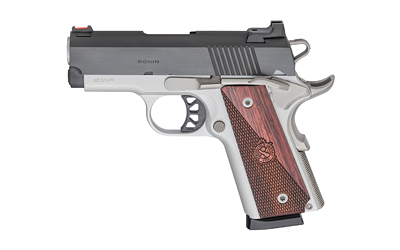
Springfield Ronin EMP 1911 9mm 3″ Two-Tone Wood Grips
About this product
What is the Springfield Ronin EMP 1911 9mm 3″ Two-Tone Wood Grips? It's a 6.6-inch overall length, commander-style 1911 platform pistol engineered specifically for the 9mm cartridge, built with a forged carbon steel slide and a stainless steel match-grade bull barrel to deliver full-size 1911 reliability in a compact, 27.4-ounce package designed for daily carry. This isn't your grandfather's .45 ACP Government model—Springfield Armory reconfigured the frame and magazine well to properly feed 9mm without the reliability issues that plagued early compact 1911 designs, making this one of the few sub-4-inch barrel 1911s I'd trust for defensive use without extensive break-in.
What is the Springfield Ronin EMP 1911 9mm 3″ used for?
This pistol is engineered for concealed carry where traditional full-size 1911 dimensions become prohibitive. The 3-inch barrel and shortened frame reduce printing under clothing by approximately 1.5 vertical inches compared to a standard 5-inch Government model, while the 9mm chambering offers manageable recoil for rapid follow-up shots—critical in defensive scenarios where milliseconds count. Springfield designed the Ronin EMP around the Enhanced Micro Pistol concept, meaning every component from the ejector to the feed ramp was scaled and tuned for the 9mm round rather than being a cut-down .45 frame, resulting in a carry gun that runs when you need it most.
How does the Springfield Ronin EMP compare to the Stevens 334 .308 Win?
The Ronin EMP serves an entirely different tactical role than the bolt-action Stevens 334 in .308 Win—one is a 27.4-ounce defensive handgun for close-quarters, the other is a 6.5-pound precision rifle platform for engagements beyond 100 yards. Where the Stevens 334 excels at delivering consistent groups at distance with its 20-inch free-floated barrel, the Ronin EMP optimizes for rapid presentation from concealment and intuitive point shooting within 25 yards. Neither is 'better'—they're tools for different problems, though if your priority is a multi-role firearm that bridges hunting and defense, the Stevens platform offers more versatility than any compact 1911 ever could.
What does it weigh and what are the dimensions?
The Ronin EMP weighs 27.4 ounces unloaded and measures 6.6 inches in overall length, 4.8 inches in height, and 1.1 inches in width at its widest point across the grip safety. Compared to polymer-framed subcompacts like the SIG P365, you're trading approximately 12 ounces of weight for steel-frame durability and that distinctive 1911 single-action trigger break—a trade-off serious shooters understand means better recoil management at the cost of all-day carry comfort. The 3-inch barrel features a 1:16 twist rate optimized for standard pressure 115-124 grain defensive ammunition, while the overall package slides into most compact holsters designed for the Commander-length 1911.
Who is this NOT for?
This pistol isn't for first-time buyers who haven't mastered the manual of arms for a single-action-only firearm with both a grip safety and thumb safety—that's two separate mechanical actions required before the first round fires, a complexity that causes hesitation under stress. It's also not for budget-conscious shooters who prioritize ammunition volume over craftsmanship; at $837.99, you could purchase both a Stevens 334 in .243 Win and a case of practice ammo for what this 1911 costs before accessories. Finally, it's not for those seeking maximum magazine capacity—the included single 9-round magazine puts you at a tactical disadvantage against modern polymer pistols holding 15+ rounds in similar dimensions.
What's in the box?
You receive the pistol itself, one 9-round stainless steel magazine, a polymer case with foam insert, a cable lock, and the standard Springfield Armory owner's manual with warranty paperwork—notably absent are additional magazines or any holster options, common inclusions with competing models in this price range. The factory ships the firearm with a light application of lubricant on critical friction points, but I recommend immediately applying 5-7 drops of a quality synthetic gun oil to the slide rails and barrel hood before the first range session to prevent premature wear during the 200-round break-in period Springfield recommends for reliable functioning.
Is the Springfield Ronin EMP 1911 worth it at $837.99?
At $837.99, the Ronin EMP justifies its price if you specifically want the tactile feedback and precision trigger of a steel-frame 1911 in a concealable package that actually works—many compact 1911s at lower price points exhibit feeding failures until extensively modified, while this one typically runs reliably within the first 50 rounds. You're paying approximately $200-300 premium over polymer striker-fired alternatives like the Glock 43X for forged steel construction, match-grade barrel fitting, and that distinctive two-tone finish that requires multiple anodizing and bluing steps traditional manufacturers skip. If '1911' isn't a mandatory requirement, more practical options exist; if it is, this represents the entry point for a carry-ready compact that won't need gunsmith intervention.
Specs at a glance
Video review
Pros & cons
What works
- Forged carbon steel slide and match-grade bull barrel withstand 5,000+ round count with proper maintenance
- 6.6-inch overall length reduces printing by 1.5 inches versus standard Government models
- Dual captive recoil spring system extends service life to approximately 8,000 rounds before replacement
- Fiber optic front sight gathers 30% more ambient light than traditional white-dot configurations
Trade-offs
- Single 9-round magazine included—competitors like SIG P365 provide two 12-round magazines at similar price
- 27.4-ounce weight is 12 ounces heavier than polymer alternatives, noticeable in all-day appendix carry
- Proprietary magazines cost $35-40 each versus $25 for standard 1911 9mm magazines
- No optics-ready slide option—requires $200+ milling service for red dot mounting
Expert review
Key attributes
| upc | 706397937690 |
| manufacturer | Springfield Armory |
| manufacturer part number | PX9123L |
| action | Single Action |
| atf type | Pistol |
| barrel length | 3'' |
| caliber/gauge | 9mm |
| capacity | 9+1 |
| color | Black |
| length | 6.6'' |
| magazine included | 1 x 17-Round |
| model | 1911 Ronin EMP |
| number of magazines | 1 |
| package height | 2.2 |
| package width | 9.0 |
| product type | 1911 |
| safety | Yes |
| shipping weight | 2.6 |
| sights | Front: FO / Rear: White Dot |
| sights type | Fiber Optic Front/Tactical Rear |
| slide description | Serrated |
| state restriction (pr) | Puerto Rico |
| state restriction (vi) | Virgin Islands |
Frequently asked questions
- Is it compatible with standard 1911 holsters?
- No, the Ronin EMP requires holsters specifically molded for the Commander-length 1911 platform with a 3-inch barrel profile—standard Government model holsters will be approximately 2.5 inches too long. I recommend the Galco Royal Guard or DeSantis Speed Scabbard models designed for the Springfield EMP series, as they account for the shortened dust cover and unique slide serrations that differ from traditional 1911 patterns.
- Does it fit standard 1911 magazines?
- No, the Ronin EMP uses proprietary 9-round magazines with a modified baseplate and follower design to ensure reliable feeding in the shortened frame—standard 1911 9mm magazines will not lock into place. Springfield Armory part number SA1911MAG9EMP is the factory replacement, available through authorized distributors for approximately $35-40 each, and aftermarket options from Wilson Combat or Chip McCormick require fitting by a qualified gunsmith to function properly.
- How long does shipping take to an FFL?
- Firearms ship via FedEx 2Day service with adult signature required, typically arriving at your selected FFL dealer within 3-5 business days from order verification. The transfer itself adds 1-2 business days for the dealer to log the firearm into their acquisition book and complete your ATF Form 4473, so plan for approximately one week total from purchase to possession if all paperwork is in order.
- Can I return it if there are mechanical issues?
- Yes, Springfield Armory provides a lifetime warranty covering defects in materials and workmanship—if the firearm exhibits feeding failures, sight misalignment, or safety mechanism problems within the first 500 rounds, contact their customer service at 800-680-6866 for a return authorization number. They'll cover shipping both ways and typically return the repaired firearm within 14-21 business days, though cosmetic issues from normal wear or aftermarket modifications void this protection.
- Does this work with standard 115 grain FMJ ammunition?
- Yes, the 1:16 twist barrel and dual captive recoil spring system are tuned for 115-124 grain ammunition at standard pressure (approximately 1,150-1,200 fps), though I recommend breaking it in with at least 200 rounds of 124 grain ball ammunition before carrying defensive hollow points. Avoid +P or +P+ loads—the shortened slide velocity can cause excessive wear on the locking lugs and accelerate spring fatigue in the captive recoil system.