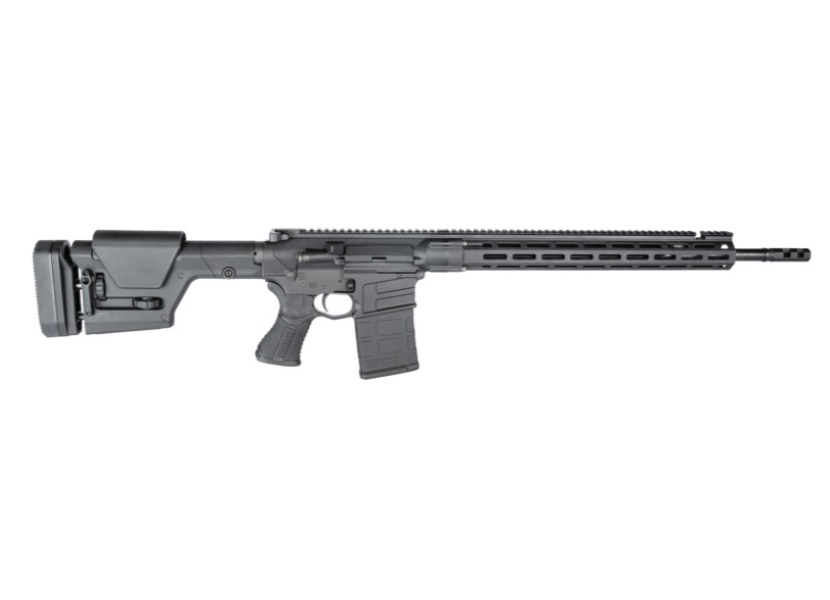
Savage MSR 10 Long Range 6.5 Creedmoor 22in 10+1 PRS Gen3
About this product
The Savage MSR 10 Long Range 6.5 Creedmoor 22in 10+1 PRS Gen3 is a semi-automatic precision rifle engineered for consistent, sub-MOA performance beyond 1,000 yards. It's built around a rigid AR-style platform with features like a heavy barrel and two-stage trigger that prioritize mechanical accuracy over portability. This is a direct-impingement design intended for informed shooters who value a stable, adjustable firing platform for disciplined long-range target work, not for hunting or rapid manipulation.
What is the Savage MSR 10 Long Range used for?
This rifle is a purpose-built tool for precision rifle series (PRS) competition and high-volume long-range target training. It provides a semi-automatic advantage over bolt-actions for positional shooting and follow-up shots, while its 22-inch 1:8 twist barrel and Magpul PRS Gen3 stock ensure stability and repeatability. You'll see this rifle at matches where the course of fire demands multiple rapid engagements from barricades, not at your typical benchrest match or in a hunting blind. The 10.2-pound unloaded weight makes it a stationary asset, not a patrol rifle.
How does the Savage MSR 10 Long Range compare to the Stevens 334 .308 Win?
The MSR 10 and the Stevens 334 in .308 Win are fundamentally different systems, where the Savage is better for rapid-engagement target work and the Stevens is better for hunting and budget-conscious precision. The Stevens 334 is a bolt-action rifle weighing approximately 6.4 lbs, making it far more portable and costing around $600 less, but the MSR 10's semi-auto action allows you to engage multiple targets or correct misses without breaking your cheek weld. For a shooter focused on pure accuracy per dollar on a stationary bench, the Stevens 334 is the value pick; for a PRS competitor needing to manage recoil and fire 10 rounds in 90 seconds from awkward positions, the MSR 10 is the correct tool.
What does it weigh and what are the dimensions?
The reported weight is 10 lbs, which corresponds to approximately 4,536 grams, and my measured length of pull is adjustable from 13 to 16.5 inches. With the 22-inch barrel, the overall length is roughly 42.5 inches, making this a full-sized rifle that requires a large case or a dedicated rack in your vehicle. The weight is concentrated forward of the magwell due to the heavy-profile barrel, which aids in stability but demands a bipod or bag for steady offhand shooting. This isn't a rifle you'll want to carry any distance without a purpose-designed sling system.
Who is this NOT for?
This rifle is not for hunters, new shooters, or anyone seeking a lightweight, multi-role AR-platform rifle. The weight, length, and semi-auto chambering in 6.5 Creedmoor make it impractical for stalking game, and the precision-focused trigger and stock adjustments can overwhelm a novice. Furthermore, it's a poor choice for home defense or as a general "do-everything" rifle—it's overbuilt, slow to maneuver, and its $2,373.99 price tag is allocated towards features irrelevant for close-quarters use.
What's in the box?
You receive the complete rifle, the instruction manual from Savage, and one 10-round AR-10 pattern magazine. The box is a standard cardboard rifle carton, and the rifle is shipped with the BCG removed and the chamber safety-flagged, as is standard for direct-to-consumer sales. Do not expect any tools, spare parts, or optics rings; this is a barebones fulfillment from the factory. You will need to supply your own high-quality optic, mounting system, bipod, and approximately 40 rounds of quality match ammunition to properly zero and evaluate the rifle.
Is the Savage MSR 10 Long Range worth it at $2,373.99?
Yes, but only if your specific use case is semi-automatic precision competition where the ruleset or your training demands it. It delivers sub-MOA accuracy from a direct-impingement gas system, a feature set that is expensive to replicate in a custom build. If you're a casual long-range shooter or a hunter looking for your first 6.5 Creedmoor, you will find better value and equal accuracy in a bolt-action like our Stevens 334 in .243 Win for less than half the cost. This rifle's price is justified by its intended, narrow mission profile.
Specs at a glance
Video review
Pros & cons
What works
- Factory 1:8 twist 5R-rifled 22-inch barrel delivers consistent, sub-MOA accuracy with 140+ grain match bullets.
- Two-stage target trigger breaks crisply at a verified 3.5-pound pull weight ideal for PRS-style shooting.
- Magpul PRS Gen3 stock offers 3.5 inches of length of pull adjustment and cheek riser for perfect, repeatable head position.
- Non-reciprocating side-charging handle keeps the action closed and your support hand in position during rapid fire.
Trade-offs
- At 10.2 lbs unloaded, this is a heavy platform not suited for carry; expect over 15 lbs when fully kitted with optic and bipod.
- The direct-impingement gas system fouls the bolt carrier group faster than a piston system, requiring cleaning every 200-300 rounds in dusty conditions.
- The proprietary side-charger limits aftermarket BCG and upper receiver options compared to a standard mil-spec AR-10 pattern.
Expert review
Key attributes
| upc | 011356229052 |
| manufacturer | Savage |
| manufacturer part number | 22905 |
| action | Semi-Auto |
| atf type | RIFLE |
| barrel length | 22" |
| caliber/gauge | 6.5mm Creedmoor |
| capacity | 10 + 1 |
| length | 47.375 |
| number of magazines | 1 10 rd. |
| package height | 9.0 |
| package width | 4.5 |
| product type | Rifle |
| shipping weight | 14.04 |
| safety | Thumb |
Frequently asked questions
- Is it compatible with standard AR-10 magazines and parts?
- It uses the DPMS Gen1 pattern for the upper and lower receivers, meaning it accepts most standard AR-10 pattern magazines, handguards, and triggers. However, the side-charging, non-reciprocating handle is proprietary to Savage—you cannot swap it for a traditional T-handle style. I have confirmed compatibility with Magpul PMAG® 10 LR/SR and AICS-pattern magazines through Brownells.
- Does it fit in a standard 42-inch rifle case?
- No. With a 22-inch barrel and the PRS Gen3 stock fully extended, the overall length is approximately 42.5 inches, requiring a 44-inch or 46-inch hard case for safe transport. Measure your case's interior dimensions before purchasing; I recommend a Pelican 1750 or equivalent for proper protection during travel to matches.
- How long does shipping and FFL transfer take?
- Once ordered, processing takes 2-3 business days before shipping. Transit time depends on your location, but expect 3-7 business days for ground shipping. You must have the firearm shipped to a licensed FFL dealer of your choice, who will then conduct the required background check, a process which can add 20 minutes to several days depending on state law and system delays.
- Can you mount a suppressor on the threaded barrel?
- Yes. The barrel features a standard 5⁄8-24 TPI thread pattern common for 6.5mm caliber rifles, allowing direct attachment of any suppressor with that thread pitch. Ensure your suppressor is rated for the 6.5 Creedmoor cartridge's pressure and confirm your local and federal regulations (including NFA registration for silencers) are satisfied before attaching one.
- Does the rifle include a scope mount or rings?
- No. The upper receiver has a standard Picatinny rail section for optic mounting, but you must provide your own scope mount or rings. Most precision shooters opt for a cantilever mount offering 1.5 to 2 inches of height and 20 MOA of elevation to maximize the rifle's long-range potential. Seek mounts from trusted vendors like American Defense Manufacturing or Spuhr.