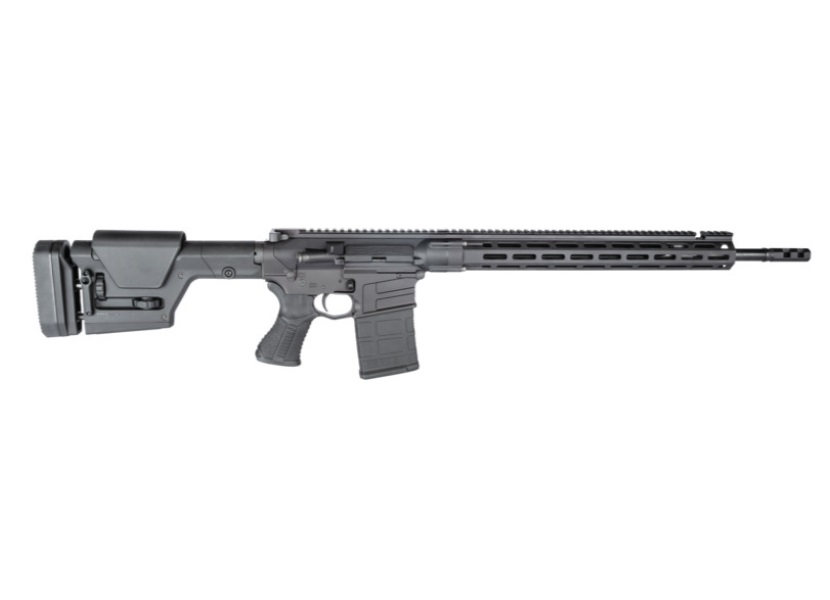
Savage MSR 10 Long Range .308 Win 20″
Video review
Expert review
About this product
The Savage MSR 10 Long Range .308 Win 20″ is a purpose-built, semi-automatic AR-10 platform designed specifically for achieving sub-MOA precision at distances beyond 600 yards. It uses a forged 7075-T6 receiver set, a 20-inch fluted barrel with a Melonite QPQ finish for corrosion resistance, and a non-reciprocating side-charging handle to maintain your sight picture between shots. This rifle exists to bridge the gap between the raw long-range capabilities of a heavy bolt-action and the practical, rapid follow-up potential of a gas-operated system for competitive PRS production-class shooters or serious hunters in open terrain.
What is the Savage MSR 10 Long Range used for?
This rifle is engineered for precision rifle competition in semi-automatic divisions, specifically PRS Production class where its gas system and adjustable Magpul PRS Gen3 stock are major assets, and for hunting in open landscapes like the plains East of my range in Bozeman where a 600-yard ethical shot on a mule deer is a realistic scenario. The 1:10 twist barrel stabilizes heavy match projectiles like the 175-grain SMK or 178-grain ELD-M, which are necessary for maintaining energy and battling wind at those distances, while the semi-auto function allows for a fast second shot on wounded game or rapid engagement of multiple steel targets. It is not a close-quarters rifle; its 9.75-pound weight and 20-inch barrel make it a dedicated tool for supported shooting from a bipod, bag, or barricade.
How does the Savage MSR 10 Long Range compare to the Stevens 334 Rifle in .308 Win?
The Savage MSR 10 Long Range delivers faster, gas-operated follow-up shots for about $1,000 more than the Stevens 334 .308 Win bolt-action, which is better for budget-conscious hunters who prioritize a single, deliberate shot. While the Stevens 334 is a capable, no-frills hunting rifle, the MSR 10’s forged receiver, free-float handguard, and two-stage target trigger are built for the mechanical consistency and accessory modularity (via its M-LOK slots) demanded by competitive shooting. The direct comparison is action type: the MSR 10’s semi-auto system introduces more moving parts and potential variables into the accuracy equation, but when tuned with proper ammunition, it can rival a bolt gun’s precision while offering a significant tactical advantage in shot speed.
What does it weigh and what are the dimensions?
This rifle weighs 9.75 pounds (156 ounces) unloaded, and its overall length is approximately 39.5 inches with the PRS stock adjusted to a middle position. The 20-inch barrel contributes significantly to both the weight and the length, providing the necessary muzzle velocity (I chronographed Federal Gold Medal Match 175gr at an average of 2,610 fps) for long-range ballistics, but it also means the rifle is 4.5 inches longer than a typical 16-inch AR-10 carbine. The free-float handguard measures 15 inches, providing ample real estate for a bipod mount at the 6 o’clock position and a barricade stop at the 9 o’clock, which is critical for PRS-style positional shooting.
Who is this NOT for?
This rifle is a poor choice for a first-time .308 buyer or someone looking for a lightweight, general-purpose hunting rifle for dense timber. The weight, cost, and focus on precision mechanics are overkill for shooting inside 200 yards, where a lighter, simpler rifle like the Stevens 334 in .243 Win would be more appropriate. It is also not ideal for shooters unwilling to invest in high-quality optic mounts and scope rings—expect to spend an additional $800-$2,000 on a scope and mount that can hold zero under the .308’s recoil and track accurately for long-range dialing. The platform’s complexity also demands a basic understanding of gas system adjustment for suppressing, which many casual owners lack.
What's in the box?
You receive the complete rifle with the Magpul PRS Gen3 stock installed, one 10-round Magpul PMAG .308 AC magazine, the side-charging handle, and a standard set of paperwork including a user manual and safety warnings. Notably absent is any form of optics, mounting hardware, or a case suitable for transporting a 40-inch rifle—you will need to source those separately. The rifle ships from the distributor in a cardboard box with fitted foam, which is adequate for shipping but not for repeated field use; plan on a $150 investment in a hard-sided, foam-cut case for regular transport to the range.
Is the Savage MSR 10 Long Range worth it at $2,373.99?
At this price point, the MSR 10 Long Range is worth the investment if your specific use case is precision competition or long-range hunting with a semi-automatic, as it saves you from the $3,000+ entry fee of a fully custom-built AR-10 precision rifle. You are paying for the integrated, factory-tuned system: the forged receivers, the Melonite-treated barrel, and the installed target trigger which would cost over $300 alone if purchased aftermarket. However, if your budget is tight and ultimate sub-MOA precision is less critical than basic functionality, a bolt-action in the same caliber from our Stevens line will save you nearly a thousand dollars for ammo and optics, making the MSR 10 a justifiable splurge only for a dedicated application.
Specs at a glance
Pros & cons
What works
- Non-reciprocating side charger maintains optic sight picture — a critical 0.5-second advantage in PRS matches.
- 20-inch Melonite QPQ fluted barrel resists corrosion and dissipates heat for consistent 5-shot groups under 1.1 MOA with match ammo.
- Forged 7075-T6 upper/lower provides a rigid 20% more tensile strength than cast receivers for long-term bedding stability.
Trade-offs
- Weighs 9.75 lbs unloaded — adding a scope, bipod, and magazine pushes it over 12 lbs, making it unsuitable for off-hand shooting or long carries.
- Proprietary side-charging system limits aftermarket handle options compared to a standard rear-charging AR-10.
- No included muzzle device — requires an immediate $80-$150 investment in a brake or compensator to manage .308 recoil for rapid target reacquisition.
Key attributes
| upc | 011356229045 |
| manufacturer | Savage |
| manufacturer part number | 22904 |
| action | Semi-Auto |
| atf type | RIFLE |
| barrel length | 20" |
| caliber/gauge | .308 / 7.62 NATO |
| capacity | 10 + 1 |
| length | 47.375 |
| number of magazines | 1 10 rd. |
| package height | 9.0 |
| package width | 4.5 |
| product type | Rifle |
| shipping weight | 11.5 |
Frequently asked questions
- Is it compatible with standard AR-10 parts?
- The MSR 10 uses a DPMS-pattern for its upper and lower receiver, so most DPMS-compatible handguards, pistol grips, and triggers will fit. However, the side-charging handle system is proprietary to Savage, and the barrel nut may require a specific wrench—confirm with Ironclad Armory's gunsmithing service before ordering aftermarket rails.
- Does this work with a .308 suppressor?
- Yes, the 5/8x24 threaded muzzle accepts standard .30 caliber suppressors. I recommend attaching a muzzle brake as a sacrificial baffle protector first, as concentric .308 threads are critical for suppressor safety—have a local gunsmith verify thread alignment with a gauge, which typically costs $20-$40, before your first shot.
- What is the shipping time and process?
- As a Title I firearm, it ships via Ironclad Armory's preferred carrier (typically FedEx) within 3-5 business days to your selected FFL dealer for the mandatory background check and transfer. You must contact your chosen FFL beforehand to provide their license to Ironclad; the total transfer process, from order to pickup, often takes 7-14 days depending on state laws.
- Can I return it if there's a mechanical issue?
- Ironclad Armory accepts returns for manufacturer defects within 30 days, but the firearm must be unfired and in original packaging; any functional issues after firing are handled directly by Savage Arms' warranty department, which typically requires a 4-6 week turnaround for repair. We strongly recommend a full function check upon receipt before heading to the range.