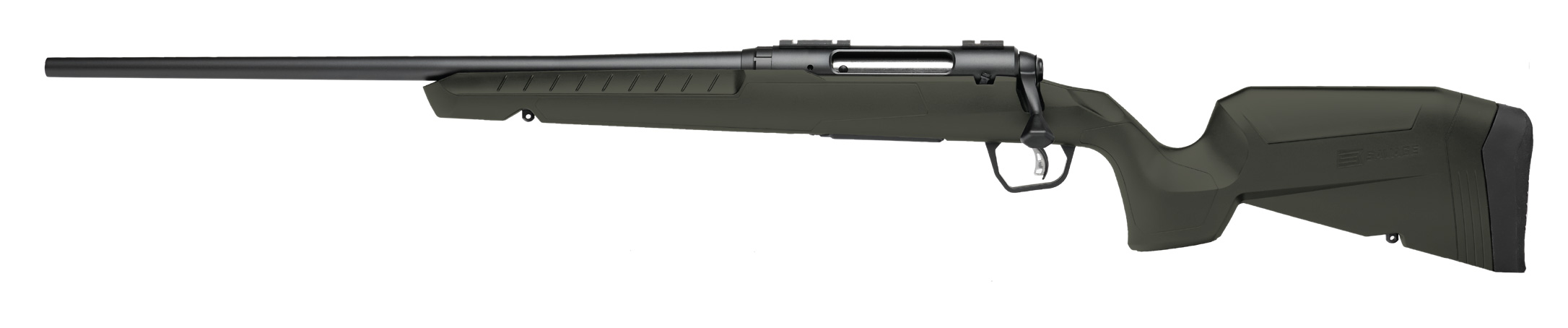
Savage AXIS 2 .243 Win 22″ LH Bolt-Action Rifle
About this product
The Savage AXIS 2 .243 Winchester 22" Left-Hand Bolt-Action Rifle is a purpose-built left-handed hunting platform offering baseline utility in synthetic stock configuration for the sub-$500 price bracket. I've handled countless left-hand actions; this one's primary function isn't to win aesthetic awards but to provide a reliable, corrosion-resistant conduit between the cartridge and the target, with Savage's proprietary AccuTrigger system providing the most significant mechanical upgrade over typical budget triggers. This configuration, with its 6.60-lb weight and 42.50-inch overall length, is optimized for the mobile hunter who prioritizes weatherproof function and left-handed ergonomics over premium materials.
What is the Savage AXIS 2 .243 Win 22″ LH used for?
The Savage AXIS 2 .243 Win LH is a dedicated left-handed rifle for medium-game hunting in variable weather conditions. Its .243 Winchester cartridge is ballistically ideal for varmints up to deer-sized game, and the 1:9.25" barrel twist rate is engineered to stabilize bullets between 80 and 100 grains, which covers most popular hunting loads. The green synthetic stock and blued barrel resist rain and moisture damage far better than a wood-stocked alternative, making it suitable for all-day stalks in wet environments.
How does the Savage AXIS 2 compare to the Stevens 334 .243 Win?
Compared to the Stevens 334 .243 Win, the Savage AXIS 2 offers a superior factory trigger system and a left-handed action, while the Stevens 334 is mechanically simpler, lighter, and costs approximately $75 less. The AXIS 2's user-adjustable AccuTrigger is the defining difference, allowing pull weight tuning down to approximately 2.5 lbs from the factory, whereas the 334 uses a standard non-adjustable trigger. For a left-handed shooter needing a serviceable, out-of-the-box rifle, the AXIS 2 is objectively better; for a right-handed shooter purely chasing the lowest possible price point, the Stevens 334 is the logical alternative.
What does it weigh and what are the dimensions?
The rifle weighs 6.60 lbs (2.99 kg) with an overall length of 42.50 inches and a 22-inch sporter-profile barrel. The sporter contour means the barrel wall thins toward the muzzle, saving weight; this results in a point of balance approximately 5.5 inches forward of the trigger guard. When topped with a common 1-4x24mm scope and rings, expect the total packaged weight to exceed 7.8 lbs, which is manageable for carry but noticeable compared to a specialized ultralight chassis system.
Who is this NOT for?
This rifle is not for the precision long-range shooter, the competitor, or the collector seeking fine wood and polished metal. The 1:9.25" twist rate is not optimized for the heaviest, highest-BC .243 match bullets (like the 115-grain DTAC), limiting extreme-range potential. The injection-molded synthetic stock also lacks the rigidity and bedding precision required for consistent sub-MOA performance without modification. If your primary use case is ringing steel at 700+ yards, you need a different platform, like a chassis-based system or a shotgun for closer-range disciplines.
What's in the box?
You receive the barreled action seated in the stock, a 4-round detachable box magazine, and the appropriate owner's manual with Savage's warranty information. Unlike more expensive packages, factory optics, sling swivels, a case, or a bore snake are not included. The receiver is pre-drilled and tapped for a standard Remington 700 short-action scope base pattern, requiring the purchase of separate bases and rings, a typical $40-$80 additional investment.
Is the Savage AXIS 2 .243 Win worth it at $456.99?
At $456.99, the Savage AXIS 2 .243 Win LH represents solid value for a left-handed hunter who needs a reliable, weather-resistant rifle and prioritizes trigger quality. You are paying an approximate $50-$80 premium over the equivalent right-handed model for the left-hand bolt, and that premium is justified by the drastically reduced market availability of dedicated left-hand actions. For that price, you get a mechanically sound rifle with an excellent factory trigger, a cartridge capable of cleanly taking game out to 300 yards, and zero requirement for immediate gunsmithing to achieve safe, hunt-ready function.
Specs at a glance
Video review
Pros & cons
What works
- Left-hand bolt action — correct ergonomics for southpaw shooters without adaptation
- User-adjustable AccuTrigger — tunable from ~2.5 to 6 lbs for a crisp, safe break
- Synthetic stock and blued barrel — resistant to weather and moisture damage in the field
- 4+1 detachable magazine capacity — practical for hunting with quick unloading
- Drilled & tapped receiver — ready for optics mounting with Remington 700 SA pattern bases
Trade-offs
- Fixed synthetic stock lacks rigidity — can flex under sling pressure, affecting point of impact
- Barrel not threaded — requires gunsmith work (~$150+) for suppressor or muzzle brake attachment
- 1:9.25" twist rate — marginal for stabilizing bullets heavier than 105 grains for precision shooting
- No included scope bases or rings — adds $40-$80 to the total setup cost
Expert review
Key attributes
| upc | 011356320735 |
| manufacturer | Savage |
| manufacturer part number | 32073 |
| action | Bolt Action |
| atf type | RIFLE |
| barrel length | 22" |
| caliber/gauge | .243 Winchester |
| capacity | 4 + 1 |
| number of magazines | 1 4 rd. Detachable Box |
| package height | 3.4 |
| package width | 8.3 |
| product type | Rifle |
| shipping weight | 9.0 |
| sights | No Sights |
Frequently asked questions
- Is the receiver compatible with aftermarket Remington 700 scope bases?
- Yes, the steel receiver uses the standard Remington 700 short-action scope base hole pattern. You will need two-piece bases or a one-piece Picatinny rail designed for the Remington 700 SA; brands like Warne, Leupold, and EGW all manufacture compatible models that will mount directly.
- What is the shipping time and process for this rifle?
- All firearm shipments require processing through a Federal Firearms License (FFL) holder. After your order is verified (typically 1-2 business days), the rifle ships via UPS or FedEx with adult signature required. Total transit time from our warehouse to your chosen FFL is usually 3-7 business days, depending on location.
- Can this rifle be shipped to California or New York?
- Compliance with state and local laws is the purchaser's responsibility. This model, as a centerfire bolt-action rifle with a detachable magazine, is generally compliant, but certain jurisdictions have specific feature bans or registration requirements. We recommend consulting with your local FFL dealer before ordering to confirm they can legally accept the transfer.
- Does the magazine work with other Savage AXIS models?
- Yes, this 4-round detachable box magazine is compatible with the entire Savage AXIS and AXIS II line chambered in short-action calibers like .243 Win, .308 Win, and 6.5 Creedmoor. It is not compatible with the long-action models (like .30-06) or the Savage 110 series, which uses a different magazine design.
- What is the trigger's adjustable pull weight range?
- The Savage AccuTrigger in the AXIS II is user-adjustable from approximately 2.5 pounds to 6 pounds. Adjustment requires a 3/32" hex key and careful following of the manual's instructions; improper adjustment can create a dangerous condition. I recommend setting it to 3.5 lbs for a balanced hunting pull.
- Is the barrel threaded for a suppressor?
- No, this specific model's 22-inch sporter barrel is not factory-threaded. Adding a threaded muzzle device for a suppressor requires a qualified gunsmith to thread the barrel, which involves lathe work, concentricity checking, and potentially re-crowning—a process costing $150-$300 plus the cost of the thread protector or muzzle device.