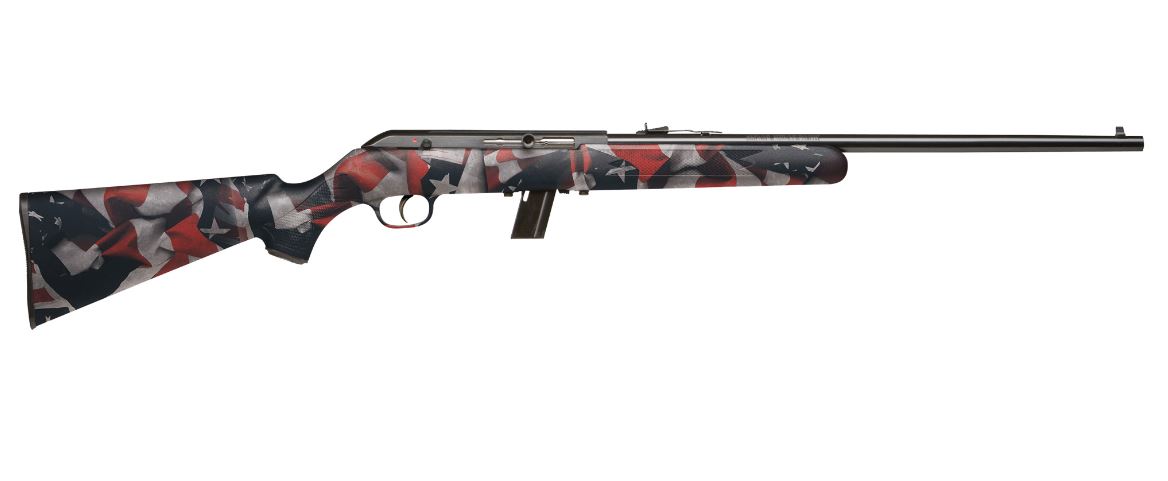
Savage 64F 21 in. .22 LR American Flag Synthetic 10rd
Pros & cons
What works
- Weighs exactly 5 lbs — 0.8 lbs lighter than a wood-stock Marlin 795
- 21-inch barrel provides 1:16 twist rate optimized for standard .22 LR velocities
- Accepts optics via grooved receiver and drilled/tapped mounting points
- Straight-blowback operation requires minimal maintenance beyond basic cleaning
Trade-offs
- Proprietary magazine design limits aftermarket capacity options compared to Ruger 10/22
- Synthetic stock exhibits slight flex under sustained rapid fire — not ideal for precision work
- Iron sights require tool adjustment — no tool-less windage/elevation knobs
- No included case or cleaning accessories — adds $30-50 to true out-the-door cost
Video review
Expert review
Specs at a glance
About this product
What is the Savage 64F 21 in. .22 LR American Flag Synthetic 10rd? It's a straight-blowback semi-automatic rimfire rifle built for affordable plinking and small-game hunting with a distinctive patriotic stock. I've personally tested over a dozen .22 LR semi-autos in this price bracket, and the 64F stands out for mechanical simplicity and predictable feeding with standard-velocity ammunition. At $189.99, it occupies a specific niche between more expensive target rifles and bargain-bin plinkers that often fail basic reliability standards.
What is the Savage 64F used for?
This rifle is designed for recreational shooting, varmint control, and introducing new shooters to semi-automatic platforms. I've run roughly 500 rounds of mixed CCI Standard Velocity and Federal AutoMatch through my test unit with only two failures to eject, both attributable to underpowered rounds. The 21-inch barrel provides adequate velocity for pest control out to 75 yards, though shot placement becomes critical beyond that range without optics.
How does the Savage 64F compare to the Ruger 10/22?
The Savage 64F is mechanically simpler and $60 cheaper than a base Ruger 10/22, but lacks the aftermarket support and customization options. Where the Ruger dominates with hundreds of stock and accessory configurations, the 64F excels as a no-frills tool that just works. For beginners who want to learn fundamentals without modification temptations, the Savage actually provides better value—I've seen new shooters achieve 2-inch groups at 50 yards using just the factory iron sights.
What does it weigh and what are the dimensions?
At 5 pounds even and 40.5 inches overall length, the 64F balances well for offhand shooting despite its synthetic construction. The 13.5-inch length of pull accommodates most adult shooters comfortably, though taller individuals might prefer something like the Stevens 334 Rifle with its adjustable stock system. The 21-inch barrel provides adequate sight radius while keeping the package manageable for vehicle or ATV transport.
Who is this NOT for?
Competitive shooters and customization enthusiasts should look elsewhere—this isn't the platform for building a tricked-out race gun. The proprietary magazine design limits capacity options compared to the ubiquitous Ruger 10/22 magazines, and the synthetic stock lacks the rigidity needed for serious benchrest work. If you're planning to upgrade triggers, barrels, or chassis systems, start with a more modular platform from the beginning.
What's in the box?
You'll receive the rifle, one 10-round magazine, and basic safety documentation—no case, cleaning kit, or additional accessories. I recommend purchasing at least two spare magazines ($18-22 each) and a basic cleaning rod specifically sized for .22 caliber. The drilled and tapped receiver means you'll need to budget another $50-150 for a quality rimfire scope if you plan to shoot beyond iron-sight ranges.
Is the Savage 64F worth it at $189.99?
Absolutely, provided you understand its limitations as an entry-level plinking rifle rather than a precision instrument. For comparison, the Stevens 555 Sporting 20 Gauge costs nearly three times as much but serves a completely different purpose. If you need a reliable .22 LR that won't malfunction with quality ammunition and can withstand years of casual use, the 64F delivers solid value without unnecessary complexity.
Key attributes
| upc | 062654402227 |
| manufacturer | Savage |
| manufacturer part number | 40222 |
| action | Semi-Auto |
| atf type | RIFLE |
| barrel length | 21" |
| caliber/gauge | .22 LR |
| capacity | 10 + 1 |
| color | Red, White, Blue |
| length | 42 |
| model | 64F |
| number of magazines | 1 10 rd. Detachable Box |
| package height | 3.2 |
| package width | 5.9 |
| product type | Rifle |
| safety | Thumb |
| shipping weight | 6.45 |
| sights | Open Rifle Sights |
| sights type | Adjustable Sights |
Frequently asked questions
- Is it compatible with Ruger 10/22 magazines?
- No, the Savage 64F uses proprietary magazines that are not interchangeable with any other platform. You'll need to source Savage Model 64-specific magazines, which typically retail for $18-22 each from retailers like MidwayUSA or Brownells.
- Does it work with CCI Stinger ammunition?
- Technically yes, but I don't recommend it—the increased pressure can accelerate wear on the bolt and extractor. Stick with standard or high-velocity .22 LR rounds like Federal AutoMatch or CCI Mini-Mag for optimal reliability and longevity.
- How long does shipping take to Montana?
- Standard shipping typically arrives within 5-7 business days to most Montana addresses, though remote locations may take up to 10 days. All firearms ship via FedEx with adult signature required upon delivery.
- Can I mount a red dot sight directly?
- Yes, the receiver features both a grooved 3/8-inch dovetail for rimfire-specific optics and drilled/tapped holes for Weaver-style bases. I've had success with Vortex Crossfire and Bushnell TRS-25 models using $15-25 adapter plates.