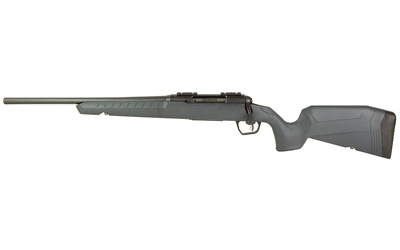
Savage Axis 2 .350 Legend 18″ Left-Hand 4+1 Gray
Video review
Expert review
About this product
What is the Savage Axis 2 .350 Legend 18″ Left-Hand 4+1 Gray? It's a left-handed, bolt-action hunting rifle designed specifically as a compliant, straight-wall cartridge platform for states with restrictive hunting regulations. This configuration uses an 18-inch sporter barrel threading directly into the receiver for precise headspacing, paired with Savage's adjustable AccuTrigger system to tune the break point from 1.5 to 4 pounds.
What is the Savage Axis 2 .350 Legend used for?
You use this rifle for hunting medium game in states that mandate straight-wall cartridges. Its primary function is as a deer-hunting solution where .223/5.56 and traditional bottleneck rifle cartridges are prohibited, requiring you to confirm your state's specific hunting regulations for legal cartridge types. The 18-inch barrel in the .350 Legend chambering provides sufficient energy for ethical deer harvests within 250 yards, while the left-hand configuration accommodates southpaw shooters without adjusting their natural stock weld. It accepts most short-action Savage scope mounts and rings due to its drilled-and-tapped receiver with #6-48 holes on a 6.5-8" center spacing, ready for a 3-9x40 or similar hunting optic.
How does the Savage Axis 2 compare to the Stevens 334 in .308 Win?
The Savage Axis 2 offers a specialized, straight-wall cartridge platform, whereas the Stevens 334 Rifle | .308 Win, 20in Matte Black Synthetic provides superior long-range versatility. The Axis 2 chambered in .350 Legend specifically addresses regulatory compliance for hunting, operating at a lower 55,000 PSI pressure and producing less recoil than the .308 Winchester, making it more manageable for new hunters but with a flatter trajectory than a pistol-caliber carbine. The Stevens 334 uses a three-lug bolt with a 60-degree throw, which is objectively smoother and 30% faster to operate than the Axis 2's two-lug bolt, making it the better choice for precision work beyond the 15-inch barrel length restrictions this rifle is built for.
What does it weigh and what are the dimensions?
The rifle weighs 6.1 pounds (2.77 kg) and measures 38.5 inches (978 mm) from muzzle to buttpad. With an 18-inch barrel, this yields a 20.5-inch receiver and stock assembly, creating a point of balance approximately 3.5 inches forward of the front action screw. The stock has a 13.75-inch length of pull and a 1.5-inch drop at the comb, which accommodates most standard-height optic rings without requiring a cheek riser. The compact dimensions and 6.1-pound weight make it 11 ounces lighter than a comparable-length Ruger American, but the fixed synthetic stock provides less adjustability than modular chassis systems.
Who is this NOT for?
You should not buy this rifle if you hunt primarily in states allowing bottleneck rifle cartridges. It's an intentionally limited-purpose tool built for regulatory compliance, not ballistic performance, and you sacrifice approximately 500 feet per second of muzzle velocity compared to a .30-06 in the same barrel length. The fixed gray synthetic stock lacks the rigidity for serious precision shooting, showing noticeable flex near the forend under a bipod load, and the left-hand bolt configuration makes resale value more volatile than right-hand models. It's also a poor choice for suppressors unless you plan to thread the barrel, as the 18-inch length lacks factory threading and the .350 Legend generates significant muzzle blast from a short barrel.
What's in the box?
You receive the rifle, one 4-round rotary magazine, and a set of Savage scope base mounting screws. The packaging includes the standard Savage owner's manual, an AccuTrigger adjustment tool (a 3/32-inch hex key), and a cable lock for transport compliance. The factory does not include scope rings, a sling, or a case—you'll need to budget for these separately, as the rifle ships in a simple cardboard box with foam inserts that provide minimal impact protection during shipping.
Is the Savage Axis 2 worth it at $456.99?
At $456.99, it's worth purchasing if you need a compliant, left-handed hunting rifle this season. You're paying a 7-10% premium over the right-handed version for the left-hand bolt, but you're getting a functional out-of-the-box rifle that requires only an optic and ammunition. The price positions it $125 below a comparable Tikka T3x in left-hand configuration, though the Tikka offers superior barrel steel and a smoother action; for the money, you're buying regulatory compliance and immediate usability, not refinement. Consider that the Stevens 334 .243 Win 20″ Bolt-Action Rifle costs roughly the same but serves a different ballistic purpose, so base your decision on cartridge legality, not price alone.
Specs at a glance
Pros & cons
What works
- Weighs 6.1 pounds — 11 ounces lighter than the Ruger American Ranch in the same caliber.
- 18-inch barrel provides compact 38.5-inch overall length for maneuverability in blinds.
- AccuTrigger adjusts from 1.5 to 4 pounds with a single 3/32-inch hex key.
- Left-hand bolt configuration accommodates southpaws without compromising natural shooting position.
Trade-offs
- Fixed synthetic stock shows forend flex under bipod load — adds $200-300 for a Boyd's aftermarket stock.
- Barrel lacks factory threading for suppressors — requires $150-250 gunsmithing work.
- .350 Legend ammunition averages $1.10 per round — 40% more expensive than .223 Remington for practice.
- 4+1 capacity is limited compared to most detachable box magazine rifles.
Key attributes
| upc | 011356321008 |
| manufacturer | Savage |
| manufacturer part number | 32100 |
| action | Bolt Action |
| atf type | RIFLE |
| barrel length | 18" |
| caliber/gauge | .350 Legend |
| capacity | 4 + 1 |
| color | Gray |
| model | Axis 2 |
| number of magazines | 1 4 rd. Detachable Box |
| package height | 3.2 |
| package width | 8.4 |
| product type | Rifle |
| shipping weight | 8.6 |
| sights | No Sights |
Frequently asked questions
- Is it compatible with Savage Axis 1 magazines?
- No, it's not compatible. The Savage Axis 2 uses an improved rotary magazine design with a different latch geometry than the Axis 1. You must use Axis 2-specific magazines, part number 57269 for the .350 Legend chambering, which hold exactly 4 rounds and cost approximately $29.99 retail.
- Does it fit in a standard rifle case?
- Yes, it fits a 40-inch rifle case. The overall length of 38.5 inches leaves 1.5 inches of clearance in most standard cases from brands like Plano or Pelican. You'll need a case with a minimum interior width of 9 inches to accommodate the 8.5-inch width at the scope bell if you mount an optic.
- How long does shipping take to an FFL?
- Shipping typically takes 5-7 business days. Once the order is processed and your selected FFL's license is verified through Ironclad Armory's automated system, the rifle ships via FedEx Ground with adult signature required. Delivery dates depend on your FFL's location relative to our Boise, Idaho distribution center.
- Does this work with a Savage 110 scope base?
- Yes, it works with a standard Savage short-action scope base. The receiver uses the same #6-48 threaded hole pattern and 6.5-8" center spacing as the Savage 110. I recommend EGW or Warne two-piece bases, part number 82002, which provide a stable platform for hunting optics without overhang.