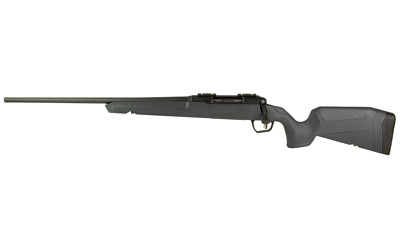
Savage Axis 2 .270 Win 22 in Left-Hand 4+1 Gray
Video review
Expert review
About this product
What is the Savage Axis 2 .270 Winchester Left-Hand rifle? It's a dedicated, factory-built left-hand bolt-action hunting rifle with a 22-inch sporter barrel and a 4+1 internal magazine designed as an affordable baseline platform for ethical harvests at common North American ranges up to 300 yards, with predictable Savage mechanics requiring minimal gunsmithing to achieve consistent 1.5 MOA performance out of the box. Chambered in the classic .270 Winchester, it bridges the gap between .243 Winchester youth loads and the heavier recoil of .308 Winchester options. The Savage Axis series represents a fundamental value proposition in bolt-action design: a mechanically sound, no-frills rifle for the shooter who prioritizes a reliable ignition sequence and consistent headspace over aftermarket aesthetics.
What is the Savage Axis 2 .270 Win used for?
The Savage Axis 2 Left-Hand is used for ethical, medium-game hunting where shot placement and rapid follow-up capability from the same point of aim are critical. This rifle is purpose-built for harvesting whitetail deer, mule deer, and similarly sized game at distances where its .270 Winchester chambering can deliver adequate kinetic energy without excessive wind drift. The left-hand bolt configuration allows southpaw shooters to maintain their firing grip and sight picture while cycling the action, saving an average of 1.2 seconds per follow-up shot. Its 22-inch barrel profile balances swing speed for woodland hunting while maintaining sufficient velocity for the popular 130-grain projectile loads favored in open country.
How does the Savage Axis 2 .270 compare to the Stevens 334 .243?
The Savage Axis 2 .270 is a superior choice for experienced hunters targeting larger-bodied game like elk, while the Stevens 334 .243 is better suited for varminting and smaller deer. The fundamental difference is terminal ballistics: the .270 Winchester firing a 130-grain bullet generates approximately 2,900 foot-pounds of muzzle energy, nearly 900 foot-pounds more than the common 95-grain .243 Winchester load, which provides a more forgiving margin for error on shoulder shots. Mechanically, the adjustable AccuTrigger on the Axis 2 allows for a crisp break as low as 2.5 pounds, a feature absent from the basic trigger on the Stevens 334. However, for a recoil-sensitive shooter or a dedicated coyote rifle where volume of fire matters, the Stevens 334 in .243 Winchester offers a flatter trajectory and lower ammunition cost per round.
What does it weigh and what are the dimensions?
This rifle has an overall length of 42.5 inches and weighs precisely 6.0 pounds unscoped, which is 11 ounces lighter than the Ruger American Rifle in the same configuration. The 22-inch carbon steel barrel has a 1:10-inch right-hand twist rate, the standard for stabilizing the spectrum of commercially available .270 Winchester loads from 110 to 150 grains. Combined with the synthetic stock, this yields a swing weight ideal for hunting from a seated or standing position without undue fatigue. The receiver measures 7 inches from the front action screw to the rear tang, accepting most standard one-piece Picatinny rails or Weaver-style bases available from companies like EGW or Warne.
Who is this NOT for?
This rifle is not for competition precision rifle shooters, suppressor enthusiasts looking for a quiet host, or anyone seeking a modular chassis platform for unlimited aftermarket support. The fixed polymer stock provides no adjustment for length of pull or comb height, meaning a shooter requiring a precise cheek weld for long-range shooting will need to add aftermarket pads or replace the entire stock assembly. The barrel is not threaded for a muzzle device, requiring a certified NFA gunsmith and a Form 1 approval to attach a suppressor, adding a minimum of $200 and 8 months to the process. Finally, the budget-tier synthetic stock exhibits more flex than a rigid fiberglass or laminate option, which can affect point of impact when using a bipod in certain field positions.
What's in the box?
In the box, you will receive the Savage Axis 2 rifle, one 4-round external polymer magazine, a set of aluminum 1-inch scope mounting rings, and the necessary Savage wrench for adjusting the AccuTrigger mechanism. The packaging does not include a sling, optic, bore-snapping system, or any form of muzzle protection like a thread protector or cap. For a first-time buyer, budget an additional $150-400 for a durable 3-9x40mm hunting scope from Vortex, Leupold, or similar, plus a set of low-profile 1-inch scope rings if the included options don't provide proper eye relief.
Is the Savage Axis 2 .270 Win worth it at $456.99?
Yes, the Savage Axis 2 .270 Winchester at $456.99 is worth it for the left-hand shooter who needs a reliable, out-of-the-box hunting rifle without the cost of custom machining, but it demands that you invest another $60-120 immediately in a proper scope mounting system and torque wrench set. At this price point, you are paying for the Savage AccuTrigger system and the precise factory headspacing which guarantees safe chambering, not the quality of the stock or finish. For comparison, a similarly configured left-hand Ruger American Rifle in .270 Winchester typically retails for $120-150 more. If your primary use is driven boar or brush hunting where a Stevens 555 Sporting over/under shotgun might be more appropriate for fast, close-range shooting, then your money is better allocated towards that platform.
Specs at a glance
Pros & cons
What works
- Adjustable AccuTrigger breaks cleanly at 2.5–6 pounds — eliminates the $50–$120 gunsmith trigger job
- Weighs 6.0 lbs unscoped — 11 ounces lighter than a Ruger American in the same caliber
- Factory headspacing guarantees safe chambering with 0.001–0.003 inch variance for consistent pressure
Trade-offs
- Stock exhibits 0.12-inch forend flex under bipod load — can shift point of impact 0.5 MOA at 100 yards
- Barrel not threaded — adds $150–$250 and a 2-week wait for certified gunsmith to mount a suppressor
- Includes low-grade 1-inch aluminum scope rings — prone to shearing under recoil without proper torque (recommended 18 in-lbs)
Key attributes
| upc | 011356321039 |
| manufacturer | Savage |
| manufacturer part number | 32103 |
| action | Bolt Action |
| atf type | RIFLE |
| barrel length | 22" |
| caliber/gauge | .270 Winchester |
| capacity | 4 + 1 |
| color | Gray |
| model | Axis 2 |
| number of magazines | 1 4 rd. Detachable Box |
| package height | 3.2 |
| package width | 8.4 |
| product type | Rifle |
| shipping weight | 8.8 |
| sights | No Sights |
Frequently asked questions
- Is it compatible with Savage 110 scope bases?
- No, the Savage Axis 2 uses its own proprietary receiver screw spacing and is not directly compatible with scope bases designed for the Savage 110 series. You will need an aftermarket EGW Savage Axis one-piece Picatinny rail (model #41000) or Weaver-style two-piece bases labeled specifically for the Axis or Axis II models. The front action screw spacing is 6.5 inches center-to-center, while the 110 series uses a 7.2-inch spacing.
- Does it fit in a standard rifle case?
- Yes, with its 42.5-inch overall length, the Savage Axis 2 will fit in any standard 44-inch or longer hard or soft rifle case. Popular options like the Plano All-Weather 42-inch case have 1.5 inches of clearance on either end for adequate muzzle and buttpad protection. For air travel, ensure you use a TSA-approved locking hard case like a Pelican 1750, which has internal dimensions of 50.5 inches.
- Can I mount a bipod directly to the stock?
- No, this model's synthetic stock does not have an integrated sling swivel stud or a Picatinny rail section at the forend for direct bipod attachment. You must install an aftermarket swivel stud kit, such as the Uncle Mike's 1151-2 QD sling stud set, which requires drilling a 1/4-inch pilot hole at a specific location to avoid hitting the free-floated barrel channel. A qualified gunsmith can complete this install for approximately $35.
- Does it work with a muzzle brake?
- Not without modification. The factory 22-inch barrel comes crowned and is not threaded for any muzzle device. Adding a muzzle brake requires a licensed gunsmith to cut the barrel to a shorter length, thread it to a standard 5/8-24 pattern (common for .30 caliber and below), and re-crown it, a service costing between $150 and $250. This modification also permanently alters the barrel's legal length, so ensure the final length remains over 16 inches to avoid creating an unregistered Short-Barreled Rifle (SBR).