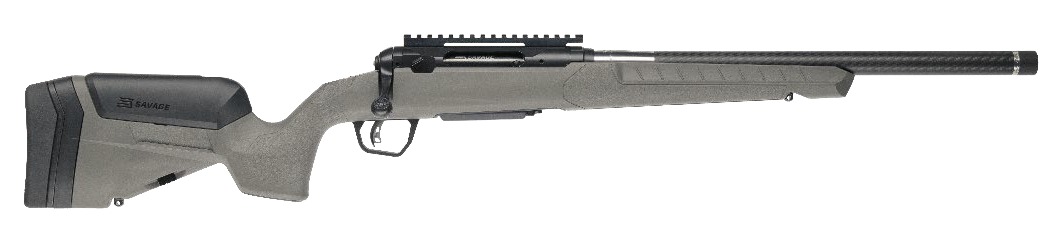
Savage 110 Carbon Hunter .300 Win Mag, 20″ RH
Pros & cons
What works
- Weighs ~6.8 lbs — over 1 lb lighter than a comparable all-steel-barreled hunting rifle.
- 20-inch carbon-wrapped barrel with 5/8-24 threads — ready for a suppressor without a gunsmith.
- AccuTrigger adjustable from 2.5 to 6 lbs — provides a clean, crisp pull for precision field shots.
- Full Cerakote finish on action — provides superior corrosion resistance compared to standard bluing.
Trade-offs
- .300 Win Mag from a 20-inch barrel — significant muzzle blast and flash unsuppressed, with a ~75 fps velocity loss.
- 3-round magazine capacity — one round less than many competitors' standard offerings for long-range hunting.
- Flat Dark Gray synthetic stock — while adjustable for LOP, has minimal texturing and a basic feel for a $1k rifle.
Video review
Expert review
Specs at a glance
About this product
The Savage 110 Carbon Hunter .300 Win Mag 20″ is a lightweight, suppressor-ready, bolt-action hunting rifle built around a corrosion-resistant, carbon-fiber-wrapped barrel. It represents Savage's effort to modernize their proven 110 platform with materials and features aimed at the serious hunter who values packable weight and straightforward field maintenance. The 20-inch barrel length in .300 Winchester Magnum specifically targets those who will pair it with a sound suppressor, creating a formidable but practical long-range package.
What is the Savage 110 Carbon Hunter used for?
This rifle is primarily used for long-range, precision hunting of large North American game from elk and moose to bear, especially in scenarios where extended hikes and weight management are critical. I consider it a dedicated mountain rifle, where its 1:10 twist barrel, threaded muzzle, and ability to handle heavy, high-BC .30-caliber projectiles are most valuable. The Flat Dark Gray synthetic stock and Cerakoted action provide adequate durability for adverse weather, but this is not a bench-rest rifle—it's a tool for making ethical, decisive shots in the field from 300 to 800 yards.
How does the Savage 110 Carbon Hunter compare to the Stevens 334?
The Carbon Hunter is a purpose-built, premium offering, while the Stevens 334 is a value-oriented, utilitarian rifle. The Carbon Hunter's carbon-wrapped barrel shaves over a pound off the total weight compared to the standard steel barrel on a Stevens 334, and it adds the crucial threaded muzzle and full Cerakote protection the 334 lacks. For the hunter who needs to save every ounce over 10 miles of elevation change, the Carbon Hunter is superior; for someone shooting from a blind or a truck most of the time, the Stevens 334 is the more sensible purchase. You can see the Stevens 334 in .308 here to understand the baseline.
What does it weigh and what are the dimensions?
Unscoped and without a magazine, this rifle weighs approximately 6.8 pounds, or 108.8 ounces. Its overall length with the 20-inch barrel is 40.5 inches, and it's 8.5 inches tall at the comb. The magazine well accepts Savage Axis-style detachable box magazines, contributing to the 3-round total capacity. This makes it notably handier than a rifle with a standard 24 or 26-inch barrel, but be aware that a 20-inch barrel in .300 Win Mag sacrifices roughly 75-100 fps of muzzle velocity versus a 24-inch tube.
Who is this NOT for?
This rifle is not for a first-time shooter, a budget-conscious plinker, or someone who dislikes recoil. The .300 Winchester Magnum cartridge generates significant recoil and muzzle blast, especially from this short 20-inch barrel, and the ammunition itself is expensive, frequently over $3.50 per round. It's also not ideal for a hunter who exclusively pursues whitetail deer at under 200 yards; a lighter-kicking cartridge in a standard rifle like a Stevens 334 in .243 Win would be more appropriate and cost-effective.
What's in the box?
You receive the rifle, one 3-round detachable steel box magazine, two keys for the AccuTrigger adjustment tool, and the Savage owner's manual with warranty card. The manual provides a guide for the 2.5-to-6-pound trigger pull weight adjustment range. The one-piece 0 MOA Picatinny rail is pre-mounted, but you'll need to supply your own scope, scope rings, and thread protector or muzzle device. Unlike some European rifles, Savage does not include a trigger lock.
Is the Savage 110 Carbon Hunter worth it at $1029.99?
Yes, if your specific use case justifies its specialized design. At this price point, you are paying a premium of nearly $400 over a base-model Stevens 334 for the carbon-wrapped barrel, threaded muzzle, and enhanced corrosion protection. For a hunter who will use a suppressor and needs to minimize carried weight, that premium is an operational necessity and a worthwhile investment. If you don't need those features, you are paying for capability you won't use, and a standard, all-steel rifle from Savage or another maker would be a better value.
Key attributes
| upc | 011356329547 |
| manufacturer | Savage |
| manufacturer part number | 32954 |
| action | Bolt Action |
| barrel length | 20" |
| caliber/gauge | .300 Winchester Magnum |
| capacity | 3 |
| color | TUNGSTEN |
| model | 110 |
| product type | Rifle |
Frequently asked questions
- Is the muzzle threaded for a suppressor?
- Yes, the 20-inch carbon fiber barrel features a standard 5/8-24 threaded muzzle. This is the common thread pitch for .30 caliber rifles, allowing direct attachment of many popular sound suppressors like those from SilencerCo, Dead Air, or Rugged. Always ensure your chosen suppressor is rated for the .300 Winchester Magnum cartridge.
- Does it accept aftermarket stocks?
- Yes, with a caveat. The action uses Savage's standard centerfeed 110 short action footprint, but with the 20-inch carbon barrel's unique contour, you must ensure any aftermarket chassis or stock has enough clearance in the forend. Most stocks designed for the Savage 110 Hunter or Trophy Hunter series will fit, but always confirm with the stock manufacturer, like Boyd's or Magpul, before purchasing.
- How long does shipping take?
- Shipping for firearms to your selected FFL dealer typically takes 3-5 business days for processing, packing, and carrier pickup from our warehouse. Once the carrier has it, ground transit is usually 3-7 additional business days depending on your location. You will be provided with a tracking number as soon as the carrier scans the package.
- Can I return it if there's a defect?
- Yes. We offer a 30-day inspection period from the date your FFL receives the firearm. If a manufacturing defect is found, you must contact Ironclad Armory customer support immediately to initiate a Return Merchandise Authorization (RMA). The firearm must be returned in its original condition and packaging, and all returns must ship through a licensed FFL holder in compliance with federal law.