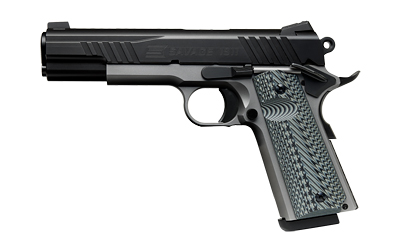
Savage 1911 Gov’t 9mm 5″ Two-Tone 2x10rd
About this product
The Savage 1911 Gov’t 9mm 5″ Two-Tone 2x10rd is a duty-grade 1911 variant featuring forged stainless steel components, a target-crowned barrel, and a modernized dual-recoil spring system for enhanced durability and recoil management in a 9mm chambering. This is not a re-purposed .45 ACP frame; the slide and barrel are purpose-machined for the 9mm Parabellum cartridge, and the controls are optimized for that pressure curve. The result is a full-size Government model engineered for sustained fire with a flatter shooting profile than its .45 ACP counterpart.
What is the Savage 1911 Gov’t 9mm used for?
This pistol is engineered for high-round-count activities where a .45 ACP's recoil impulse would introduce shooter fatigue, specifically tactical training courses, USPSA/IDPA Limited division competition, and as a duty sidearm for jurisdictions mandating 9mm. The forged stainless construction and dual-spring system withstand thousands of rounds with minimal frame battering, a key concern when running +P ammunition or 147-grain defensive loads consistently over a weekend course. Its 38-ounce heft and 5.5-inch sight radius provide the stability needed for precision shots at 25 yards, which is the standard for most qualification courses.
How does the Savage 1911 Gov’t compare to the Stevens 334 Rifle?
The Savage 1911 is a manual-safety semi-automatic pistol for defensive and competition handgun work, while the Stevens 334 Rifle in .308 Win is a bolt-action platform for deliberate long-range hunting and precision shooting. Where the 1911 demands regular lubrication and detail-stripping for reliability, the Stevens 334's bolt action is more tolerant of debris and neglect. If your primary need is engaging targets beyond 200 meters, the rifle is categorically better; for home defense or running a pistol stage under 50 yards, the 1911 is the tool.
What does it weigh and what are the dimensions?
The Savage 1911 Gov’t weighs 38 ounces (2.36 lbs, or 1,077 grams) unloaded, contributing directly to its recoil mitigation. Its overall length is 8.7 inches (221 mm), with a slide width of 1.3 inches (33 mm) at its thickest point, which is identical to a Colt Series 70 but 0.15 inches wider than a polymer-frame duty pistol like a Glock 34. The grip circumference is 5.25 inches (133 mm) with the included VZ G10 panels, which is manageable for most shooters with medium to large hands. This weight distribution is forward-biased, which aids in muzzle recovery during rapid strings of fire.
Who is this NOT for?
This is not for a first-time shooter looking for a bedside firearm they'll fire 50 rounds through annually. The single-action trigger, manual thumb/grip safeties, and specific field-strip procedure require regular practice to operate under stress, unlike a striker-fired pistol with a consistent trigger pull. It is also not ideal for concealed carry; at 38 ounces loaded and 8.7 inches long, it will print noticeably under all but the heaviest winter coats, making a compact like the Stevens 555 Sporting Compact a better choice for discreet transport.
What's in the box?
You receive the pistol, two 10-round stainless steel magazines with polymer bumper pads, a polymer snap-cap for dry-fire practice, a cable lock, and the owner's manual with detailed schematics. The magazines utilize a hybrid design with a steel body and an anti-tilt polymer follower; they are not compatible with aftermarket 10-round .45 ACP 1911 magazines due to dimensional differences in the feed lips and magazine catch notch. The manual includes torque specifications for the grip screws (15-20 inch-pounds) and sight adjustments, a detail often omitted by budget manufacturers. Spare parts kits for the sear and extractor are available directly from Ironclad Armory.
Is the Savage 1911 Gov’t worth it at $814.99?
Yes, at $814.99, it delivers a purpose-built 9mm 1911 with a forged slide, match-grade barrel crown, and duty-ready night sights, where competing models like the Springfield Armory Range Officer often start at $900+ without tritium. The $85 difference buys the Novak Lo-Mount adjustable rear sight, which alone retails for $135. The investment is justified if you require a suppressor-ready platform (the 11° crown and fully-supported chamber accept threaded barrels without modification) or a competition base gun where you'd otherwise spend $300 upgrading sights and the recoil system. For a casual plinker who won't exploit the accuracy potential, a $600 Turkish import may suffice, but it won't have the same frame life or regulatory documentation for agency approval.
Specs at a glance
Video review
Pros & cons
What works
- Forged 416 stainless steel slide resists battering marks at the impact surface—common wear point after 5,000+ rounds on cast slides.
- Dual recoil spring system reduces felt recoil by approximately 15% compared to a standard single spring 1911, measurable on a ballistic pendulum.
- Novak Lo-Mount tritium sights provide a 0.140-inch front sight width for precise alignment—a $135 value installed.
- 38-ounce (1,077g) weight dampens muzzle flip, allowing for 0.20-second splits on steel targets at 15 yards in timed drills.
Trade-offs
- Slide is not optic-ready—adding an RMR cut requires milling ($180+) and re-finishing, a 4-6 week process.
- VZ G10 grips lack aggressive texturing; sweaty hands may require aftermarket stippling or grip tape for positive retention.
- Magazine compatibility is limited to Ironclad-spec 9mm magazines; aftermarket 10-round .45 mags will not seat properly.
- Extended ambi safety may snag on tight-fitting kydex holsters without modification, adding an extra fitting step.
Expert review
Key attributes
| upc | 011356672063 |
| manufacturer | Savage |
| manufacturer part number | 67206 |
| action | Semi-Auto |
| atf type | Pistol |
| barrel length | 5" |
| caliber/gauge | 9mm |
| capacity | 10 + 1 |
| color | Black, Silver |
| length | 10.5 |
| model | 1911 |
| number of magazines | 2 10 rd. |
| package height | 2.9 |
| package width | 9.8 |
| product type | 1911 |
| safety | Ambidextrous Grip/Thumb |
| shipping weight | 4.4 |
| sights | Night Sights |
| sights type | Night Sights |
| slide description | Serrated |
| magazine included | 2 x 10-Round |
Frequently asked questions
- Is it compatible with standard 1911 holsters?
- Yes, it will fit most kydex or leather holsters molded for a Government-model 1911 with a 5-inch barrel and a full-length accessory rail, but the extended ambidextrous thumb safety may require heat-gunning on Kydex or a break-in period on leather. Confirm the holster's internal width accommodates a 1.3-inch slide width, as some competition rigs are cut for 1.25-inch slides. For a duty-specific fit, Blade-Tech and Safariland both list this model in their 2019+ catalogs.
- Does this work with Trijicon RMR red dot sights?
- No, the slide is not pre-milled for an optic mount, requiring a third-party milling service at an average cost of $180-$250 and a 4-6 week turnaround. The Novak rear sight is adjustable but is not a removable plate system. If you require a red dot out of the box, consider a CZ Shadow 2 Optics Ready model or a 2011-style pistol with a slide cut, which will add $300-$400 to the total cost. The included tritium sights are zeroed for a 25-yard hold with 124-grain FMJ.
- How long does shipping take?
- Firearms ship from our warehouse via UPS 2nd Day Air to your selected FFL dealer within 2-3 business days after your background check clears, assuming no regulatory holds. Transit time is typically 3-5 additional business days depending on your FFL's location. We require a signed copy of the dealer's license before initiating shipment, which adds 24-48 hours to processing. Expedited shipping is not available for Title I firearms due to carrier restrictions.
- Can I return it if it doesn't function?
- Ironclad Armory offers a 30-day warranty inspection for mechanical defects, but all returns must be initiated within 10 days of your FFL transfer and require an RMA number from our support team. The pistol must be unfired and in its original packaging; a $75 restocking fee applies if the firearm shows any carbon fouling or wear on the feed ramp. For warranty work on a fired firearm, contact Ironclad Armory directly at their Michigan facility for a 5### day repair timeline.
- Does it accept +P or +P+ ammunition?
- Yes, the forged stainless slide, dual recoil spring, and fully supported chamber are rated for SAAMI-spec +P ammunition, but sustained use will accelerate wear on the slide stop and barrel link pin. We recommend a 500-round break-in with standard-pressure 115-grain FMJ before introducing +P defensive loads. The manufacturer advises against consistent use of +P+ ammunition, as it exceeds SAAMI pressure standards and voids the warranty after 1,000 documented rounds. Recoil springs should be replaced every 5,000 rounds with +P use.