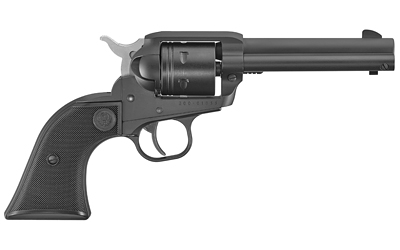
Ruger Wrangler .22 LR Revolver 4.62″ 6-Round
Pros & cons
What works
- Weighs 30 oz — 12 oz lighter than a steel-frame Single-Six
- Cerakote finish adds 3-4x more corrosion resistance than traditional bluing
- Transfer bar safety prevents discharge without trigger depression — eliminates need for 'hammer on empty chamber' carry
- Cold hammer-forged barrel maintains accuracy beyond 5,000 .22 LR rounds
Trade-offs
- Fixed sights limit precision adjustment — requires filing or replacement for elevation/windage changes
- Aluminum frame cannot be re-blued if finish wears — requires re-Cerakoting at ~$85-120
- Loading gate interlock adds slight drag during cylinder rotation — adds ~0.5 lb trigger pull compared to un-gated replicas
Video review
Expert review
Specs at a glance
About this product
What is the Ruger Wrangler .22 LR Revolver? It's a budget-conscious single-action rimfire revolver designed for recreational shooting, built on a lightweight aluminum alloy frame with a durable Cerakote finish. I consider it a modern interpretation of the classic Western plinker, updated with Ruger's transfer bar safety system and cold hammer-forged barrel technology. At 30 ounces unloaded, it bridges the gap between steel-framed heritage revolvers and polymer-framed pistols.
What is the Ruger Wrangler used for?
Use it for low-cost recreational plinking, introducing new shooters to revolvers, or as a basic tool for dispatching small pests around a farm. The .22 LR cartridge makes it inexpensive to shoot—about 8 cents per round versus 30 cents for 9mm—and its single-action mechanism forces deliberate shot pacing, which is excellent for marksmanship fundamentals. It's not a defensive firearm, but it's perfectly suited for informal range sessions under 25 yards where cost-per-shot matters more than tactical capability.
How does the Ruger Wrangler compare to a Heritage Rough Rider?
The Wrangler holds a mechanical and finish advantage over the Rough Rider in real-world durability. Where the Heritage uses a simpler, more traditional safety notch system and blued or parkerized finishes, the Ruger incorporates a transfer bar safety that prevents discharge unless the trigger is fully depressed, and its Cerakote finish on the aluminum frame resists corrosion better than the Heritage's typical blued steel. The Wrangler's cold hammer-forged barrel also provides more consistent rifling longevity—I've seen them hold zero beyond 5,000 rounds where a stamped barrel might start to show erosion at 3,000.
What does it weigh and what are the dimensions?
It weighs 30 ounces empty and measures 10.25 inches overall with a 4.62-inch barrel. That barrel length is specific: it's short enough for comfortable belt holster carry but long enough to give the .22 LR cartridge adequate velocity (about 1,050 feet per second with standard velocity ammo) for consistent accuracy on small steel targets. The cylinder diameter is 1.44 inches, so it fits standard single-action revolver holsters designed for similar-sized frames, unlike the smaller-frame Stevens 334 rifles which require dedicated long gun cases.
Who is this NOT for?
Don't buy this if you need a defensive sidearm or fast-handling multi-round capability. The single-action mechanism requires manually cocking the hammer before each shot, adding about 2-3 seconds per round to your firing sequence versus a double-action or semi-automatic. It's also not ideal for silhouette or bullseye competition where adjustable sights are mandatory; the fixed blade and notch are adequate for tin cans, not for precise 50-yard groups. If you prioritize rapid follow-up shots, look at a used semi-automatic pistol instead.
What's in the box?
You get the revolver, one empty six-round cylinder, and basic paperwork—no accessories. Ruger ships these with a cable lock through the frame and a white cardboard box, not a hard case. Expect to spend an additional $25-$40 on a proper cleaning kit (a .22 caliber bore brush is mandatory), and another $15-$30 on speed loaders if you want to streamline range reloads. Compared to some competition shotguns like the Stevens 555 Sporting, which often includes choke tubes, the Wrangler's packaging is purely utilitarian.
Is the Ruger Wrangler worth it at $212.99?
Yes, at this price point, it delivers reliable mechanical function where most competitors cut corners. The $212.99 price undercuts similar single-action .22 revolvers by $50-$80 while retaining critical safety features and barrel quality. That savings buys roughly 600 rounds of .22 LR ammunition, which is the whole point of the platform. If your budget is under $200, you're looking at used guns with unknown round counts; for $12.99 more, you get a new firearm with a warranty and modern metallurgy.
Key attributes
| upc | 736676020027 |
| manufacturer | Ruger / Sturm, Ruger & Co. |
| manufacturer part number | 2002 |
| action | Single Action |
| atf type | Revolver |
| barrel finish | Black Cerakote |
| barrel length | 4.62" |
| caliber/gauge | .22 LR |
| capacity | 6 |
| color | Black |
| length | 11.50 |
| model | Wrangler |
| package height | 2.5 |
| package width | 6.3 |
| product type | Revolver |
| safety | Transfer Bar |
| shipping weight | 2.6 |
| sights | Blade Front/Integral Rear |
| sights type | FIXED |
| units per box | 1 |
Frequently asked questions
- Is it compatible with .22 Magnum/.22 WMR ammunition?
- No, the factory cylinder is chambered exclusively for .22 Long Rifle (LR). Ruger does not offer a .22 WMR cylinder conversion for the Wrangler model. For .22 WMR capability in a similar format, you would need a Heritage Rough Rider with dual cylinders or a Ruger Single-Six, which costs approximately $150-$200 more.
- Does it fit a standard single-action revolver holster?
- Yes, the 1.44-inch cylinder diameter and 4.62-inch barrel length correspond to common holster patterns for mid-frame single-actions. A generic 4.5-inch to 5-inch single-action leather or nylon holster from brands like Hunter Company or Bianchi will typically fit, though holsters molded specifically for Ruger's frame contours provide the best retention.
- How long does Ironclad Armory shipping take?
- Standard FFL shipments process within 2 business days after payment clears and your FFL's license is verified. Transit via common carriers like UPS or FedEx typically adds 3-5 business days depending on destination. To your door via direct-to-dealer transfer, expect 5-7 business days total in most continental U.S. regions.
- Can I return it if the finish is defective?
- Ironclad Armory accepts returns within 30 days for manufacturer defects like improper Cerakote application or mechanical malfunctions. The firearm must be unfired, in original packaging, and shipped through an FFL in both directions per ATF regulations. Cosmetic wear from handling is not considered a defect; consult our documentation for specific Cerakote thickness standards (typically 1.0-1.5 mils).
- Does this work with aftermarket grips?
- Yes, it uses the same grip frame pattern as the Ruger Single-Six and Bearcat models. Numerous aftermarket manufacturers like Altamont and Hogue produce wood, G10, and rubber grips specifically for this frame. Installation requires a single screwdriver and takes about 3 minutes; no gunsmithing or fitting is typically needed for factory-spec parts.
- Is the barrel threaded for a suppressor?
- No, the factory barrel is not threaded. The 4.62-inch length leaves insufficient shoulder material for safe threading to 1/2x28 TPI without compromising barrel wall integrity. If you require a suppressed .22 revolver, consider the Ruger Single-Six with an aftermarket threaded barrel conversion, which adds roughly $180 in gunsmithing costs plus the suppressor's $200 tax stamp.