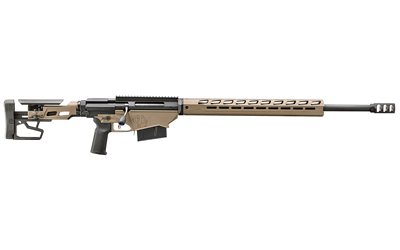
Ruger Precision Rifle 300 PRC — 26″ Smoked Bronze
Pros & cons
What works
- 26-inch heavy-contour barrel with 5/8"-24 threads — ready for suppressor or brake without modification.
- Fully adjustable aluminum chassis — permits 1.5 inches of length-of-pull and 0.75 inches of cheek riser adjustment for a perfect fit.
- Ruger Marksman Adjustable trigger — user-configurable pull weight from 2.5 to 4 pounds with a crisp, clean break.
- Accepts AICS-pattern magazines — provides reliable feeding and compatibility with common precision rifle mags.
Trade-offs
- Heavy at 14.8 pounds unloaded — unsuitable for mobile hunting or extended carry.
- .300 PRC ammunition cost — averages $3.50 to $5.00 per round for match-grade loads, making practice expensive.
- No optic, mount, or case included — requires an additional investment of $1,000+ for a capable long-range setup.
- Aggressive recoil impulse — mandates a muzzle brake or suppressor for comfortable extended shooting sessions.
Video review
Expert review
Specs at a glance
About this product
The Ruger Precision Rifle in .300 PRC is a purpose-built, semi-modular bolt-action chassis rifle engineered for consistent long-range precision engagement beyond 1,000 yards. It combines a heavy-contour, threaded 26-inch barrel with a folding, fully adjustable stock and a receiver machined to accept AICS-pattern magazines. This specific model features a smoked bronze Cerakote finish over a hammer-forged 4140 chrome-molybdenum steel barrel, providing both corrosion resistance and the thermal stability required for sustained fire during training or competition strings.
What is the Ruger Precision Rifle .300 PRC used for?
This rifle is designed for disciplined long-range target shooting, tactical training, and competition disciplines like PRS (Precision Rifle Series). The 26-inch barrel and 1:9-inch twist rate are optimized to stabilize heavy .300 PRC projectiles (typically 212-250 grain) at velocities that extend a flat trajectory past 1,500 yards, making it a competent choice for shooters working on their wind calls and ballistic data collection. Its M-LOK free-float handguard and adjustable stock allow for the mounting of bipods, night vision bridges, and support bags common in positional shooting.
How does the Ruger Precision Rifle compare to the Stevens 334 Rifle in .308 Win?
The Ruger Precision Rifle is a superior platform for dedicated long-range shooting, while the Stevens 334 is a more cost-effective entry-point for general-purpose hunting. The key mechanical difference is the chassis system: the Ruger uses a fully adjustable aluminum chassis with an integrated AR-style pistol grip and folding stock, whereas the Stevens employs a traditional synthetic stock. For pure precision work, the Ruger’s chassis offers greater rigidity and ergonomic adjustability, translating to potentially tighter groups at extreme distances. However, the Stevens is nearly 3 pounds lighter at around 6.5 lbs, making it far more practical for carrying in the field.
What does it weigh and what are its dimensions?
This rifle weighs 14.8 pounds unloaded without an optic, and measures 46.5 inches in overall length with the stock extended. The folded length is 33.75 inches, a critical figure for transport in a Pelican-type hard case or a vehicle. The heavy-contour barrel profile contributes significantly to the weight but is essential for mitigating barrel harmonics and heat shift during extended shooting sessions; you’re trading portability for downrange consistency.
Who is this NOT for?
This is not a rifle for a new shooter, a casual plinker, or someone seeking a lightweight hunting rig. The .300 PRC cartridge generates substantial recoil (approximately 35-40 ft-lbs of energy at the shoulder) and has a per-round cost nearly triple that of common .308 Winchester ammunition. Furthermore, the rifle’s 14.8-pound weight and 46.5-inch length make it cumbersome for any application requiring mobility, like stalking or hiking in uneven terrain. If your primary use is whitetail hunting from a blind inside 300 yards, a lighter traditional rifle like the Stevens 334 is a more sensible tool.
What’s in the box with the Ruger Precision Rifle 300 PRC?
You receive the complete rifle, one 10-round AICS-pattern detachable metal magazine, a Magpul MOE-K2-XL grip installed on the chassis, and the necessary tools for adjusting the length of pull, cheek riser height, and cant. Notably absent is any form of optic, mount, muzzle device, or case. Ruger ships these rifles in a basic cardboard box with foam inserts, so you will need to budget for a suitable hard case, a scope mount like a 20 MOA Picatinny rail, and a high-magnification optic capable of resolving targets at 1,000+ yards.
Is the Ruger Precision Rifle worth it at $2,193.99?
Yes, for the shooter who has outgrown the capabilities of a factory hunting rifle and is ready to invest in a dedicated precision platform without entering the $4,000+ custom rifle market. At this price point, you are paying for the integrated chassis system, the reputable Ruger Marksman adjustable trigger (which breaks cleanly at a predictable 2.5 to 4 pounds), and the threaded, heavy-contour barrel ready for a suppressor or muzzle brake. The value proposition is its out-of-the-box readiness for serious long-range work; you are buying a complete system that would cost significantly more if you purchased a barreled action and an aftermarket chassis separately.
Key attributes
| upc | 736676181070 |
| manufacturer | Ruger / Sturm, Ruger & Co. |
| manufacturer part number | 18107 |
| action | Bolt Action |
| atf type | RIFLE |
| barrel finish | Black |
| barrel length | 26" |
| caliber/gauge | .300 PRC |
| capacity | 10 + 1 |
| color | Black |
| length | 43.5500 |
| model | Precision Rifle |
| number of magazines | 2 10 rd. Magpul PMAG |
| package height | 4.7 |
| package width | 9.7 |
| product type | Rifle |
| safety | Ambidextrous |
| shipping weight | 18.3 |
| sights | No |
| thread pattern | 5/8"x24 |
Frequently asked questions
- Is the Ruger Precision Rifle compatible with AICS magazines?
- Yes. The rifle's lower assembly is machined to accept standard AICS-pattern detachable box magazines. It ships with one 10-round metal magazine, and you can source additional 5-round or 10-round magazines from manufacturers like Magpul or Accurate-Mag for around $35 to $80 each.
- Does the threaded muzzle accept a .30 caliber suppressor?
- Yes. The 26-inch barrel is threaded 5/8"-24, which is the standard thread pitch for .30 caliber muzzle devices and suppressors. You can direct-thread a suppressor like a SilencerCo Omega 300 or use a compatible muzzle brake as a mounting platform. Always ensure your suppressor is rated for the pressure and volume of the .300 PRC cartridge.
- How long does shipping to an FFL typically take?
- For in-stock items, Ironclad Armory processes and ships within 2 business days. Transit time then depends on the carrier and destination, but ground shipping to most continental US locations takes 3-7 additional business days. The firearm will be shipped to your chosen, valid Federal Firearms License (FFL) holder for transfer.
- Can I return a firearm if I change my mind?
- No. Due to federal regulations, firearms transferred through an FFL cannot be returned simply because a customer changes their mind. Returns are only accepted if the firearm is defective or arrived damaged, and such returns must be initiated within 14 days of receiving the firearm from your FFL, following our specific RMA process.
- Does this rifle work with a Harris bipod?
- Yes, directly. The M-LOK free-float handguard has Picatinny rail sections at the 6 o'clock position. You can attach a Harris-style bipod with a Picatinny clamp, or use an M-LOK adapter for a slimmer profile. Ensure any bipod has a 90-degree leg swing for stable deployment from prone or bench positions.