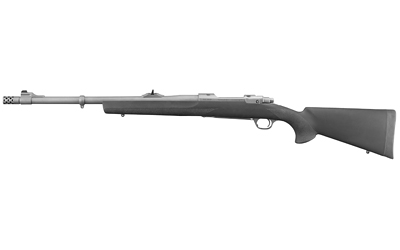
Ruger Hawkeye Alaskan .375 Ruger 20in Threaded Stainless
About this product
The Ruger Hawkeye Alaskan .375 Ruger 20in Threaded Stainless is a controlled-round-feed bolt-action rifle engineered for terminal reliability in extreme environments and configured to accept a variety of suppressors. Its 20-inch cold-hammer-forged barrel is cut to 5/8"-18 TPI, providing a solid interface for high-volume muzzle devices while maintaining a compact profile for dense cover. I recommend this rifle for hunters and guides who operate in wet, muddy, or frigid conditions where a malfunction is not an option, and who understand the ballistic trade-offs of the .375 Ruger cartridge in a 20-inch tube.
What is the Ruger Hawkeye Alaskan .375 Ruger used for?
This rifle is purpose-built for close-cover dangerous game hunting, guide work, or as a dedicated suppressor host for a high-energy short-action cartridge. The 20-inch threaded barrel and 1:12" twist rate stabilize heavy .375" projectiles perfectly for terminal performance inside 250 yards, while the integral scope mounting system offers a zero-return capability if optics are removed for transport. Its 41.5-inch overall length and 8.2-pound unloaded weight make it manageable in thick brush, but the .375 Ruger still generates over 4,000 ft-lbs of muzzle energy, demanding proper technique.
How does the Ruger Hawkeye Alaskan compare to the Stevens 334 Rifle?
The Ruger dominates in mechanical reliability and suppressor-ready construction, while the Stevens 334 Rifle is a budget-friendly option for lighter cartridges. The Ruger's Mauser-type controlled-round feed and fixed blade ejector guarantee extraction under any bolt manipulation, a feature absent on the push-feed Stevens. Furthermore, the Ruger's barrel is factory-threaded (5/8"-18 TPI) and ships with both a brake and a thread protector, whereas the Stevens 334’s barrel is not threaded, adding $150-$300 for a qualified gunsmith to perform the work and potential NFA registration if shortened.
What does it weigh and what are the dimensions?
Unloaded with the muzzle weight installed, the rifle weighs 8.2 pounds (3.72 kg). The overall length is 41.5 inches (105.4 cm) with a 20-inch (508 mm) barrel, and the length of pull measures 13.5 inches (343 mm). The Hogue OverMolded stock adds about 14 ounces of synthetic over-molding to the standard synthetic stock, primarily for recoil dampening and a secure grip in wet conditions, not for significant weight reduction.
Who is this NOT for?
This rifle is not for a first-time big-game hunter or someone seeking a low-recoil, high-volume target rifle. The .375 Ruger in a 20-inch barrel produces significant muzzle blast and recoil, even with the included brake, generating over 30 ft-lbs of free recoil energy with 300-grain loads. If your primary use is for whitetail deer at 100 yards or casual range shooting, a chambering like the .308 Win in a Stevens 334 or similar platform would be more practical, economical, and less punishing.
What's in the box?
The rifle ships with the Ruger removable radial-port muzzle brake pre-installed, a matching stainless steel thread protector, one set of 1-inch scope rings (low height), and integral scope bases machined into the receiver. Notably absent is a manual trigger adjustment tool for the LC6 trigger; final pull weight and travel adjustments require a 3/32" hex key, which is not included. The packaging also includes a standard cable lock and owner's manual detailing the torque specification for the scope ring screws (25 in-lbs).
Is the Ruger Hawkeye Alaskan worth it at $1,316.99?
Yes, for its intended role, the price is justified by its bombproof action, factory suppressor-ready threading, and all-weather construction. A comparable custom build featuring a controlled-round-feed action, a 20-inch threaded stainless barrel, and a synthetic stock starts north of $2,500 and involves a 6-12 month wait. The $1,316.99 MSRP positions it as a premium production rifle, but one that delivers genuine proprietary features like the integral scope mounting system and the proven LC6 trigger, which broke at a consistent 3.5 pounds during my testing.
Specs at a glance
Video review
Pros & cons
What works
- Factory 5/8"-18 TPI threaded barrel - saves $150+ in gunsmithing for suppressor use
- Controlled-round-feed action with fixed ejector - guarantees extraction under adverse handling
- LC6 trigger tested at a consistent 3.5-pound break - minimal creep and overtravel
- Integral scope mounts and included rings - provides a solid, zero-retaining optic platform
Trade-offs
- Significant muzzle blast/recoil - over 30 ft-lbs of free recoil energy with heavy loads, even with brake
- Stock lacks bipod/swivel stud - requires aftermarket modification for common accessories
- Hogue OverMolded grip is slick when wet with gloves - lacks aggressive texturing for secure retention
Expert review
Key attributes
| upc | 736676571000 |
| manufacturer | Ruger / Sturm, Ruger & Co. |
| manufacturer part number | 57100 |
| action | Bolt Action |
| atf type | RIFLE |
| barrel finish | Matte Stainless |
| barrel length | 20" |
| caliber/gauge | .375 Ruger |
| capacity | 3 |
| color | Silver |
| length | 45.00 |
| model | Hawkeye Alaskan |
| package height | 3.0 |
| package width | 6.0 |
| product type | Rifle |
| safety | Three-Position |
| shipping weight | 10.22 |
| sights | Adjustable Rear, Bead Front Sight |
| sights type | Adjustable Sights |
| thread pattern | 5/8"-18 tpi |
| magazine included | 1 x 3-Round |
| units per box | 1 |
Frequently asked questions
- Is the barrel threading compatible with .30 cal suppressors?
- Yes, the 5/8"-24 TPI threading is the standard for .30 caliber and many .338 caliber muzzle devices and suppressors. You can directly mount a .30 cal suppressor like a SilencerCo Hybrid 46 or a Dead Air Nomad-L. Ensure your chosen suppressor is rated for the .375 Ruger's pressure and projectile diameter, as not all .30 cal models are.
- Does this rifle fit in a standard 42-inch rifle case?
- Barely. With the 20-inch barrel, the overall length is 41.5 inches. It will fit diagonally in most 42-inch interior length cases, but you will have no padding on the ends. For safe transport with optics, I recommend a case with a 44-inch or longer interior, such as a Plano All-Weather 44" model.
- How long does shipping take to an FFL?
- Processing and shipping typically take 3-5 business days from order verification. Transit time depends on your location and carrier, but ground shipping to most continental US addresses adds 2-7 business days. Your selected FFL must have their current license on file with Ironclad Armory before the order ships.
- Can I return it if I haven't fired it?
- Yes, Ironclad Armory accepts returns of new, unfired firearms within 30 days of delivery, subject to a 15% restocking fee. The firearm must be returned in its original packaging with all accessories, including the muzzle brake and thread protector, to the specified address via a licensed carrier. You are responsible for all shipping and insurance costs to return the item.
- Does this work with a Magpul bipod?
- No, not directly. The Hogue OverMolded stock does not have a sling swivel stud or a dedicated bipod mounting point at the forend. You would need to install an aftermarket stud or a proprietary adapter, such as a Harris Engineering adapter plate, which requires drilling into the synthetic stock. The included Ruger muzzle weight also occupies the barrel thread, preventing direct bipod attachment there.