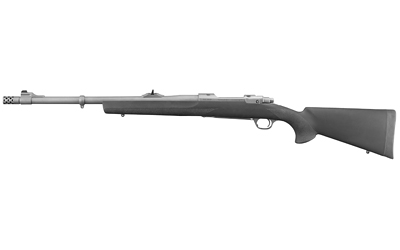
Ruger Hawkeye Alaskan .300 Win Mag 20-inch Stainless
Pros & cons
What works
- 20-inch cold hammer-forged stainless barrel - 4 inches shorter than standard magnum rifles for superior packability.
- Integral Picatinny scope base - provides a rigid, permanent mounting solution saving $80-$120 on aftermarket bases/rings.
- Includes both radial-port muzzle brake and muzzle weight - user can switch between reduced recoil and reduced muzzle blast in under 60 seconds.
Trade-offs
- LC6 trigger is non-adjustable - fixed pull weight of ~4.25 lbs, a trigger replacement kit costs $45+.
- Hogue OverMolded stock is slick when wet - lacks aggressive texturing, aftermarket stippling or grip tape recommended for wet environments.
- Proprietary magazine system - uses Ruger-specific AICS-pattern mags, limiting aftermarket options compared to true AICS-compatible actions.
Video review
Expert review
Specs at a glance
About this product
The Ruger Hawkeye Alaskan .300 Win Mag 20-inch Stainless is a purpose-built, short-barreled magnum rifle designed for hunters operating in restrictive terrain where a compact, powerful, and corrosion-resistant firearm is mandatory. It represents a specific subset of hunting tools that trades some ballistic velocity for handling speed and packability, built around Ruger's controlled-feed M77 action. The integral Picatinny rail base and iron sights provide immediate utility, while the proprietary muzzle system gives you direct control over felt recoil and muzzle signature.
What is the Ruger Hawkeye Alaskan used for?
This rifle is built for hunting large, dangerous game in thick brush or mountainous terrain where shots are typically under 300 yards and quick handling trumps ultra-long-range ballistics. The 20-inch barrel keeps the overall length manageable at 40.5 inches, which is 3.5 inches shorter than a standard 24-inch magnum rifle, making it significantly easier to maneuver in a vehicle, a ground blind, or when climbing with a slung rifle. Its stainless steel construction and synthetic Hogue OverMolded stock make it a primary choice for Alaska coastal hunts or any environment with persistent moisture, salt, or abrasive vegetation.
How does the Ruger Hawkeye Alaskan compare to the Stevens 334 in .308 Win?
While both are compact bolt-actions, the Alaskan is a specialized tool for larger game and the Stevens 334 is a general-purpose hunting rifle for mid-sized game like deer. The Alaskan fires the significantly more powerful .300 Winchester Magnum cartridge, generating roughly 4,000 ft-lbs of muzzle energy compared to the .308 Winchester's 2,600 ft-lbs, making it suitable for moose, brown bear, and elk at extended ranges. However, this comes with substantially more felt recoil, a heavier rifle weight of 7.5 lbs unloaded compared to the Stevens 334's 6.5 lbs, and higher ammunition cost, so the Stevens 334 in .308 Win is objectively better for most North American deer hunting where the magnum's power is unnecessary and punishing. For those considering stepping up from a standard hunting cartridge like the the Stevens 334 .308 Win rifle, the Alaskan represents a substantial jump in both capability and shooter responsibility.
What does it weigh and what are the dimensions?
Unloaded with the muzzle weight installed, this rifle scales at 7.5 lbs (120 oz) and measures 40.5 inches in overall length. The 20-inch cold hammer-forged, stainless steel barrel has a 1:10-inch right-hand twist rate, which stabilizes heavy, high-BC bullets up to 220 grains essential for deep penetration. The Hogue stock contributes to this weight but provides critical recoil dampening; the rifle balances approximately 1.5 inches forward of the front action screw, giving it a slight forward bias that aids in steady offhand shooting but requires attention when carrying in a sling for extended periods.
Who is this NOT for?
This is not a rifle for new shooters, budget-conscious hunters, or those who plan to fire 100+ rounds in a single range session. The .300 Winchester Magnum in a 20-inch barrel produces formidable recoil and muzzle blast, even with the included brake, and factory ammunition averages over $3.50 per round. If your primary use is paper punching, varmint control, or shooting from a stationary bench, a lighter-recoiling, longer-barreled rifle like a .30-06 or a Stevens 334 in .243 Win — our editorial take will be more enjoyable and cost-effective. Additionally, the integral Picatinny rail precludes the use of traditional split-ring scope bases, limiting some optic-mounting options.
What's in the box?
You receive the complete rifle, the removable radial-port muzzle brake, a matching muzzle weight (also known as a thread protector), a single 3-round AICS-pattern detachable box magazine, and the factory owner's manual. Notably, the thread protector is essential if you remove the brake, as the 1/2-24 threaded muzzle is cut to 0.625 inches in diameter, requiring a specific thread protector; using a standard 1/2-28 AR-type device is dangerous and will damage the threads. Ruger does not include a thread-locking compound for the brake, so I recommend applying a medium-strength thread locker like Loctite 243 during installation.
Is the Ruger Hawkeye Alaskan worth it at $1,278.99?
Yes, for the hunter who specifically needs its blend of compactness, power, and environmental resistance, it represents a solid value against custom-built alternatives. A comparable custom rifle with a shortened, threaded magnum contour barrel and a premium synthetic stock would start around $2,200 before optics. The trade-off is accepting Ruger's factory LC6 trigger, which breaks cleanly at about 4.25 lbs but is not user-adjustable for weight without aftermarket springs or a full replacement. At this price point, you are paying for the specialized barrel and action configuration, not for a refined, match-grade trigger or a hand-bedded stock.
Key attributes
| upc | 736676571024 |
| manufacturer | Ruger / Sturm, Ruger & Co. |
| manufacturer part number | 57102 |
| action | Bolt Action |
| atf type | RIFLE |
| barrel finish | Matte Stainless |
| barrel length | 20'' |
| caliber/gauge | .300 Winchester Magnum |
| capacity | 3-Round |
| color | Silver |
| length | 42'' |
| magazine included | 1 x 3-Round |
| model | Hawkeye |
| package height | 3.0 |
| package width | 6.0 |
| product type | Rifle |
| safety | Three-Position |
| shipping weight | 10.21 |
| sights | Adjustable Rear, Bead Front Sight |
| sights type | Adjustable Sights |
| thread pattern | 1/2"-24 tpi |
| units per box | 1 |
Frequently asked questions
- Is the threaded muzzle compatible with a .30 cal suppressor?
- Yes, the 1/2-24 thread pattern is the standard for .30 caliber centerfire rifle suppressors from brands like SilencerCo, Dead Air, and Rugged Suppressors. However, you must first remove the factory-installed muzzle brake or weight, and you are responsible for ensuring your suppressor is rated for .300 Winchester Magnum pressures. Always consult with your local FFL/SOT regarding NFA transfer procedures, as this process typically takes 6-10 months for ATF Form 4 approval.
- Does this rifle accept aftermarket stocks?
- With modification, yes. The Hawkeye Alaskan uses Ruger's M77 short-action footprint, but the specific bottom metal for the detachable magazine system can limit direct drop-in compatibility. Stocks from manufacturers like Bell & Carlson or Boyd's will require minor inletting work by a competent gunsmith, which typically adds $150-$250 to the total cost. The factory Hogue stock is chemically bonded to an aluminum bedding block, making removal a precise task.
- Can I use .300 WSM ammunition in this rifle?
- Absolutely not. The .300 Winchester Short Magnum (WSM) is a completely different cartridge with a larger case head diameter and shorter overall length. Attempting to chamber and fire a .300 WSM round in a .300 Win Mag chamber will result in a dangerous obstruction, potential case head separation, and catastrophic firearm failure. Only use ammunition explicitly marked '.300 Winchester Magnum' or '.300 Win Mag'.
- What is the twist rate of the barrel?
- The cold hammer-forged stainless steel barrel has a 1:10-inch right-hand twist rate. This rate is optimal for stabilizing long, heavy-for-caliber bullets in the 180-grain to 220-grain range, which are preferred for deep penetration on large game like elk and brown bear. Lighter bullets (150-165 grains) will also stabilize but may not provide optimal terminal performance at extended ranges beyond 400 yards.