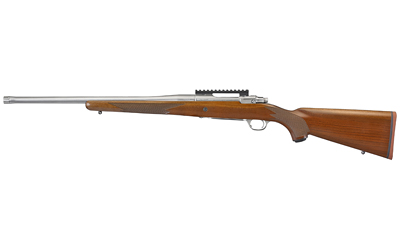
Ruger M77 Hawkeye Hunter 308 Win 20″ Satin Stainless
About this product
The Ruger M77 Hawkeye Hunter 308 Win 20" Satin Stainless is a controlled-round-feed bolt-action rifle built around a free-floated, cold hammer-forged stainless steel barrel and a classic American walnut stock. This configuration emphasizes field reliability over benchrest precision, with Ruger's three-position safety and a 20 MOA Picatinny rail bridging traditional hunting rifle ergonomics and modern long-range optics compatibility. At $1,165.99, it occupies a specific niche between entry-level hunting rifles and custom precision platforms.
What is the Ruger M77 Hawkeye Hunter used for?
This rifle is purpose-built for controlled-cycling hunting scenarios where a single, reliable shot matters more than rapid follow-ups. The Mauser-type controlled round feed and 4+1 capacity make it ideal for medium to large game in wooded or mountainous terrain where inclement weather and rough handling are expected. The 20-inch barrel keeps the overall length manageable at 40.5 inches while maintaining effective .308 Winchester ballistics out to 600 yards.
How does the Ruger M77 Hawkeye Hunter compare to the Stevens 334 Rifle?
The Ruger M77's controlled-feed action and walnut stock construction justify its $400 premium over the push-feed Stevens 334 in .308 Win. Where the Stevens 334 uses a synthetic stock and simpler action for budget-conscious hunters, the Ruger provides superior extraction reliability in adverse conditions and better harmonics from its free-floated barrel. The Ruger's 20 MOA rail also gives it an immediate advantage for long-range optics compared to the Stevens' flat base.
What does it weigh and what are the dimensions?
At 7 pounds unloaded, the M77 Hawkeye Hunter balances weight distribution for steady offhand shooting without becoming burdensome during extended stalks. The 20-inch barrel contributes to an overall length of 40.5 inches, making it 2 inches shorter than most 22-inch hunting rifles while the 13.5-inch length of pull accommodates most adult shooters wearing winter layers. The magazine capacity is 4 rounds of .308 Winchester, with a fifth round able to be carried in the chamber.
Who is this NOT for?
Budget-conscious hunters who prioritize cost over mechanical redundancy should consider the Stevens 334 instead. The Ruger's controlled-feed action adds complexity and cost that push-foot designs don't require for typical range use. Competitive shooters needing sub-MOA guarantees might find the 1.25-1.5 MOA factory accuracy insufficient compared to custom-barreled precision rifles costing twice as much.
What's in the box?
The rifle ships with a factory-installed 5/8"-24 thread protector and the 20 MOA Picatinny rail already mounted to the receiver. Unlike many competitors, Ruger includes the optics rail as standard equipment rather than a $75-100 accessory. Documentation includes a comprehensive owner's manual covering disassembly and Ruger's warranty registration materials, but does not include scope rings or a case.
Is the Ruger M77 Hawkeye Hunter worth it at $1,165.99?
For hunters who prioritize extraction reliability in adverse conditions, the M77's price reflects its mechanical superiority over push-feed alternatives. The combination of cold hammer-forged stainless barrel, controlled-round feed, and 20 MOA rail creates a package that would cost $300-400 more if assembled from aftermarket parts on a donor action. At this price point, you're paying for Ruger's manufacturing consistency rather than custom gunsmithing.
Specs at a glance
Video review
Pros & cons
What works
- Controlled-round feed extraction - virtually eliminates failure-to-extract malfunctions
- 20 MOA Picatinny rail included - saves $75-100 versus aftermarket purchase
- Free-floated cold hammer-forged barrel - maintains consistent harmonics for 1.25-1.5 MOA accuracy
- 5/8"-24 threaded muzzle - direct compatibility with .30 cal suppressors without adapter
Trade-offs
- 4+1 capacity limited compared to 5-10 round detachable magazine systems
- Walnut stock susceptible to moisture warping without regular maintenance
- LC6 trigger not as crisp as aftermarket options from Timney or Jewel
- 20-inch barrel sacrifices 75-100 fps velocity versus 22-24 inch .308 barrels
Expert review
Key attributes
| upc | 736676571079 |
| manufacturer | Ruger / Sturm, Ruger & Co. |
| manufacturer part number | 57107 |
| action | Bolt Action |
| atf type | RIFLE |
| barrel finish | Satin Stainless |
| barrel length | 20" |
| caliber/gauge | .308 / 7.62 NATO |
| capacity | 4 + 1 |
| color | Stainless |
| length | 45.00 |
| model | Hawkeye Hunter |
| package height | 3.0 |
| package width | 6.5 |
| product type | Rifle |
| safety | Three-Position |
| shipping weight | 8.2 |
| sights | No |
| thread pattern | 5/8"-24 tpi |
| units per box | 1 |
Frequently asked questions
- Is the barrel threaded for a suppressor?
- Yes, the muzzle uses a standard 5/8"-24 thread pattern compatible with most .30 caliber suppressors. The factory includes a thread protector that must be removed using a 3/4" wrench before mounting muzzle devices. Check local NFA regulations before purchasing a suppressor for this rifle.
- Does it come with scope rings?
- No, the rifle includes a 20 MOA Picatinny rail but requires separate purchase of rings. Ruger recommends their proprietary Ruger Precision rings or standard Picatinny-compatible rings from brands like Warne or Leupold. The rail's 20 MOA cant provides approximately 20 additional minutes of elevation adjustment for long-range shooting.
- What is the trigger pull weight?
- Ruger's LC6 trigger breaks consistently at 3.5 to 4 pounds from the factory with minimal creep. The trigger is adjustable for pull weight but requires partial disassembly of the trigger group. Most hunters will find the stock setting appropriate for field use without modification.
- How accurate is this rifle?
- With factory match ammunition, expect 1.25 to 1.5 MOA groups from a rested position. The cold hammer-forged barrel with 5R rifling typically requires 50-100 rounds to break in before achieving optimal consistency. The free-floated barrel design minimizes point-of-impact shift from sling pressure or bipod use.
- Can the stock be replaced with aftermarket options?
- Yes, the M77 uses a standardized action screw spacing that accommodates aftermarket stocks from Boyd's, Bell & Carlson, and McMillan. The hinged floorplate mechanism requires specific inletting that may limit some stock options compared to detachable magazine models. Replacement typically takes 15-20 minutes with basic gunsmithing tools.