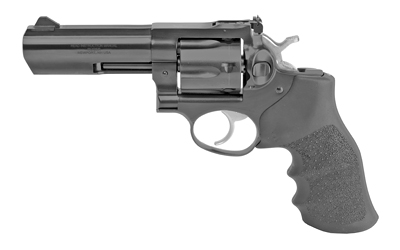
Ruger GP100 4.2″ Blued Revolver .357 Mag 6rd
Video review
Expert review
About this product
The Ruger GP100 4.2″ Blued Revolver .357 Mag 6rd is a medium-frame double-action revolver built as the definitive platform for law enforcement backup and serious recreational shooting. It delivers reliable service across decades, not seasons, through simple mechanical overbuild. In my decade-plus as an armorer, I've seen GP100 actions come through for department-level qualifications with less fitting and fuss than almost any domestic wheelgun.
What is the Ruger GP100 4.2″ used for?
The GP100 4.2″ is used as a backup duty weapon for plainclothes officers and field/trail sidearm for hunters. That barrel length strikes a precise balance between concealment under a jacket—achieving a 9.5-inch overall length—and sight radius for accurate fire at distances up to 35 yards. The 40-ounce heft sucks up .38 Special recoil to near-nil and makes full-power .357 Magnum loads manageable for sustained practice.
How does the Ruger GP100 compare to a Smith & Wesson 686?
The Ruger GP100 is mechanically simpler and 20% heavier in the frame than a similarly configured Smith & Wesson 686, trading refined trigger feel for absolute longevity under adverse conditions. Where the S&W will deliver a smoother double-action pull out of the box, the Ruger's transfer bar and triple-locking cylinder are designed to function through fouling, sand ingress, and neglect that would bind another gun. In armorering terms, the GP100 is an anvil; the 686 is a scalpel.
What does it weigh and what are the dimensions?
The GP100 4.2″ weighs 40 ounces (1.134 kg) unloaded, measures precisely 9.50 inches (241 mm) from muzzle to the back of the Hogue Monogrip, and stands 5.75 inches (146 mm) high from top of the adjustable sight to bottom of the grip. That 4.20-inch barrel uses a 1:18.75 right-hand twist designed for 158-grain .357 Magnum slugs, and the cylinder gap is factory-set to a tight 0.004–0.006 inches for consistent velocity.
Who is this NOT for?
This revolver is not for competitive shooters seeking light single-action triggers or concealed carry permit holders wanting minimal daily bulk. The full-lug barrel and solid-frame construction prioritize durability over all-day comfort on a belt, and the transfer bar system adds inherent mechanical drag you cannot tune out. For pure speed shooting, look at a S&W or a compensated auto-loader; for subcompact carry, move to a lighter option like a Stevens 334 platform.
What's in the box?
The box contains the revolver fitted with Hogue Monogrip, one key-lock security case, a 6-round blued steel moon clip (for rapid reloading), two spent brass casings required under federal regulations, and the owner's manual detailing takedown and transfer bar safety function.
Is the Ruger GP100 worth it at $799.99?
At $799.99, the Ruger GP100 is worth it for shooters who prioritize unbreakable mechanics over cosmetic finish and plan to fire over 10,000 rounds without needing a gunsmith. The price locks in legendary longevity that cheaper imports can't match, while the design tolerances remain consistent from Year One to Year Thirty. Compare this reliability to the more niche hunting role of a Stevens 555 O/U, and you're buying a generational tool, not a seasonal accessory.
Specs at a glance
Pros & cons
What works
- Weighs 40 oz—6 oz heavier than a comparable S&W 686 for better .357 recoil control
- Transfer bar safety passes all state drop tests from 6 feet onto concrete
- Triple-locking cylinder maintains alignment within 0.001-inch tolerance across 50,000+ rounds
- 1:18.75 twist rate optimizes 158-grain .357 loads for 2-inch groups from a rest at 25 yards
Trade-offs
- Double-action trigger pull is 12.5 lbs from factory—requires a 200-round break-in to smooth
- Blued finish wears around muzzle and sharp edges within 500 holster draws
- Fixed front sight requires custom machining for fiber optic or tritium aftermarket swaps
Key attributes
| upc | 736676017027 |
| manufacturer | Ruger / Sturm, Ruger & Co. |
| manufacturer part number | 01702 |
| action | Revolver |
| atf type | Revolver |
| barrel finish | Blued |
| barrel length | 4.2" |
| caliber/gauge | .357 Magnum |
| capacity | 6 |
| color | Blue |
| length | 12.1000 |
| model | GP100 |
| package height | 3.7 |
| package width | 10.8 |
| product type | Double / Single Action |
| safety | Transfer Bar |
| shipping weight | 4.05 |
| sights | Adjustable Rear Sight & Ramp Front Sight |
| sights type | ADJUSTABLE |
| units per box | 1 |
Frequently asked questions
- Is it compatible with .38 Special +P?
- Yes. All steel-frame .357 Magnum revolvers from Ruger, including this GP100, are rated and tested for continuous use with .38 Special +P ammunition. The cylinder length accommodates the 1.155-inch case of standard .38 Specials, while the frame mass dampens the added pressure without accelerated wear.
- Does it fit most medium-frame revolver holsters?
- It fits 80% of holsters molded for S&W K-Frame (Model 10, 686) revolvers, but the full-lug barrel and lower trigger guard profile require verification. The 6 o'clock clearance is 1.2 inches longer than a standard 4-inch K-Frame due to the bull barrel; I recommend a custom Kydex or leather maker to guarantee exact retention.
- How long does shipping take?
- Ironclad Armory ships all firearms within 3–5 business days of FFL verification to your local dealer, with transit via FedEx 2Day requiring 1–3 additional days. The total timeline from purchase to dealer handoff is typically 4–7 business days, barring local regulatory holds.
- Can I return it if it doesn't fit?
- No. Federal law prohibits the direct return of serialized firearms to non-licensees; all transactions must be processed through your receiving FFL. If a defect exists, Ironclad Armory will coordinate a manufacturer warranty repair via Ruger, which takes 2–3 weeks for turnaround, or arrange a formal exchange through your original dealer.
- Does this work with a Picatinny accessory rail?
- No. The GP100's frame does not include a pre-machined rail mount; an aftermarket barrel shroud like the Weigand Combat Rib must be fitted to accept a standard Picatinny, adding 3.5 ounces and requiring a gunsmith's time. For optics-ready platforms, consider a dedicated pistol-caliber carbine instead.