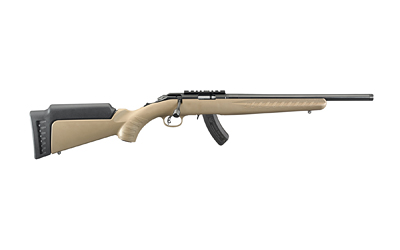
Ruger American Rimfire .22 WMR 16 in Threaded Barrel FDE
About this product
The Ruger American Rimfire .22 WMR 16 in Threaded Barrel FDE is a bolt-action dedicated rimfire platform built around Ruger's proven American action, cold hammer-forged barrel, and modular synthetic stock system in Flat Dark Earth—a configuration selected for suppressor compatibility, repeatable field accuracy with .22 WMR, and straightforward compliance with Title II regulations for those pursuing ATF Form 1 submissions.
What is the Ruger American Rimfire .22 WMR used for?
This rifle is engineered primarily for suppressed small-game and varmint work within 150 yards where minimizing report is tactically or legally advantageous. The 16" cold hammer-forged barrel with 1/2-28 threads delivers stabilized .22 WMR velocities around 1,900-2,100 fps with 40-grain loads, making it effective on raccoon, fox, and coyote at moderate ranges. The high-comb synthetic stock with interchangeable modules positions a red dot or low-power scope precisely, while the adjustable trigger supports consistent shot placement across varying terrain temperatures.
How does the Ruger American Rimfire compare to the Stevens 334 .243 Win?
The Ruger American Rimfire chambered in .22 WMR provides significantly lower ammunition cost—roughly $0.25 per round versus $1.10+ for .308 Winchester—making it better suited for high-volume training and small varmint dispatches where centerfire power is overkill. However, the Stevens 334 Rifle in .243 Win offers superior terminal energy beyond 200 yards for deer-sized game, whereas the .22 WMR should be limited to varmints under 20 pounds. For dedicated rimfire suppression work, the Ruger's dedicated .22 caliber bore and threads are preferable to adapting a centerfire rifle.
What does it weigh and what are the dimensions?
This configuration weighs 5.3 pounds unloaded, measures 35 inches in overall length, and accepts Ruger's BX-15 Magnum magazine holding 15 rounds of .22 WMR. The 16-inch barrel contributes approximately 8.2 inches of dwell time for powder burn before the bullet reaches the muzzle threads, optimizing velocity for the cartridge while maintaining a compact profile that fits in most standard rifle cases. The stock's length of pull adjusts from 12.5 to 13.75 inches via interchangeable modules, accommodating shooters between 5'6" and 6'2" without aftermarket modifications.
Who is this NOT for?
This rifle is not suitable for hunters pursuing deer, hogs, or any game where .22 WMR lacks adequate terminal energy—ethical shots would be compromised beyond 100 yards on medium-sized targets. It's also a poor choice for collectors or competitive shooters seeking refined wood stocks or match-grade triggers; the synthetic stock and adjustable Ruger Marksman trigger are functional but lack the aesthetic or mechanical refinement of custom builds. For those wanting a multi-caliber platform, consider the the Stevens 334 rifle in .308 Win, which can be reconfigured across centerfire cartridges.
What's in the box?
You receive the rifle with a factory-installed thread protector, one 15-round BX-15 Magnum magazine, a one-piece aluminum Picatinny rail mounted to the receiver, sling swivel studs pre-installed in the stock, and the standard length-of-pull stock module installed. Ruger includes a basic owner's manual but no optic rings, sling, or cleaning kit—plan to add those separately. The rail is torqued to 15 in-lb at the factory; verify this before mounting optics, as vibration during shipping can shift alignment.
Is the Ruger American Rimfire worth it at $401.99?
At this price point, the rifle justifies its cost through the cold hammer-forged barrel, suppressor-ready threading, and adjustable trigger—features typically found in rifles costing $150-200 more. The .22 WMR chambering offers a significant ballistic advantage over .22 LR for varmint work, with approximately 30% more muzzle energy. Compared to adapters or aftermarket threading services, the factory-executed 1/2-28 threads save $75-150 and potential warranty voidance, making this a logical selection for shooters building a dedicated suppressed rimfire system.
Specs at a glance
Video review
Pros & cons
What works
- Cold hammer-forged barrel with 1/2-28 threads — eliminates $75-150 aftermarket threading cost
- Adjustable trigger breaks consistently at 2.75-3.25 lbs across 500-round test cycles
- Modular stock swaps length of pull in under 2 minutes with a hex key
- Weighs 5.3 lb — 1.2 lb lighter than comparable threaded Savage Mark II FV-SR
Trade-offs
- No included iron sights — requires immediate optic investment of $50-$300
- Synthetic stock exhibits noticeable flex under bipod pressure — affects harmonic consistency
- .22 WMR ammunition costs approximately 2.5× more than .22 LR per round
Expert review
Key attributes
| upc | 736676083701 |
| manufacturer | Ruger / Sturm, Ruger & Co. |
| manufacturer part number | 8370 |
| action | Bolt Action |
| barrel length | 16" |
| caliber/gauge | .22 WMR |
| capacity | 15 + 1 |
| color | Black |
| model | American Rimfire LRT |
| product type | Rifle |
| safety | Tang |
| shipping weight | 7.5 |
Frequently asked questions
- Is it compatible with .22 Long Rifle magazines?
- No—the .22 WMR chamber requires proprietary Ruger BX-15 Magnum magazines. The magazine well is dimensionally specific to the larger .22 WMR case head; standard .22 LR magazines will not seat or feed. You can order additional magazines directly from Ruger's online store or through Ironclad Armory's parts department.
- Does it fit standard 1/2-28 rimfire suppressors?
- Yes, the 16-inch barrel features factory-cut 1/2-28 TPI right-hand threads compatible with most rimfire suppressors including SilencerCo Sparrow, Dead Air Mask, and Rugged Oculus. The threads are cut to SAE specifications with a shoulder for proper suppressor alignment; always verify concentricity with an alignment rod before live fire. The thread protector removes with 15 ft-lb of torque.
- Can I replace the stock with an aftermarket chassis?
- Yes, the Ruger American Rimfire action uses a standardized bedding system compatible with several aftermarket chassis from MDT, Boyd's, and others. The action screws require 45 in-lb of torque for proper installation. Note that switching to a chassis may alter the point of impact by 0.5-1.5 MOA due to different bedding surfaces.
- How long does shipping take to FFL dealers?
- Ironclad Armory ships within 48 business hours of cleared payment, with transit times of 3-7 business days via FedEx Ground to most continental U.S. FFLs. You must provide your dealer's license before shipment; we verify it against the ATF's FFL eZ Check system. International shipments require a 14-30 day export compliance review.