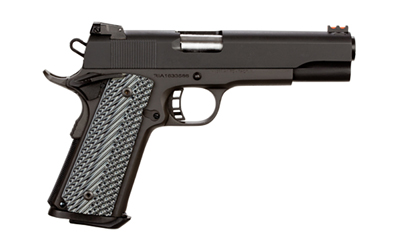
Rock Island Rock Ultra FS 10mm 5″ Parkerized
About this product
What is the Rock Island Rock Ultra FS 10mm 5" Parkerized? It's a full-size, steel-frame 1911 pattern pistol chambered in 10mm Auto, incorporating traditional 70-series design with modern upgrades like a 5-inch button-rifled barrel, a black parkerized finish, and G10 tactical grips for control. This configuration provides a specific counterpoint to the modern polymer-framed, striker-fired pistols prevalent today, offering shooters a heavy, all-steel platform better suited to taming the 10mm's substantial recoil. The included fiber optic front sight and adjustable rear sight emphasize practical field accuracy over competition-level refinements, placing it firmly in the working pistol category.
What is the Rock Island Rock Ultra FS used for?
The Rock Ultra FS is designed as a reliable, durable field pistol for backcountry defense, hunting camp carry, or as a heavy-recoil training platform. Its primary role is to offer a robust 1911-pattern firearm capable of handling full-power 10mm Auto loads, like those from Underwood or Buffalo Bore, with greater stability and longevity than a polymer-frame alternative. The 5-inch barrel improves ballistic performance over shorter-barreled 10mms, pushing 180-grain projectiles to approximately 1,250 feet per second, making it suitable as a sidearm where larger predators are a concern. It's a tool, not a trophy, built for hard use rather than safe-queen status.
How does the Rock Ultra FS compare to the Springfield Armory Ronin 1911?
Springfield's Ronin 1911 in 10mm is a direct competitor. The Rock Ultra FS is the better choice for cost-conscious buyers prioritizing a robust, no-frills field pistol, delivering comparable core mechanical function for $603.99 versus the Ronin's typical $900-plus price tag. The trade-off is in fit, finish, and parts pedigree. The Ronin features a forged slide and frame, more refined blending, and MIM parts generally considered higher-grade; the Rock Island uses a cast frame and more budget-conscious internal components. For a shooter who intends to use the pistol hard or as a base for custom work, the Rock Ultra FS offers greater value. For those seeking an out-of-the-box heirloom feel, the Springfield Ronin merits the higher investment.
What does it weigh and what are the dimensions?
This is a substantial, heavy pistol, weighing 40 ounces (2.49 pounds or 1,134 grams) unloaded due to its all-steel construction. Its overall dimensions are classic Government Model: 8.8 inches in total length, 5.5 inches in height (with magazine), and a slide width of 1.3 inches. The 5-inch barrel has a 1:16-inch twist rate, optimal for stabilizing heavy 10mm projectiles, and the grip circumference measures 5.25 inches with the included G10 panels. Compared to a polymer-framed pistol like a Glock 20, the Rock Ultra FS adds over a half-pound of mass, which directly translates to reduced felt recoil with stout ammunition.
Who is this NOT for?
This pistol is not for a first-time gun owner, a concealed carry permit holder seeking a discreet daily carry piece, or a competitive action shooter. Its 40-ounce weight and 5-inch barrel length make it impractical for all-day concealed carry, and its traditional single-action-only trigger with manual thumb and grip safeties requires dedicated training to operate safely under stress. It's also not for shooters who exclusively run mild, target-grade 10mm ammunition; at this price, you're paying for a frame overbuilt to handle hot loads. If your primary interest is in a lightweight, high-capacity 10mm for plinking, you'd be better served by a Glock 20 or the Stevens 334 Rifle for a different kind of backcountry firepower.
What's in the box?
The factory box for the Rock Ultra FS contains the pistol with one single-stack 8-round steel magazine, a basic polymer bushing wrench for field stripping, a small padlock for securing the firearm, and the standard manufacturer's warranty paperwork and manual. It does not include a hard case, a cleaning kit, or a second magazine, which are common omissions at this price point. The magazine features a flat steel base plate and a traditional Devel-style follower, and spare magazines are typically available for around $30-$40 each from Rock Island or third-party manufacturers like Wilson Combat or Chip McCormick.
Is the Rock Ultra FS worth it at $603.99?
A 10mm 1911 at just over $600 offers excellent mechanical value for a specific user. The construction—a steel frame, barrel, and slide with a durable parkerized finish—represents a significant amount of raw material and machining time for the price. You are getting a reliable, fundamentally sound 1911 platform capable of handling the 10mm cartridge's pressure, a task that has strained and cracked lesser frames. The return on investment comes in long-term durability and recoil management, not in target-grade fit or high-end components. If your priority is a rugged, simple 10mm pistol for demanding environments, this is a justifiable purchase. If you demand flawless slide-to-frame fit out of the box, you'll need to budget for smithing or look at higher-tier manufacturers.
Specs at a glance
Video review
Pros & cons
What works
- All-steel frame and slide weigh 40 oz (2.49 lb), absorbing 10mm recoil far better than a 30 oz polymer pistol.
- 5-inch button-rifled barrel with 1:16" twist provides excellent velocity and stability for heavy 180-200 grain 10mm projectiles.
- G10 tactical grips offer aggressive, non-slip texture superior to standard wood or plastic checkering in wet/cold conditions.
- Includes an adjustable rear sight, a feature often absent on budget 1911s like the Taurus PT1911, allowing for precise windage and elevation zeroing.
Trade-offs
- Parkerized finish is functional but lacks corrosion resistance compared to modern Cerakote or Tenifer; requires diligent oiling in humid environments.
- Feed ramp is not throated from the factory for semi-wadcutter bullets; reliable feeding requires round-nose or jacketed hollow point profiles until smoothed.
- Cast frame (not forged) has a theoretical longevity limit well below that of a forged frame under extreme round counts of the hottest 10mm loads.
- Some initial examples exhibit a slightly gritty trigger feel for the first 100-200 rounds, requiring a proper break-in period to smooth out.
Expert review
Key attributes
| upc | 4806015519911 |
| manufacturer | Armscor/Rock Island Armory |
| manufacturer part number | 51991 |
| action | Single Action |
| atf type | Pistol |
| barrel length | 5" |
| caliber/gauge | 10mm |
| capacity | 8 + 1 |
| color | Black |
| length | 10.5 |
| model | Rock Series |
| number of magazines | 1 |
| package height | 2.6 |
| package width | 10.2 |
| product type | Pistol |
| safety | Ambidextrous |
| shipping weight | 3.7 |
| sights | Adjustable Sights |
| sights type | FIBER OPTIC |
| slide description | Serrated |
| state restriction (ca) | NO DIRECT SHIP TO CALIFORNIA |
| units per box | 1 |
Frequently asked questions
- Is it compatible with standard 1911 magazines?
- The Rock Ultra FS in 10mm requires dedicated 10mm magazines, which are not mechanically compatible with .45 ACP 1911 magazines due to different feed lip geometry and internal magazine dimensions to accommodate the longer 10mm Auto cartridge. Single-stack 8-round 10mm magazines from manufacturers like Wilson Combat (#47-10M) or Chip McCormick (#10mm-8) will function, but you must verify they are specifically marked for 10mm to ensure proper feeding and prevent malfunctions. The included magazine is a standard 8-round steel body with a flat base plate.
- Does this have a firing pin block safety?
- No, the Rock Ultra FS does not have a firing pin block (Series 80-style) safety. It employs a traditional 1911 Series 70 configuration, relying on the inertia of the firing pin and the grip and manual thumb safeties alone. This design often results in a cleaner, lighter trigger pull but is a consideration for some shooters who prefer the redundant mechanical safety of a firing pin block. Always engage the manual thumb safety and ensure a proper firing grip to deactivate the beavertail grip safety before holstering.
- Can I mount an optic on the slide?
- The slide is not machined or prepared for any direct optic mounting system from the factory; it is a traditional dovetail rear sight configuration. Installing a red dot optic would require sending the slide to a qualified gunsmith for precision milling, which typically costs between $150 to $300 plus the cost of the optic plate itself. An alternative is a dovetail-mount plate adapter, but these sit high and can be less reliable for maintaining zero. If you want an optics-ready 10mm 1911, you'll need to look at models specifically offered in that configuration from other brands.
- How long does it take to break in?
- Expect a 200 to 300-round initial break-in period with full-power ammunition (not underloaded target rounds) to smooth out the feed ramp, barrel bed, and slide-to-frame interface. During this time, you may experience occasional failures to feed on the last round in the magazine or a stiff manual safety lever; these are common on new 1911s at this price point. A full cleaning and lubrication with a quality gun oil like Break-Free CLP or Slip 2000 EWL after the first 50 and 200 rounds is recommended to accelerate the process.
- What is the trigger pull weight?
- From the factory, the skeletonized trigger delivers a pull weight typically between 5.5 and 6.5 pounds, measured on a digital gauge. It's a single-stage pull with some mechanical take-up and a clean, if not glass-rod crisp, break. This is heavier than many after-market 1911 triggers but is appropriate for a field/tactical pistol and is generally safe from an out-of-the-box liability standpoint. A skilled gunsmith can reliably tune this down to 4-4.5 pounds for approximately $75-$120 without compromising safety for the lockwork.