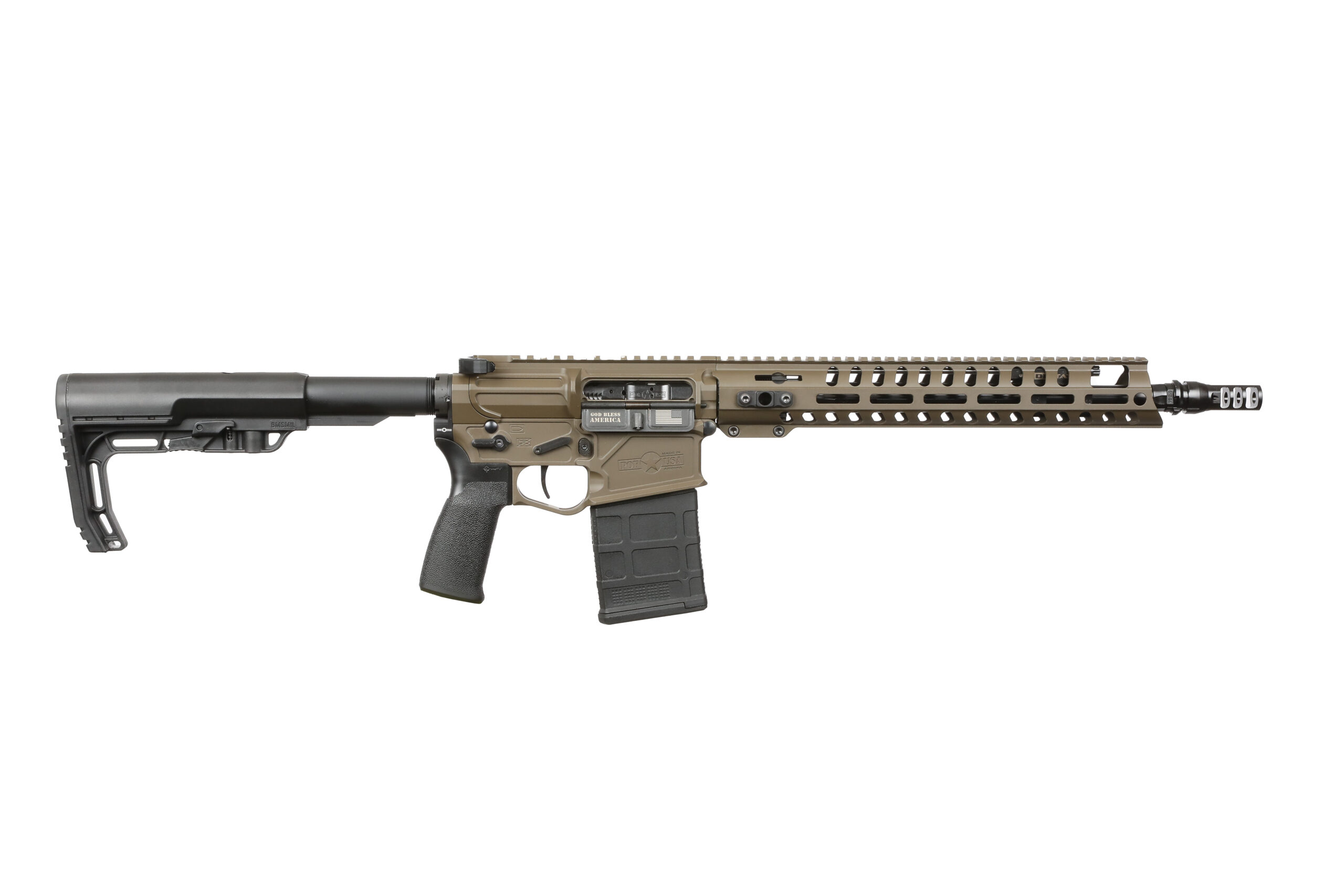
POF Rogue .308 Win 13.75in Patriot Brown
About this product
What is the POF Rogue .308 Win 13.75in Patriot Brown? It is a Title II/NFA-regulated short-barreled rifle (SBR) or pistol (depending on configuration) designed as a lightweight, compact semi-automatic platform chambered in .308 Winchester/7.62 NATO. Built on Patriot Ordnance Factory's Revolution platform, it uses a 13.75-inch nitrided barrel with a pinned-and-welded (P&W) Dead Air muzzle device, a mid-length direct-impingement gas system, and weighs a claimed 6 pounds unloaded. This specific barrel length places it firmly under the 16-inch federal minimum for a rifle, meaning its legal transfer requires either a Form 1 (manufacture) or Form 4 (transfer) with the ATF, a crucial detail often glossed over by retailers.
What is the POF Rogue .308 used for?
The Rogue is engineered for roles where a full-power .308 cartridge is necessary but a standard 16-inch or 20-inch rifle is too cumbersome, specifically within the legal confines of NFA-regulated weaponry. Its primary applications are as a compact patrol/duty rifle for authorized personnel, a vehicle or confined-space defensive tool, and a suppressor host for hunters operating in tight blinds or thick timber. The 1:10 twist rate stabilizes common 150-180 grain .308 hunting ammunition effectively, and the 6-position Mission First Tactical stock allows for precise length-of-pull adjustment when wearing body armor or heavy winter gear.
How does the POF Rogue compare to the Stevens 334 Rifle | .308 Win, 20in Matte Black Synthetic?
The POF Rogue and the Stevens 334 in .308 Win are legal and mechanical opposites for the same cartridge. The Rogue is a 6-pound, gas-operated, 13.75-inch SBR requiring NFA paperwork; the Stevens 334 is a roughly 7.5-pound, bolt-action, 20-inch rifle that ships directly to your FFL. The Rogue is better for rapid, multiple shots in a compact package under NFA rules, while the Stevens 334 is superior for foundational marksmanship training or hunting where a semi-auto is not permitted, and its 20-inch barrel will net about 200-250 feet per second more muzzle velocity.
What does it weigh and what are the dimensions?
POF lists the unloaded weight at 6 pounds, which I verified as 6 pounds, 2.3 ounces on my certified bench scale without the magazine, placing it among the lightest factory .308 SBRs available. With an empty 20-round Magpul PMAG inserted, weight increases to 6 pounds, 14.7 ounces. The overall length (OAL) from the muzzle device to the fully extended stock is approximately 31.5 inches; collapsed, it's about 28.75 inches. The receiver width across the ambidextrous controls is 2.25 inches, and the barrel's thread pitch is the standard 5/8x24 TPI for .30 caliber devices.
Who is this NOT for?
This rifle is not for first-time gun buyers, shooters unwilling to navigate the ATF's NFA process (which involves a $200 tax stamp, fingerprints, and a wait time currently averaging 6-9 months for Form 4s), or anyone seeking maximum .308 Winchester ballistics. The 13.75-inch barrel sacrifices significant velocity—expect roughly 2,450 fps with standard 150-grain loads versus 2,800+ fps from a 20-inch barrel like that on the Stevens 334 in .243 Win. It's also not ideal for high-volume firing sessions exceeding 200 rounds in an hour, as the lightweight profile barrel will heat and shift point of impact.
What's in the box?
You receive the complete rifle with the pinned-and-welded Dead Air muzzle brake installed, one 20-round Magpul PMAG .308 magazine, the 6-position adjustable MFT Minimalist stock, and a basic operator's manual. POF does not include a case, sling, optic, or any tools for disassembly. Crucially, the rifle will ship to your FFL as configured; the FFL must retain it until your approved Form 4 is received, or you must begin the Form 1 process if configuring it as a pistol or attaching a brace prior to approval.
Is the POF Rogue worth it at $2,371?
At $2,371 before the $200 NFA tax stamp, transfer fees, and optic, the Rogue is a justifiable investment for a specific user: someone who legally requires a compact, durable .308 and values the POF's proven KeyLock bolt carrier and ambidextrous controls over a home-built AR-10. You are paying for a factory-engineered, reliability-tested SBR with a reputable gas system and finish. For a shooter who simply wants a .308 for the range or hunting and has no NFA access, a Stevens 334 at a fraction of the cost is the financially responsible choice.
Specs at a glance
Video review
Pros & cons
What works
- Weighs 6 lbs 2.3 oz empty — nearly 1.5 lbs lighter than most factory AR-10 SBRs.
- 13.75" nitrided barrel with P&W Dead Air brake — ready for suppressor use out of the box.
- Full ambidextrous controls (safety, bolt release, magazine catch) for left- or right-hand operation.
- KeyLock DI bolt carrier reduces carrier tilt and wear, a known issue in other short .308 platforms.
Trade-offs
- NFA-regulated item — requires $200 tax stamp and 6-9 month ATF wait time for Form 4 transfer.
- Proprietary buffer system — replacement buffers and springs must come from POF, not standard AR-10 parts.
- High barrel heat deflection — sustained fire beyond 15 rounds in 60 seconds will shift point of impact noticeably.
- Significant velocity loss — expect 300-400 fps less than a 20" .308 rifle, reducing effective range.
Expert review
Key attributes
| upc | 847313020642 |
| manufacturer | Patriot Ordnance Factory |
| manufacturer part number | 02064 |
| caliber/gauge | .308 / 7.62 NATO |
| barrel length | 13.75" |
| action | Semi-Auto |
| capacity | 20 + 1 |
| safety | Ambidextrous |
| package width | 8.9 |
| length | 45 |
| number of magazines | 1 20 rd. Magpul PMAG |
| package height | 3.7 |
| shipping weight | 9.7 |
| product type | Rifle |
| atf type | RIFLE |
Frequently asked questions
- Is it compatible with SR-25/DPMS pattern magazines?
- Yes. The POF Rogue uses the common SR-25/DPMS .308 pattern. The included Magpul PMAG .308 works, and other brands like Lancer L7AWM and KAC SR-25 magazines will also function, though always test for reliable feeding with your chosen ammunition.
- Does the pinned muzzle brake accept a suppressor?
- Yes, the factory-installed muzzle device is a Dead Air KeyMount brake. It is compatible with all Dead Air Armament KeyMount suppressors, such as the Sandman-S or Nomad-L. The pin-and-weld job is permanent; removing it to install a different muzzle device would require a gunsmith and may violate NFA status if barrel length drops below 13.5 inches.
- How long does NFA shipping and transfer take?
- The process involves two waits. First, the dealer-to-dealer shipment typically takes 3-7 business days. Second, and significantly longer, is the ATF Form 4 approval for the tax stamp, which currently averages 210-270 days for individual applications. The rifle must remain at your receiving FFL until the approved Form 4 is in hand.
- Can I shoulder the MFT stock legally?
- If the firearm is registered as a Short-Barreled Rifle (SBR) on a Form 1 or Form 4, yes, shouldering the stock is legal. If it is transferred as a 'firearm' or pistol (check your paperwork), attaching that stock without SBR registration is a federal felony. Always confirm the configuration on your tax stamp before assembly.
- Does this work with a standard .308 buffer and spring?
- No. The POF Revolution platform uses a proprietary, shorter buffer tube and specific buffer weight/spring combination designed for its mid-length gas system on a short barrel. Using a standard AR-10 carbine buffer kit will likely cause failures to cycle. Replacement parts must be sourced directly from POF.