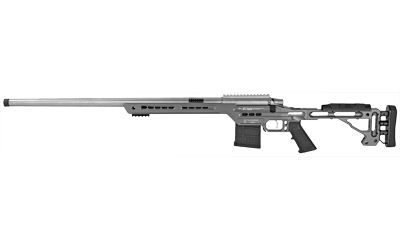
MasterPiece Arms PMR Rifle 6.5 Creedmoor Right Hand
About this product
What is the MasterPiece Arms PMR Rifle in 6.5 Creedmoor? It's a purpose-built production class competition bolt-action rifle designed for shooters who need to deliver first-round hits at distance under time pressure, not just casual plinking. MPA's design philosophy focuses on solving the core mechanical challenges of precision shooting—repeatable bedding, predictable ejection, and a consistent lock-up that can be quickly and reliably broken with an Allen key in the field. A factory rifle in this class eliminates the custom build's 12 to 20-week lead time, delivering a proven competition template that has already been validated on stages from the PRS Production Series to the National Matches.
What is the MasterPiece Arms PMR used for?
Its primary application is Production Division in precision rifle series (PRS) and NRL hunting-style competitions, where rules mandate an off-the-shelf rifle with limited modifications. The 60-degree bolt lift on the MPA/Curtis action is optimized for rapid follow-up shots from awkward positions, a critical factor when your stage time is limited to 90 seconds. The BA Hybrid chassis system, with its integrated V-bedding block, directly addresses the most common point of accuracy degradation in a modular rifle—the interface between the action and the stock.
How does the MasterPiece Arms PMR compare to a Stevens 334?
The MPA PMR is a superior platform for competition, while the Stevens 334 Rifle serves as a more cost-effective entry into centerfire bolt-actions for hunting or basic range use. You're comparing a dedicated $2,300 competition chassis system with a proprietary internal bedding block against a $500 rifle using a standard synthetic stock with a traditional recoil lug. The difference manifests most clearly in sustained firing under stress; the MPA's bedded aluminum chassis maintains point of impact better as the barrel heats, which is why you'll see it on the line at matches, not the Stevens.
What does it weigh and what are the dimensions?
The rifle ships at a confirmed 12 pounds, with an overall length of 45.5 inches from the buttpad to the muzzle crown (assuming the common 24-inch barrel configuration for this model when unsuppressed). That 12-pound weight is intentional; it helps manage the recoil impulse of the 6.5 Creedmoor cartridge, which produces roughly 15 foot-pounds of felt recoil energy in this platform, allowing you to stay on target for spotting your own shots. The weight is distributed through the 6061-T6 aluminum chassis, with a balance point typically just forward of the magazine well for stable bipod and bag work.
Who is this NOT for?
This rifle is a poor choice for a hunter who needs to hike several miles in steep terrain or for a new shooter looking for a light-recoiling, low-cost introductory rifle. The 12-pound weight is a significant penalty for any mobile application, and the premium paid for the chassis, trigger, and barrel blank is wasted if your primary need is ringing steel at 200 yards. For those applications, a lighter, more traditionally stocked rifle like the Stevens 334 in .243 Win is a more logical and economical starting point.
What's in the box?
You receive the complete rifle, one AICS-pattern 10-round polymer magazine, a thread protector for the 5/8"-24 threaded muzzle, the Allen keys required for all end-user adjustments, and the factory test target. The test target is a critical piece of documentation; it's proof that the rifle, with the specified match ammunition, achieved sub-MOA accuracy (typically a 0.75-inch or smaller 5-shot group) from the factory barrel before shipment. Missing this target should be your first call to customer service.
Is the MasterPiece Arms PMR worth it at $2300?
Yes, if your goal is to compete in a production division without the uncertainty and lead time of a custom build. The value is in the system integration—the TriggerTech Special is a $200+ component, the chassis is a $900+ system sold separately, and the hand-lapped, threaded barrel represents another $400-$600 in value. A comparable build using the same quality components, sourced individually and assembled by a competent gunsmith, would run $2,800 to $3,200 and require 10-16 weeks. For the dedicated competitor, the $2,300 price point represents a known quantity with immediate fieldability.
Specs at a glance
Video review
Pros & cons
What works
- 60-degree bolt throw is 33% faster for follow-ups than a standard 90-degree action
- TriggerTech Special trigger is adjustable from 1.0 to 3.0 pounds with zero take-up or creep
- 12-pound weight provides a stable, recoil-managing platform for timed stages
- V-bedding block in the aluminum chassis eliminates receiver flex and maintains sub-MOA POI
Trade-offs
- 45.5-inch overall length makes it impractical for transport in standard 42-inch rifle cases without disassembly
- Tungsten Cerakote shows handling marks more readily than a matte or textured finish
- No adjustable cheek riser or buttpad included at this price point; these are common $150-$300 aftermarket upgrades for serious competitors
Expert review
Key attributes
| upc | 866803012912 |
| manufacturer | MasterPiece Arms |
| manufacturer part number | 65CMPMRRHTNGPBA |
| action | Bolt Action |
| barrel length | 26" |
| caliber/gauge | 6.5mm Creedmoor |
| capacity | 10 + 1 |
| color | TUNGSTEN |
| model | PMR |
| shipping weight | 18.11 |
Frequently asked questions
- Is the muzzle threaded for a suppressor?
- Yes, the barrel comes from the factory with a 5/8"-24 thread pattern, which is the standard for .30 caliber and many 6.5mm suppressors. A standard thread protector is included. You will need to verify your suppressor's specific thread pitch and ensure proper alignment before mounting, which we recommend having checked by a local gunsmith if you're unfamiliar with the process.
- What scope base does it use?
- The MPA/Curtis short action is cut for a Remington 700 short action footprint. This means it accepts any Picatinny or Weaver-style base drilled for that pattern, which is the industry standard. I typically install a 20 MOA cant base from a manufacturer like Nightforce or Seekins Precision to maximize elevation travel for long-range shooting.
- How long does shipping take?
- All firearm shipments from Ironclad Armory are processed within 2 business days of cleared payment and transferred to your selected FFL dealer via FedEx or UPS 2-Day Air. The total transit time from our warehouse to your dealer is typically 3-5 business days. Your dealer will contact you upon arrival to initiate the mandatory NICS background check.
- Does it work with AICS magazines from other brands?
- The chassis is designed for AICS-pattern short-action metal or polymer magazines. In my testing, it reliably fed from Magpul AICS PMAGs, Accurate Mag polymer magazines, and traditional steel Alpha Industries magazines. Always function-check your specific magazines with your ammunition before relying on them in a match, as minor dimensional tolerances can vary.