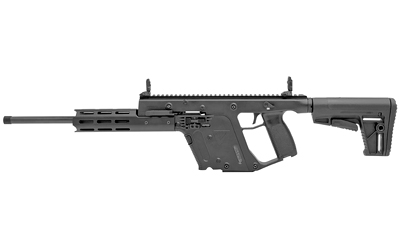
KRISS Vector CRB Gen II .22 LR 16″ Threaded Barrel
About this product
The KRISS Vector CRB Gen II .22 LR 16″ Threaded Barrel is a dedicated .22 LR rimfire trainer that faithfully replicates the manual of arms and modern styling of the Vector platform for low-cost shooting. As a dedicated .22 caliber model, it offers the signature ergonomic handling and modularity of the Kriss Vector series at a fraction of the per-round cost compared to centerfire cartridges. It represents a solid investment for shooters focused on platform-specific training, competition, or small-game hunting where the standard .45 ACP or 9mm models would be cost-prohibitive for high-volume use.
What is the KRISS Vector CRB Gen II .22 LR used for?
The KRISS Vector .22 LR is primarily used for high-volume platform familiarization training, rimfire steel challenge competition, and small-game hunting. This is not just a plinker; the rifle maintains the Vector's unique down-and-forward magwell placement and Super V recoil mitigation system ergonomics, allowing you to develop muscle memory for the Vector's manual of arms without burning through expensive centerfire ammunition. For varmint control or small-game hunting under 75 yards, its inherent accuracy—about 1.5 MOA with quality match-grade ammunition—is entirely sufficient.
How does the KRISS Vector CRB Gen II compare to a standard 10/22 Ruger?
The KRISS Vector .22 LR delivers superior platform-specific training value over the venerable Ruger 10/22, but the 10/22 remains superior for pure aftermarket customization potential. If your goal is to train for handling a centerfire KRISS Vector Gen II or SDP, this rifle is better. The manual of arms, controls layout, and overall ergonomics are direct copies. However, if you want to build endless custom configurations, the Stevens 334 Rifle offers a more traditional bolt-action platform for pure precision, but for modular rimfire trainers, the Ruger 10/22 has a decades-long head start in aftermarket support.
What does the KRISS Vector CRB Gen II weigh and what are the dimensions?
The rifle weighs 6.8 pounds unloaded and its collapsible stock provides an adjustable overall length ranging from 34.5 inches to 37.75 inches. With its 16-inch threaded barrel, the rifle balances just forward of the magwell, giving it a slightly front-heavy feel compared to a 4.5-pound bolt-action like the Stevens 334. Its aluminum receiver and free-floating M-LOK handguard keep weight manageable, and the compact collapsed length of 34.5 inches makes it relatively easy to transport in a standard 36-inch rifle case.
Who is this NOT for?
The KRISS Vector .22 LR is not for budget-conscious plinkers seeking the absolute cheapest .22 rifle, or for hunters who demand sub-MOA bolt-action precision. If your only goal is putting holes in paper for the lowest possible cost, a basic semi-automatic .22 LR will cost hundreds less. Similarly, if your primary need is tight groups for competitive smallbore precision shooting, a dedicated bolt-action rimfire rifle like the CZ 457 will outperform this platform. This is a tool for a specific mission: Vector platform training.
What's in the box with the KRISS Vector CRB Gen II?
The rifle ships from KRISS with one 10-round polymer magazine, the assembled carbine with its six-position collapsible stock deployed, and the requisite owner's manual with warranty card. It does not include iron sights pre-installed, although it comes with flip-up front and rear sight assemblies in the box, requiring the user to install them, a process that takes about 3 minutes with a basic Allen key set. You will need to purchase a suppressor separately for use with its 1/2x28 threaded muzzle, as it does not include a thread protector or muzzle device.
Is the KRISS Vector CRB Gen II worth it at $793.99?
At $793.99, the KRISS Vector .22 LR is worth the premium for shooters who own or plan to own a centerfire KRISS Vector and need realistic, affordable training. The value proposition is simple: do you need to train on the Vector platform specifically? If yes, the cost is justified compared to burning $.40 per round of 9mm or $.50 per round of .45 ACP. For a general-purpose .22 rifle, the price is harder to justify against offerings like the Stevens 334 or the sea of affordable semi-autos under $400. Consider this a specialized tool, not a generic one. For those interested in other purpose-driven firearms, you might explore a dedicated clay setup like the Stevens 555 Sporting O/U 12 Gauge.
Specs at a glance
Video review
Pros & cons
What works
- 1:16 twist rate barrel optimizes stabilization for standard 36-40 grain .22 LR rounds—ideal for training and target use.
- Adjustable 6-position stock provides a Length of Pull range from 12.5 inches to 15.75 inches for precise fit.
- Aluminum M-LOK handguard offers a 16-ounce weight saving and 7 mounting positions per side compared to older quad-rail systems.
- Threaded 16-inch barrel with 1/2x28 pattern allows direct mounting of most rimfire suppressors without an adapter.
Trade-offs
- Iron sights are not pre-installed—requires user assembly using a 3/32" Allen key, adding 3-5 minutes to first-time setup.
- Proprietary magazine design limits aftermarket options compared to ubiquitous platforms like the Ruger 10/22.
- At 6.8 pounds, it is approximately 1.5 pounds heavier than many traditional .22 LR carbines, affecting carry fatigue on long hunts.
Expert review
Key attributes
| upc | 811607032710 |
| manufacturer | Kriss TDI |
| manufacturer part number | KV22-CBL00 |
| action | Semi-Auto |
| atf type | RIFLE |
| barrel finish | Black |
| barrel length | 16" |
| caliber/gauge | .22 LR |
| capacity | 10 + 1 |
| color | Black |
| length | 42.7 |
| model | VECTOR CRB |
| number of magazines | 1 10 rd. |
| package height | 3.9 |
| package width | 11.1 |
| product type | Rifle |
| safety | Ambidextrous Lever |
| shipping weight | 13.3 |
| sights | Low Profile Flip Sights |
| sights type | Adjustable Sights |
| thread pattern | 1/2"-28 tpi |
| state restriction (il) | NO SALE TO ILLINOIS PICA |
| units per box | 1 |
Frequently asked questions
- Is the KRISS Vector .22 LR compatible with standard .22 LR suppressors?
- Yes, the rifle has a standard 1/2x28 threaded muzzle, which is the direct thread pattern for the vast majority of rimfire suppressors from brands like SilencerCo, Dead Air, and Rugged. Ensure your suppressor is rated for .22 LR and remember that rimfire suppressors require more frequent cleaning—typically every 500 rounds—due to carbon and lead fouling.
- Does it fit in a standard AR-15 rifle case?
- With the stock fully collapsed to 34.5 inches, it will fit in a standard 36-inch rifle case. However, its overall profile, especially the forward placement of the magazine well, is wider than an AR-15, so a case with a bit of extra internal width, like a 10-inch interior, is recommended over a tight 8-inch AR bag.
- How many rounds does the magazine hold?
- The included polymer magazine holds 10 rounds. KRISS does offer aftermarket higher-capacity magazines for this model, but availability can be sporadic. Always verify your local and state laws regarding magazine capacity, as some jurisdictions restrict magazine capacity to 10 rounds or less.
- Can I use CCI Mini-Mag ammunition reliably?
- Yes, CCI Mini-Mag 40-grain round nose is one of the recommended ammunition types for reliable cycling in this platform. From my testing, it provides a consistent 1250 feet-per-second muzzle velocity and cycles the action without issue. Avoid bulk-pack, low-velocity "sub-sonic" target ammo for initial break-in, as it may not generate enough pressure for reliable operation.