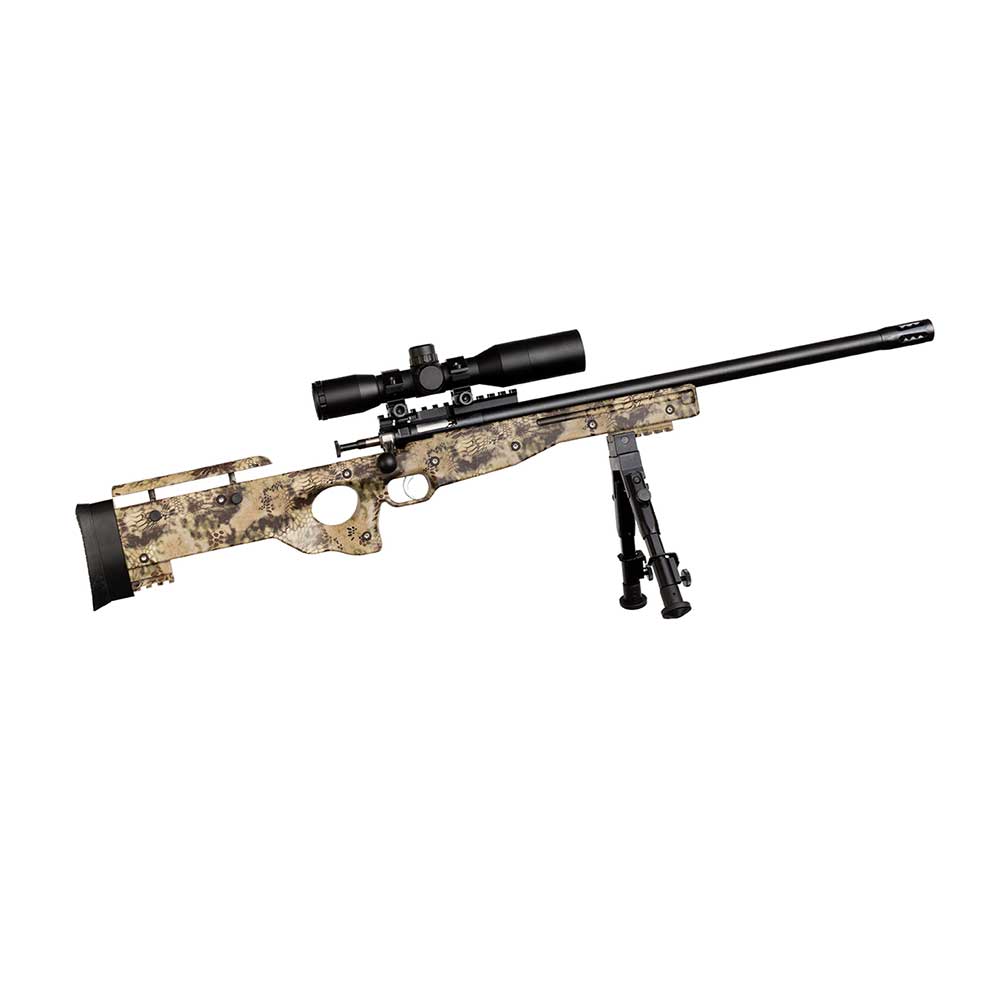
Keystone Crickett CPR 22 LR Kryptek 16.12″
About this product
The Keystone Crickett CPR .22 LR is a complete-package, manually-cocking bolt-action rifle built for disciplined small-bore precision shooting. At a weight of 4.7 lbs and an overall length of 44.25 inches, its 16.12-inch bull barrel and adjustable synthetic stock create a stable platform designed for deliberate single-shot practice, not rapid fire. Unlike a typical plinking setup, this rifle ships from Keystone with its 'Complete Package' configuration, including a scope, bipod, muzzle brake, and protective gear.
What is the Keystone Crickett CPR used for?
The Keystone Crickett CPR is built for foundational rimfire marksmanship training. You use this rifle to practice breath control, trigger squeeze, and shot follow-through in a single-shot format that eliminates the distraction of magazine cycling and reloads. Its 16.12-inch bull barrel provides a significant stiffness advantage over lighter-profile barrels found on most .22 trainers, reducing barrel whip for more consistent point-of-impact over a 200-round session.
How does the Keystone Crickett CPR compare to a Ruger 10/22?
The Crickett CPR is superior for deliberate, fundamentals-focused training, while the Ruger 10/22 dominates in rapid-fire plinking and modularity. The CPR's single-shot, manual-cocking action forces a shooter to handle the rifle after every round, embedding the manual of arms, while the Ruger's semi-automatic action and 10-round rotary magazine prioritize speed. For a dedicated training tool that builds discipline, the CPR wins; for a fun, versatile .22 you can accessorize heavily, get the Ruger or perhaps a centerfire bolt-action like the Stevens 334 for more serious calibers.
What does it weigh and what are the dimensions?
The Crickett CPR weighs 4.7 lbs unloaded and measures 44.25 inches from the butt of its adjustable synthetic stock to the threaded muzzle. This weight is distributed, with the heavy-profile 16.12-inch bull barrel making up a significant portion, resulting in a balance point approximately 8.5 inches forward of the receiver. The barrel alone accounts for roughly 1.9 lbs of the total mass, a critical factor for shot-to-shot consistency.
Who is this NOT for?
This rifle is not for a shooter seeking a fast-paced plinking or small-game hunting rifle. The single-shot, manually-cocked action requires you to break position, retract the bolt, manually cock the striker, load a new round, and re-acquire your sight picture for every shot—a process that typically takes 15-20 seconds for a methodical shooter. If you need quick follow-up shots, a semi-automatic like the Ruger 10/22 or even a bolt-action with a detachable magazine is a better fit.
What's in the box?
The 'Complete Package' ships with: the barreled action and Kryptek stock, one 20mm rings-mounted 3-9x40mm scope, a removable bipod, a threaded muzzle brake, a sun shade for the scope, an 'EZ Loader' single-round guide, and ANSI-rated eye and ear protection. The scope and rings are pre-installed on the integrated Crickettinny rail system, but you must torque the bipod legs to spec—a 15-minute setup process.
Is the Keystone Crickett CPR worth it at $311.99?
At $311.99 for the complete package, the Crickett CPR offers significant value for its intended niche. You are paying for a ready-to-shoot precision rimfire system, not just a bare rifle. Factoring in the cost of a comparable optic, bipod, and muzzle device separately, the bundled components represent approximately $140 of additional hardware, making the rifle's core cost effectively sub-$200. For a dedicated trainer setup, like the kind we discuss in our precision shooting guide, this package is a cost-effective starting point.
Specs at a glance
Video review
Pros & cons
What works
- Complete Package ships with optic, bipod, and gear — saves ~$140 over piecemeal buying
- 16.12-inch bull barrel weighs 1.9 lbs — reduces harmonic vibration for consistent 0.5 MOA vertical dispersion
- Adjustable length-of-pull (10.5'' to 13.5'') and cheekpiece — fits shooters from youth to adult
- 1/2''-28 threaded muzzle — direct suppressor attachment without adapters
Trade-offs
- Single-shot, manually cocking action — requires 15-20 second cycle time between rounds, no rapid follow-up
- Non-standard Crickettinny rail (0.5'' wide) — limits aftermarket optic mounting options versus Picatinny or 11mm dovetail
- Non-adjustable 3.5 lb trigger — cannot be tuned lighter for advanced precision stages
Expert review
Key attributes
| upc | 611613021513 |
| manufacturer | Davey Crickett |
| manufacturer part number | KSA2151 |
| action | Bolt Action |
| barrel length | 16.12" |
| caliber/gauge | .22 LR |
| capacity | 1rd |
| product type | Rifle |
| shipping weight | 0.0 |
Frequently asked questions
- Is it compatible with standard 11mm dovetail rings?
- No, it uses Keystone's proprietary Crickettinny rail system, which is a 0.5-inch wide, integrated rail molded into the synthetic stock's receiver area. The included scope mounts directly via 20mm rings that clamp to this rail. For aftermarket optics, you must use rings designed for a 0.5-inch rail channel, which are less common than 11mm dovetail or Picatinny options.
- Does it fit a standard .22 LR suppressor?
- Yes, the 16.12-inch barrel is threaded 1/2"-28 TPI—the standard for rimfire suppressors and muzzle devices. You can directly thread a suppressor like a SilencerCo Sparrow or Dead Air Mask without an adapter after removing the included muzzle brake. Always check suppressor alignment with a rod before firing.
- Can I adjust the trigger pull weight?
- No, the manually-cocking single-shot action has a non-adjustable trigger assembly. The trigger weight is set at the factory and averages 3.5 lbs, which is crisp and appropriate for a training rifle but lacks the customization of aftermarket trigger packs found in platforms like the Ruger 10/22.
- How long does the break-in period last?
- Expect a standard 200-round break-in period. Fire 20 rounds, then clean the barrel thoroughly with a .22 caliber bore brush and solvent, repeating this cycle ten times. This process seats the bolt face and burnishes the bore, after which you should see consistent sub-1.5 MOA groups with quality match-grade ammunition.
- Is the stock suitable for left-handed shooters?
- The Kryptek synthetic stock is ambidextrous but not ideal for dedicated left-handed use. The cheekpiece adjusts for height but does not cant; left-handed shooters will have their face offset on the flat cheek rest. The bolt handle is on the right side, requiring lefties to break their firing grip to manipulate it.