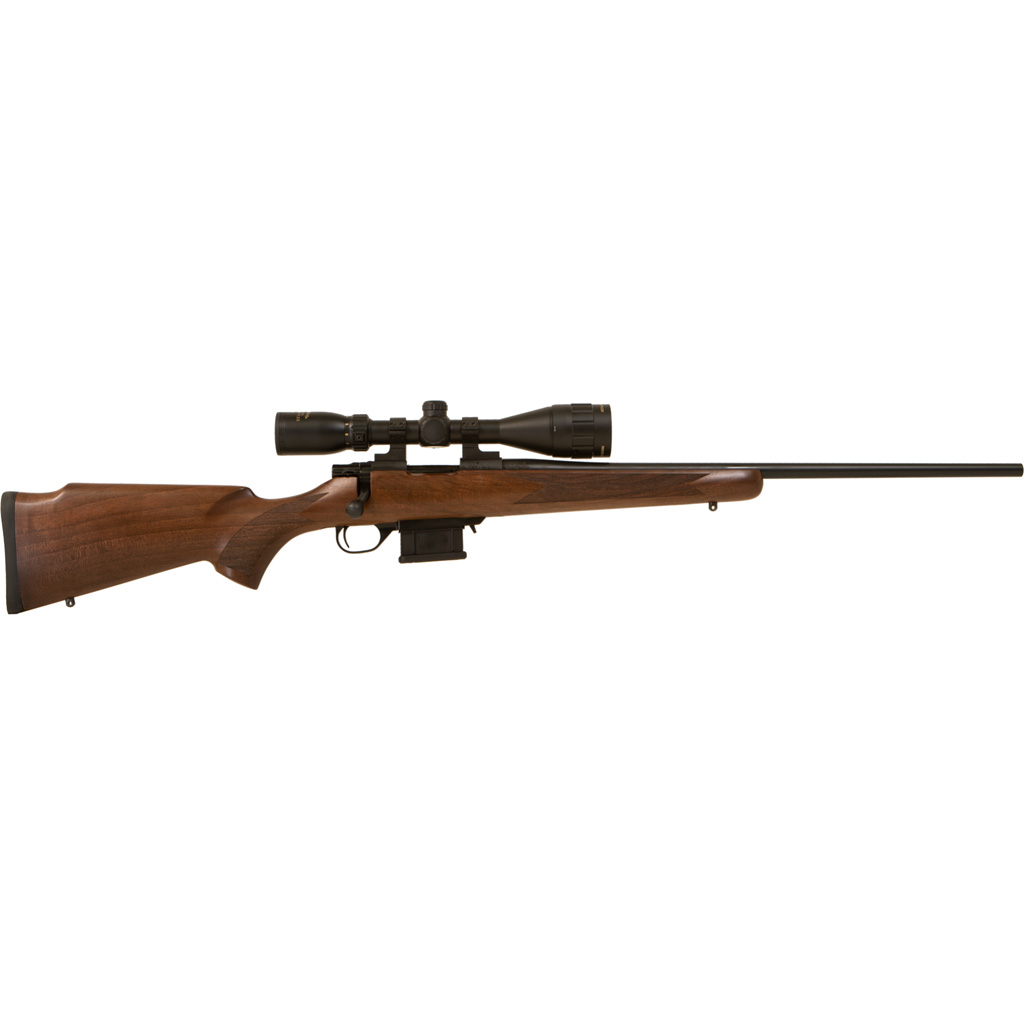
Howa M1100 Walnut Hunter GamePro Rifle .22 LR 18 in. w/ Scope
Video review
Expert review
About this product
What is the Howa M1100 Walnut Hunter GamePro Rifle? It's a bolt-action .22 LR rimfire rifle designed as a no-excuses, out-of-the-box platform for precise small-game hunting and field-target shooting, distinguished by its Japanese-forged steel action and included optic. This rifle ships with a mounted scope, a characteristic uncommon in this price bracket for rifles built to this standard, which immediately shifts the value proposition from a project to a tool. My first inspection of the receiver channel and bolt face revealed Howa's typical attention to machining tolerances, a carryover from their centerfire manufacturing that directly influences .22 LR consistency.
What is the Howa M1100 Walnut Hunter GamePro Rifle used for?
The Howa M1100 is used for eliminating squirrels, rabbits, and crows at ethical rimfire distances, with a secondary role as a low-cost, high-precision trainer for fundamentals like trigger control and scope tracking. Its 10-round magazine and 18-inch barrel optimize it for deliberate, single-shot field applications rather than high-volume plinking, and the 6.2-pound unloaded weight provides the stability needed for off-hand shots at 50 yards. The supplied Nikko Stirling GamePro scope's 3-9x magnification is perfectly matched to the cartridge's realistic 100-yard maximum effective range on small game.
How does the Howa M1100 Walnut Hunter GamePro Rifle compare to the Stevens 334 Rifle in .243 Win?
The Howa M1100 is better for training new shooters and hunting small game under 100 yards, while the Stevens 334 in .308 Win is a superior choice for deer or larger game at extended ranges. The Stevens 334 operates at a completely different power and recoil level, costs significantly more per round to feed, and serves a different legal and ethical purpose. Choosing between them isn't about quality; it's about matching the tool to the task where rimfire sufficiency meets regulatory allowance, unlike the centerfire requirement for most larger game.
What does it weigh and what are the dimensions?
The rifle weighs 6.2 pounds (2.81 kg) unloaded, with an overall length of 39.5 inches and a 1.5-inch thick walnut stock at the comb for consistent cheek weld. The 18-inch barrel contributes to a balance point approximately 6 inches forward of the trigger guard, and the 13.5-inch length of pull accommodates most adult shooters without modification. Compared to synthetic-stocked .22 LR trainers, this walnut configuration adds roughly 1.2 pounds of stabilizing mass, directly damping tremor for more precise off-hand shots.
Who is this NOT for?
This rifle is not for tactical competitors seeking a chassis-based .22 LR platform for PRS Rimfire matches that require immediate accessory rail compatibility. It lacks the Picatinny forend and adjustable stock crucial for that discipline, and its classic sporter profile makes mounting a bipod or bag rider an aftermarket chore. It's also a poor choice for ultra-high-volume 'can plinking' where a semi-automatic like a Ruger 10/22 offers faster follow-up shots; the bolt-action cycle time here is about 2.5 seconds between aimed shots.
What's in the box?
In the box, you receive the barreled action with scope base installed, the Nikko Stirling GamePro 3-9x40mm scope mounted and bore-sighted, one 10-round steel magazine, a basic set of scope ring wrenches, and a factory manual with test target. Notably absent are any thread protectors or sling swivel studs; the barrel is not threaded, and the stock requires drilling for swivels. The factory bore-sight is typically within 4 inches at 25 yards, sufficient to get you on paper for final zeroing, which takes about 12 rounds of .22 LR.
Is the Howa M1100 Walnut Hunter GamePro Rifle worth it at $677.99?
At $677.99, this rifle is worth it for the shooter who demands a forged-steel action, classic wood furniture, and a functional optic in one purchase, avoiding the $150-$250 typically spent separately on a comparable scope and rings. The value lies in the integrated system reliability; Howa controls the mounting interface, eliminating the common end-user error of misaligned rings that cause scope tracking issues. For a simpler, budget-first rimfire option without an optic, consider the bolt-action platform in our Stevens 334 lineup, but understand you're trading material pedigree for initial cost savings.
Specs at a glance
Pros & cons
What works
- Forged steel action - provides a rigid, consistent lockup superior to many competing Zytel or aluminum receiver .22s.
- Includes mounted 3-9x40mm scope - saves $150+ versus sourcing equivalent rings and a Nikko Stirling optic separately.
- 6.2 lb total weight - 1.2 lbs heavier than synthetic trainers for enhanced off-hand stability.
- 18-inch hammer-forged barrel - promotes consistent muzzle velocity, key for precision at 75+ yards.
Trade-offs
- No threaded barrel - eliminates straightforward suppressor use without costly gunsmithing/NFA paperwork.
- Proprietary 10-rd magazine - limits aftermarket high-capacity options common with Ruger 10/22 platforms.
- Stock lacks sling swivel studs - requires drilling/tapping for field sling, a 30-minute gunsmith task.
- Classic sporter profile - not compatible with modern chassis systems for competitive shooting disciplines.
Key attributes
| upc | 682146882773 |
| manufacturer | Howa |
| manufacturer part number | HWH22WMRGP |
Frequently asked questions
- Is the barrel threaded for a suppressor?
- No, the 18-inch barrel on the M1100 Walnut Hunter is not threaded. It features a crowned muzzle. Adding threads would require a certified gunsmith to machine the barrel, a process typically costing $120-$200 plus NFA paperwork if constructing a Short-Barreled Rifle (SBR).
- Does it accept aftermarket 10/22 magazines?
- No, it uses a proprietary Howa-designed 10-round steel magazine. Third-party options are limited compared to the ubiquitous Ruger 10/22 platform. The magazine release is a heel catch at the rear of the magazine well, not a button release.
- Can the scope be swapped for a red dot?
- Yes, the receiver is drilled and tapped for a standard 0 MOA Picatinny rail (sold separately). The included Nikko Stirling GamePro scope uses 1-inch rings. A micro red dot would require a low-profile Picatinny-to-dot mount, adding approximately 1.5 ounces to the system weight.
- How long does shipping to an FFL take?
- For in-stock items, processing and shipping to your selected FFL dealer typically takes 3-5 business days. The FFL must then conduct the required NICS background check, which is an additional, variable wait time upon your arrival for pickup.
- Does this work with standard .22 LR, Long, and Short?
- It is chambered specifically for .22 Long Rifle (LR) cartridges only. While .22 Short may physically chamber, it will not feed reliably from the magazine and can cause fouling issues. I recommend against using anything other than standard or high-velocity .22 LR rounds.