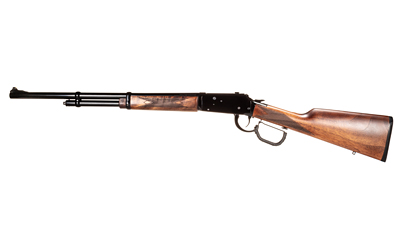
Heritage Range Side .410 20in Lever Action Shotgun
Pros & cons
What works
- Weighs 6.4 lb unloaded — 2.5 lb lighter than many 12-gauge lever guns, aiding one-handed carry.
- 20-inch barrel yields a 39.5-inch overall length — over 8 inches shorter than standard O/U .410 shotguns for better maneuverability.
- 5+1 round capacity allows for multiple engagements without reloading, unlike single-shot .410 alternatives.
- Lever cycles in approximately 1.2 seconds for a follow-up shot, faster than breaking open a traditional single-shot.
Trade-offs
- 2.5-inch chamber only — cannot use common 3-inch .410 shells, limiting ammunition selection and power.
- Permanent cylinder bore — no choke tube compatibility, resulting in wide, inefficient patterns past 30 yards.
- Requires user-supplied sling swivel hardware — an additional $15-$30 cost to utilize the mounted studs.
- Turkish walnut stock is finished but not sealed — vulnerable to moisture damage without applied linseed or tung oil.
Video review
Expert review
Specs at a glance
About this product
The Heritage Range Side .410 20in Lever Action Shotgun is a short-barrel, lightweight scattergun designed for one-handed operation in tight quarters, built around traditional lever-action mechanics with modern safety features. It represents a specific subset of firearms where maneuverability trumps outright power, engineered for scenarios where compact handling and rapid follow-up shots with low-recoil .410 loads are the primary requirement. This is not a high-volume competition shotgun or a heavy-duty hunting tool—it's a purpose-built mechanical solution for a narrow set of applications.
What is the Heritage Range Side .410 used for?
The Heritage Range Side is primarily used for pest control, small-game hunting at close ranges under 30 yards, and recreational steel or clay target practice requiring rapid engagement. Its 20-inch barrel length keeps the overall firearm length to just 39.5 inches, making it exceptionally maneuverable from blinds, vehicles, or in dense brush where a longer-barreled Stevens 555 Sporting O/U Shotgun .410 Bore 28 in would snag. The side-loading gate allows for safe, controlled topping-off of the 5+1 capacity without breaking the shooting position—a feature borrowed from tactical carbines, not typical shotguns.
How does the Heritage Range Side compare to the Stevens 555 Sporting O/U .410?
The Heritage lever-action is mechanically superior for rapid sequential target engagement at practical ranges, while the Stevens 555 Sporting O/U is better for formal clay disciplines requiring precise barrel regulation. The lever action on the Heritage cycles in approximately 1.2 seconds from shot-to-ready, versus the break-action Stevens requiring 3-4 seconds to open, manually eject, reload, and close. However, the Stevens offers the inherent advantage of two choke tubes for patterning versatility at longer distances, whereas the Heritage is cylinder-bored. For a walk-up grouse hunter needing a fast second shot, the Heritage is the clear tool; for a formal range with predetermined target paths, the Stevens 555 is the correct choice.
What does it weigh and what are the dimensions?
Unloaded weight is 6.4 pounds, with a balance point 1.5 inches forward of the trigger guard, keeping it muzzle-light for one-handed carry. The Turkish walnut stock has a length of pull of 14 inches and a drop at comb of 1.5 inches, favoring a quick mount over a deliberate cheek weld. Total length is 39.5 inches with the 20-inch barrel, making it 8.5 inches shorter in overall length than the Stevens 555 O/U .410 with its 28-inch tubes. This compactness is the defining physical characteristic—it's a shotgun built for portability first.
Who is this NOT for?
This shotgun is not for anyone seeking to shoot standard 12-gauge target loads, hunt waterfowl where steel shot is required, or engage targets beyond 40 yards with consistency. The 2.5-inch chamber restricts you to low-powered .410 loads, and the fixed cylinder bore spreads patterns dramatically past 30 yards. If your primary use is high-volume clay shooting, the 5+1 capacity and manual lever cycling will be a significant disadvantage compared to a semi-automatic. It's a specialist tool, not a generalist.
What's in the box?
The firearm ships with a single 5-round polymer magazine tube follower, a cable-style trigger lock compliant with federal shipping regulations, and an owner's manual that includes a basic takedown procedure for cleaning. Unlike some competitors, it does not include a hard case; expect cardboard and foam. There are no additional choke tubes (the barrel is permanently cylinder-bored) or sling swivels pre-installed—the mounts are present, but you supply the hardware, a common cost-saving measure in this price segment.
Is the Heritage Range Side .410 worth it at $715.99?
At $715.99, it occupies a price point justifying its specific mechanical advantages over cheaper single-shot .410 options, but demands you value its unique lever-action operation. You are paying approximately $200 more than a basic break-action .410 for the capacity and rapid-cycling capability, which is financially justifiable if that capability matches your intended use. If you simply need a .410 for occasional plinking, a lower-cost alternative like a the Stevens 334 Rifle in a rifle caliber might provide more utility per dollar. This is a buy-for-a-reason firearm, not a bargain-for-the-sake-of-it purchase.
Key attributes
| upc | 727962709405 |
| manufacturer | Heritage Arms |
| manufacturer part number | RS41020BK |
| action | Lever Action |
| atf type | Shotgun |
| barrel length | 20" |
| caliber/gauge | .410 Bore |
| capacity | 5 + 1 |
| color | Black |
| length | 45.3000 |
| package height | 2.5 |
| package width | 9.1 |
| product type | Shotgun |
| safety | Firing Pin |
| shipping weight | 8.3 |
| sights | Front Bead |
| sights type | Fixed Sights |
| model | Range Side |
Frequently asked questions
- Is it compatible with 3-inch .410 shells?
- No. The chamber is machined to a maximum length of 2.5 inches, as per the manufacturer's specification on the barrel. Attempting to force a 3-inch shell will cause a dangerous failure to close the bolt completely. You must verify all ammunition meets SAAMI-spec 2.5-inch .410 Bore dimensions before loading.
- Does it fit in a standard rifle scabbard?
- Yes, its 39.5-inch overall length and lever profile allow it to fit in most scabbards designed for carbine-length lever-action rifles. I recommend the Boyt Harness Take-Down Scabbard (model #TDS-40) for a secure, padded fit that won't mar the black oxide finish during transport on an ATV or saddle.
- How long does shipping take to an FFL?
- Processing and ground shipping from our warehouse typically takes 3-5 business days. Transit time to your selected Federal Firearms License (FFL) holder varies by carrier and destination, generally adding another 2-7 business days. Your FFL will contact you for the mandatory 4473 background check upon arrival—factor in their processing time as well.
- Can I attach a sling to the swivel mounts?
- Yes, the front and rear swivel studs are 1-inch standard, accepting any common quick-detach or loop-style sling swivels. The rear stud is embedded in the Turkish walnut stock; use a 1/4-inch flat-head screwdriver for installation to avoid cracking the wood. I do not recommend slings weighing over 12 ounces, as they disrupt the firearm's balance for one-handed operation.