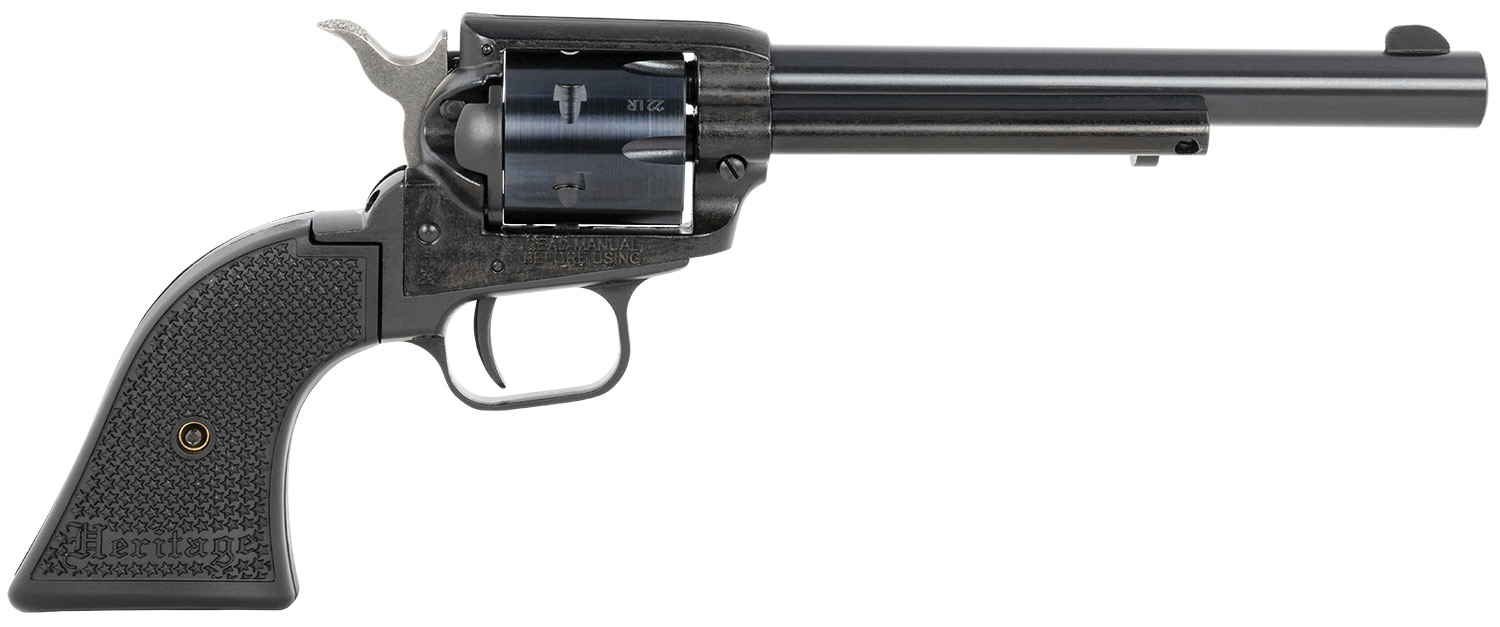
Heritage Rough Rider .22 LR 6.5″ 6-Round Revolver
Pros & cons
What works
- Includes a spare .22 Magnum cylinder - provides two-caliber flexibility for the price of one
- Weighs 33.4 oz - the 6.5-inch barrel provides a stable, forward-balanced hold for off-hand shooting
- Manual safety lever - a feature uncommon on traditional single-action revolvers, adding a layer of administrative safety
- Costs $125.99 - priced roughly $75-95 less than the all-steel Ruger Wrangler alternative
Trade-offs
- Zinc-alloy frame construction - lacks the long-term corrosion resistance and durability of a solid steel frame under heavy use
- Fixed, non-adjustable sights - limits precision adjustment for different ammunition loads; requires gunsmithing for permanent correction
- Polymer grips are slick - provides minimal texturing for positive control, especially with cold or wet hands
Video review
Expert review
Specs at a glance
About this product
The Heritage Rough Rider .22 LR 6.5-Inch 6-Round Revolver is a single-action rimfire revolver built for economical training and recreational shooting with traditional controls. It represents a specific category of firearm that prioritizes mechanical simplicity and low operating cost over modern features or premium materials. For shooters looking to understand fundamental marksmanship or introduce new users, this platform serves as an accessible entry point.
What is the Heritage Rough Rider .22 LR Revolver used for?
This revolver is used primarily for low-cost, fundamental marksmanship training and informal target shooting. Its single-action mechanism forces a deliberate trigger cycle, making it an excellent tool for teaching trigger discipline and sight alignment without the distraction of recoil or rapid fire. While some use it for casual small-game harvesting like rabbits at sub-50 yard ranges, its fixed sights and .22 LR cartridge limit its precision for serious pest control compared to optics-ready rifles like the Stevens 334 in .243 Win.
How does the Heritage Rough Rider compare to a Ruger Wrangler?
The Heritage Rough Rider offers a lower purchase price and an included manual safety, while the Ruger Wrangler provides a more durable, all-steel frame construction. At $125.99, the Rough Rider undercuts the typical $200-$220 Wrangler by roughly 35%, but you trade that for a zinc-alloy frame that lacks the long-term corrosion resistance and heft of solid steel. For pure budget-conscious target practice, the Rough Rider wins on initial cost; for a tool that will see decades of field use, the Wrangler's superior material quality is the better investment.
What does it weigh and what are the dimensions?
The revolver weighs 33.4 ounces, or just over 2 pounds, with an overall length of 11.79 inches and a barrel length of 6.5 inches. The 33.4-ounce weight is distributed mostly in the 6.5-inch steel barrel and cylinder, providing a forward balance that aids in steady off-hand shooting. The 6.5-inch sight radius is nearly 2 inches longer than many compact .22 revolvers, which improves sight picture clarity for new shooters.
Who is this NOT for?
This revolver is not for shooters seeking a defensive firearm, a precision small-game rifle alternative, or a high-round-count training tool. The single-action mechanism requiring manual cocking for each shot is impractical for defensive scenarios, and the fixed sights and inherent rimfire accuracy plateau at around 2-3 inch groups at 25 yards. For shotgun training or high-volume clay shooting, a purpose-built platform like the Stevens 555 Sporting O/U 12 Gauge would be a far more suitable investment.
What's in the box?
The revolver ships with a cardboard clamshell box containing the firearm itself, a spare .22 Magnum cylinder, the owner's manual, and a cable lock. The inclusion of a second, 6-round .22 Magnum cylinder is a notable value-add, effectively giving you two calibers in one purchase, though you must manually swap cylinders which takes approximately 30 seconds. The black polymer grips are pre-installed, and the manual includes basic takedown instructions for cleaning.
Is the Heritage Rough Rider worth it at $125.99?
At $125.99, the Rough Rider is worth it for buyers whose sole criteria is the lowest possible cost of entry into single-action revolver shooting. You are paying for functional mechanics and a classic manual-of-arms, not durability refinements or advanced ergonomics. If your budget can stretch another $75, the step up to an all-steel alternative provides a tangible increase in longevity that justifies the extra spend for most serious users.
Key attributes
| upc | 727962708385 |
| manufacturer | Heritage Arms |
| manufacturer part number | RR22B6PG |
| action | Single Action |
| atf type | Revolver |
| barrel finish | Black |
| barrel length | 6.50" |
| caliber/gauge | .22 LR |
| capacity | 6 |
| package height | 1.7 |
| package width | 5.3 |
| product type | Revolver |
| shipping weight | 2.5 |
| sights | Fixed Front/Notched Rear |
Frequently asked questions
- Is it compatible with .22 Short or .22 Long ammunition?
- Yes, the Heritage Rough Rider is compatible with .22 Short, .22 Long, and .22 Long Rifle ammunition. The cylinder is bored to accept the maximum case length of .22 LR, so shorter rounds will chamber and fire safely. I recommend standard or high-velocity .22 LR for the most reliable ignition, as some subsonic or match-grade rounds may have light primer strikes with the factory hammer spring.
- Does it fit a standard holster designed for a Single Action Army?
- No, the Heritage Rough Rider will not properly fit most holsters molded for a full-size Colt Single Action Army or modern clone. The Rough Rider's frame dimensions and 6.5-inch barrel create a unique profile. You will need a holster specifically marketed for the 'Heritage Rough Rider 6.5' model, which are available from vendors like DeSantis, Hunter Company, or Triple K Holsters, typically costing $35-$65.
- How long does assembly or cleaning take?
- A full field-strip for basic cleaning takes about 5-7 minutes once you are familiar with the single pin takedown. The process involves driving out the cylinder base pin, removing the cylinder, and optionally removing the grip panels to access the hammer and trigger springs. Re-assembly is slightly faster, at around 4-5 minutes, as aligning the cylinder hand with the ratchet requires a bit of finesse.
- Can I return it if the sights are misaligned?
- No, returns for sight misalignment on fixed-sight firearms are generally not accepted unless the defect renders the firearm unsafe to operate. Fixed sights are often regulated at the factory for a specific point of aim/impact with a given ammunition, which can vary. Minor windage or elevation corrections can be made by carefully drifting the front sight in its dovetail or filing the rear notch, which is a standard gunsmithing service costing approximately $50.