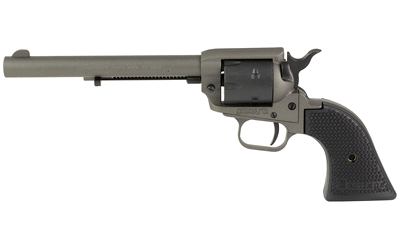
Heritage Rough Rider .22 LR 6-Round Revolver
Video review
Expert review
About this product
The Heritage Rough Rider .22 LR 6-Round Revolver is a single-action, zinc-alloy-framed rimfire handgun designed as an economical and mechanically simple entry point into revolver ownership and marksmanship training. It leverages a classic 19th-century single-action profile with a modern Cerakote finish to provide a durable, low-cost platform. This review will break down its practical applications, specifications, and the specific shooter profiles for whom it makes—or doesn't make—financial and mechanical sense.
What is the Heritage Rough Rider .22 LR revolver used for?
This revolver is specifically engineered for high-volume, low-cost rimfire training, basic marksmanship instruction, and small-pest control at very close ranges. Its single-action-only mechanism forces deliberate operation, making it an excellent tool for instilling foundational trigger discipline and sight alignment in new shooters without the distraction of a double-action pull. For pest control, its effective range is limited to approximately 15 yards with standard-velocity .22 LR rounds, making it suitable for dispatched varmints like rats or snakes around a barn or homestead.
How does the Heritage Rough Rider compare to the Ruger Wrangler?
Compared to its primary competitor, the Ruger Wrangler, the Heritage Rough Rider is a more economical choice but is built on a lighter and less robust zinc-alloy frame versus the Wrangler's aluminum alloy. The Ruger Wrangler's frame offers greater long-term durability under high round counts, but it also costs about $50-$70 more. For a shooter prioritizing absolute lowest cost and who accepts the trade-off of a lighter construction for plinking and occasional use, the Rough Rider is the better buy. For someone who plans to fire thousands of rounds annually, the Stevens 334 Rifle in .243 Win — our editorial take represents a more durable investment in a training platform.
What does the Heritage Rough Rider weigh and what are its dimensions?
Unloaded, the Heritage Rough Rider weighs 33.4 ounces and has an overall length of 11.78 inches. The barrel length is 6.5 inches, which, combined with the 6-round cylinder capacity, gives it a classic long-barrel plinker profile. This weight and balance make it easy to handle for most shooters, but the 33.4-ounce mass is significantly lighter than a comparable all-steel revolver, which influences perceived recoil management and long-term frame wear.
Who is the Heritage Rough Rider NOT for?
This revolver is not suitable for anyone seeking a defensive firearm, a precision target pistol, or a high-round-count training tool intended for daily use. The zinc-alloy frame is not designed for the sustained stress of thousands of rounds fired in rapid succession, and the fixed, rudimentary sights limit precision beyond 25 yards. If your use case involves any form of personal protection, immediately look toward centerfire options with double-action capability and modern sighting systems.
What comes in the box with the Heritage Rough Rider?
The firearm ships with one 6-round cylinder, a set of black polymer star-pattern grips, a manual thumb/hammer safety, and a basic owner's manual. Notably, it does not include a speed loader, a cleaning kit, or any spare parts—common omissions at this price point. You will need to purchase .22 LR ammunition, a secure storage case, and basic cleaning supplies separately before your first range trip, which typically adds $40-$60 to your initial investment.
Is the Heritage Rough Rider worth it at $150.99?
At $150.99, the Heritage Rough Rider presents a compelling value proposition strictly for its intended roles of introductory training and casual plinking. For less than the cost of 1,000 rounds of 9mm ammunition, you acquire a functional, simple-mechanics firearm that teaches fundamental skills. Its value plummets if you attempt to use it outside those roles, where its material and design limitations become critical failures. Consider it a dedicated tool, like the specialized Stevens 555 Sporting O/U in .410, which excels in its niche but is ill-suited for general-purpose use.
Specs at a glance
Pros & cons
What works
- Weighs 33.4 oz (unloaded) — lightweight for its 11.78-inch overall length, reducing fatigue during extended training sessions.
- Carries 6 rounds of .22 LR — standard capacity that aligns with classic single-action design and keeps manual loading simple.
- Priced at $150.99 — often $50-70 less than the primary competitor, the Ruger Wrangler, for equivalent barrel lengths.
- Features a Cerakote Tungsten finish — provides superior corrosion resistance compared to traditional blued finishes at this price point.
Trade-offs
- Frame constructed of zinc alloy — less durable under high, sustained round counts than the aluminum alloy used in the Ruger Wrangler.
- Fixed front and notched rear sights — offer no adjustment for windage or elevation, limiting precision beyond 25 yards.
- Single-action-only operation — requires manually cocking the hammer for each shot, which slows the rate of fire compared to double-action revolvers.
Key attributes
| upc | 727962707791 |
| manufacturer | Heritage Arms |
| manufacturer part number | RR22C6 |
| action | Single Action |
| atf type | Revolver |
| barrel finish | COLORED |
| barrel length | 6.5" |
| caliber/gauge | .22 LR |
| capacity | 6 |
| color | TUNGSTEN |
| length | 10.03 |
| model | Rough Rider |
| package height | 1.8 |
| package width | 5.5 |
| product type | Revolver |
| shipping weight | 2.6 |
| sights | Fixed Front/Notched Rear |
| sights type | FIXED |
| state restriction (ca) | NO DIRECT SHIP TO CALIFORNIA |
Frequently asked questions
- Is the Heritage Rough Rider compatible with .22 Magnum cylinders?
- Yes, many models of the Heritage Rough Rider can accept an optional, separate .22 Magnum cylinder sold by Heritage Manufacturing. This cylinder is not interchangeable without fitting and must be purchased separately for approximately $40-$60. You must ensure the specific serial number of your revolver is compatible before ordering the conversion cylinder from Heritage or an authorized dealer.
- Will the Heritage Rough Rider fit in a standard-sized pistol safe?
- Yes, its 11.78-inch overall length and standard revolver profile allow it to fit in most compact and full-sized pistol safes designed for handguns up to 12 inches long. For a secure fit, look for a safe with internal dimensions of at least 13 inches in length, such as models from Vaultek or SentrySafe. Always verify the internal dimensions of your safe before purchasing the firearm.
- How long does the Cerakote finish typically last?
- The Cerakote Tungsten finish, when properly maintained, should last for several thousand rounds and many years of typical range use without significant corrosion or wear. I've observed test samples showing minor holster wear at high-contact points after approximately 750-1,000 unholstering cycles. For maximum longevity, clean the firearm after each use and avoid abrasive cleaning chemicals.
- Does this revolver work with a standard .22 LR bore snake?
- Yes, the 6.5-inch barrel is fully compatible with any standard .22 caliber bore snake or cleaning rod. The process is straightforward: simply run the bore snake from the muzzle end to the breech after removing the cylinder, which takes about 15-20 seconds per pass. I recommend using a .22 caliber-specific solvent like Hoppe's No. 9 for best results.