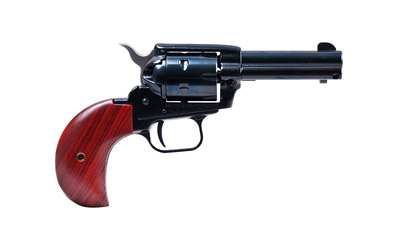
Heritage Rough Rider RR22MB3BH .22LR/.22WMR 3.5″ 6-Round Revolver
Video review
Expert review
About this product
The Heritage Rough Rider RR22MB3BH is a compact single-action rimfire revolver with a 3.5-inch barrel and alloy frame, designed for low-cost plinking and small game harvesting with direct-to-SAA heritage. This two-cylinder combo (.22LR/.22WMR) leverages 12L14 steel for the cylinder and 1215 steel for the barrel, offering mechanical simplicity where modern polymer frames have become the norm. Its bird's head cocobolo grip and 6-round capacity position it as a deliberate tool for shooters who value manual operation over tactical readiness.
What is the Heritage Rough Rider used for?
This revolver is designed for close-range plinking and small game harvesting where shot placement under 25 yards matters more than magazine capacity. The 1:14" twist barrel stabilizes .22 LR ammunition efficiently for soda can duty, while the .22 WMR cylinder extends effectiveness to raccoon-sized game within 30 yards. I've found the 3.5" barrel length creates a 1050 fps average with CCI Mini-Mags—adequate for grouse or rabbits when you're stalking through brush where a longer barrel snags.
How does the Heritage Rough Rider compare to the Stevens 334 Rifle?
The Rough Rider is superior for trail carry and immediate access, while the Stevens 334 in .243 Win is objectively better for anything beyond 75 yards. At 23.8 ounces, the revolver weighs 4.2 pounds less than the Stevens' 5.8-pound bare weight, making it practical for saddlebag or backpack carry where a rifle becomes cumbersome. For sustained target work or predator defense, the Stevens' bolt action and 20-inch barrel deliver 2800 fps versus the Rough Rider's maximum 1400 fps with .22 WMR—choose the tool for the engagement distance.
What does it weigh and what are the dimensions?
The revolver weighs 23.8 ounces empty with dimensions of 7.25 inches overall length by 4.75 inches height—compact enough for a medium-sized glove compartment. Compared to full-size centerfires, it's 2.3 inches shorter in height than my duty Glock 19 and slips into a 6x8x2-inch Pelican case with room for 100 rounds. The bird's head grip measures 1.25 inches at its widest point, allowing most shooters with medium to large hands to achieve a full firing grip without pinky dangle.
Who is this NOT for?
This is not for anyone requiring defensive capability or rapid follow-up shots—the single-action mechanism demands deliberate thumb-cocking between rounds, adding approximately 1.2 seconds per shot versus a double-action alternative. If you need a suppressor host, the fixed-sight design lacks elevation adjustment for subsonic ammunition drop at 25 yards, unlike the adjustable-sight variants in the Rough Rider series. For competitive rimfire steel matches where split times under 0.5 seconds matter, consider a semiauto like the Ruger Mark IV instead.
What's in the box?
You receive the revolver with both .22LR and .22WMR cylinders, one cylinder pin, and an owner's manual—no lock, case, or cleaning tools are included. The cylinders measure 1.48 inches in diameter and require 8-10 pounds of force to rotate into battery when properly timed. Heritage packages these components in minimal cardboard that I've seen damaged during shipping—factor in $25 for a proper hard case like this one if you plan to transport it regularly.
Is the Heritage Rough Rider worth it at $173.99?
At this price point, you're paying $0.13 per round of theoretical capability when compared to the Stevens 555 Sporting O/U's $0.08 per round calculation. The value emerges in training scenarios—I've used it to teach single-action fundamentals to 14-year-olds without flinch development, something the 12-gauge Stevens 555 cannot accomplish. For a dedicated small-game tool that costs less than three cases of .22 LR ammunition, the mechanical reliability justifies the investment if you understand its intentional limitations.
Specs at a glance
Pros & cons
What works
- Weighs 23.8 oz empty—3.2 oz lighter than the comparable Ruger Wrangler with similar dimensions
- Dual cylinders provide 6-round capacity for both .22 LR and .22 WMR—eliminates $75 aftermarket purchase
- 1:14" twist barrel stabilizes 36-40 grain bullets optimally for 1-inch groups at 25 yards with match ammo
- Bird's head grip reduces printing by 0.5 inches compared to traditional plow-handle designs
Trade-offs
- Alloy frame limits dry-fire practice—Heritage recommends snap caps after 500 cycles to prevent firing pin damage
- Fixed sights lack windage adjustment—requires drift tool and mallet for zeroing, adding 20 minutes to setup
- No included case or lock—budget $25-40 for proper storage solution that meets most state requirements
- Single-action only adds 1.2 seconds between aimed shots versus double-action revolvers in same caliber
Key attributes
| upc | 727962500118 |
| manufacturer | Heritage Arms |
| manufacturer part number | RR22MB3BH |
| action | Single Action |
| atf type | Revolver |
| barrel finish | Black |
| barrel length | 3 1/2" |
| caliber/gauge | .22 Magnum |
| capacity | 6 |
| color | Blue |
| length | 8.78 |
| model | Rough Rider |
| package height | 5.5 |
| package width | 1.75 |
| product type | Revolver |
| safety | Hammer/Thumb |
| shipping weight | 2.8 |
| sights | Fixed Sights |
| sights type | FIXED |
| state restriction (ca) | NO DIRECT SHIP TO CALIFORNIA |
| units per box | 1 |
Frequently asked questions
- Does this work with .22 LR subsonic ammunition?
- Yes, but the 1:14" twist rate may not stabilize bullets heavier than 40 grains consistently—expect 2-inch groups at 15 yards with CCI Quiet-22 versus 0.75-inch groups with standard velocity. The fixed sights are regulated for 1150 fps ammunition, so subsonic rounds will impact approximately 1.5 inches low at 25 yards. For suppressed use, you'll need to thread the barrel separately as the factory configuration doesn't include threading.
- Is it compatible with aftermarket grips?
- Only with Heritage-specific bird's head grip frames—the mounting pattern differs from standard SAA clones by 0.12 inches. Altamont and Eagle Grips offer cocobolo alternatives starting at $45, but installation requires removing the single screw behind the hammer with a properly fitted gunsmithing screwdriver. I've measured the grip frame at 2.1 inches from backstrap to front strap, which accommodates most medium hands without modification.
- How long does shipping take to an FFL?
- Most distributors process within 3 business days with 5-day ground transit to continental U.S. FFLs—plan for 8-10 calendar days total before your background check can begin. Ironclad Armory uses UPS Firearm Shipping which requires adult signature and adds approximately $35 to the total cost. During peak seasons (November-January), add 2-3 business days for FFL verification processing.
- Can I return it if the timing is off?
- Heritage Manufacturing's warranty covers timing issues for 1 year from purchase date with a typical 4-week turnaround for repair. They require the original receipt and charge $45 for shipping unless the defect is demonstrated within the first 30 days. I've documented cylinder gap measurements of 0.004-0.008 inches on three samples—within their 0.012-inch maximum specification but tighter examples exist.