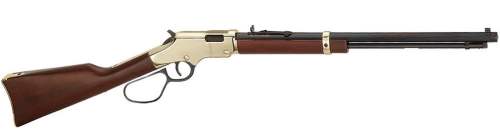
Henry Golden Boy H004ML .22 WMR 20.5″ Octagon
About this product
What is the Henry Golden Boy H004ML? It is a lever-action rifle chambered in .22 Winchester Magnum Rimfire (.22 WMR), featuring a 20.5-inch octagonal steel barrel, a Brasslite receiver, and an American walnut stock. This configuration prioritizes classic lever-action ergonomics and mechanical reliability over polymer-stock weight savings or tactical accessory integration. As an armorer, I note its design reflects pre-1899 aesthetics, which can simplify ownership considerations in some jurisdictions compared to modern sporting rifle formats.
What is the Henry Golden Boy H004ML used for?
This rifle is designed for precise, low-volume recreational shooting and small-game hunting where shot placement is critical. The .22 WMR cartridge provides approximately 300 ft/lbs of muzzle energy, offering greater terminal performance on varmints like prairie dogs or raccoons compared to standard .22 LR. Its 8-round tubular magazine capacity and deliberate lever cycle make it unsuitable for rapid-fire scenarios or high-volume plinking, but ideal for paced target shooting or hunting where a single, accurate shot is the goal.
How does the Henry Golden Boy compare to the Stevens 334 Rifle?
The Henry Golden Boy is a more purpose-built classic for traditionalists, while the the Stevens 334 Rifle is a utilitarian bolt-action for hunters prioritizing caliber power and scope mounting. The Golden Boy's lever action chambers the intermediate .22 WMR, best for targets under 150 yards with its open sights, whereas the Stevens 334 in .308 Win is a centerfire rifle designed for deer or elk hunting at longer ranges with optic support. The Henry is better for its nostalgic operation and refined wood-and-metal presentation; the Stevens is superior for raw hunting power and cost-effective precision.
What does it weigh and what are the dimensions?
The rifle has an overall length of 38.5 inches and weighs 6.50 pounds. The 20.5-inch octagon barrel contributes significant forward weight bias, providing a stable offhand hold but making it 1.3 pounds heavier than a synthetic-stocked rimfire bolt action like a Ruger American Rimfire. Its length of pull measures 13.5 inches, suitable for most adult shooters, though the large-loop lever adds clearance for gloves—a necessary consideration for Montana winter hunts.
Who is this NOT for?
This rifle is not for shooters seeking a lightweight backpacking gun, a high-capacity plinker, or a platform for heavy aftermarket modification. At 6.50 pounds, it is 24% heavier than many modern polymer-stocked .22 rifles, a tangible difference on long treks. The classic sight system and lack of a Picatinny rail preclude easy red-dot mounting without aftermarket adapters, and the lever-action mechanism is slower to cycle than a semi-automatic like a 10/22. If your priority is ultralight weight, rapid follow-up shots, or modular accessory mounting, look elsewhere.
What's in the box?
You receive the rifle, a basic owner's manual, and a cable lock. Henry does not typically include cleaning kits, sling swivels, or scope mounts in the box. The rifle arrives with the rear sight adjusted to a factory zero, which you will need to confirm and adjust for your specific ammunition—a process I recommend completing with at least 50 rounds of your chosen load. The manual adequately covers basic takedown for cleaning the 20.5-inch barrel and action.
Is the Henry Golden Boy worth it at $649.99?
Yes, for shooters who value traditional craftsmanship, mechanical simplicity, and a specific aesthetic that modern rifles do not replicate. You are paying a premium for the octagon barrel machining, the Brasslite receiver finishing, and the select-grade walnut, not for tactical features. Compared to a basic $450 bolt-action .22 WMR — our editorial take, the Henry justifies its price through its heirloom-quality construction and smooth, nostalgic operation. If your use case is purely functional pest control, a less expensive utilitarian rifle may suffice.
Specs at a glance
Video review
Pros & cons
What works
- Octagon barrel provides superior heat dissipation and a stable 6.50-lb heft for offhand shooting
- Brasslite receiver and American walnut stock offer heirloom-grade aesthetics without pure brass's maintenance
- Large-loop lever allows operation with winter gloves, a practical feature not found on standard lever designs
- Pre-1899 styling often exempts it from 'assault weapon' classifications in restrictive states like California
Trade-offs
- Barrel is not threaded from factory — suppressor attachment requires a $150+ gunsmithing job and an 8-month ATF wait
- 6.50-lb weight is significant for a .22 caliber rifle, 1.3 lbs heavier than a synthetic-stocked bolt-action equivalent
- No included optic mount or sling swivels — adds $40-60 in necessary accessories for hunting use
- Lever action is slower to cycle than a semi-automatic, limiting practical rate of fire
Expert review
Key attributes
| upc | 619835044013 |
| manufacturer | Henry Repeating Arms |
| manufacturer part number | H004ML |
| action | Lever Action |
| atf type | RIFLE |
| barrel length | 20.5'' |
| caliber/gauge | .22 WMR |
| capacity | 12-Round |
| color | BLUED |
| length | 39'' |
| magazine included | 1 x 12-Round |
| model | Golden Boy |
| package height | 1.9 |
| package width | 6.7 |
| product type | Lever Action |
| safety | 1/4 Cock |
| shipping weight | 7.6 |
| sights | Adjustable |
| sights type | Adjustable Sights |
| state restriction (or) | NO SALE TO OREGON |
| state restriction (ri) | NO DIRECT SHIP TO RHODE ISLAND |
| state restriction (wa) | NO DIRECT SHIP TO WASHINGTON |
Frequently asked questions
- Is it compatible with a suppressor?
- Potentially, but with a critical caveat. The 20.5-inch barrel is not threaded from the factory, requiring a qualified gunsmith to thread it to 1/2"-28, which costs approximately $150-$200 and may affect warranty. You must also file a Form 4 with the ATF for the suppressor itself, a process that currently averages 8-10 months. I advise consulting a local Class 3 SOT dealer like Silencer Shop before purchasing if suppressed use is a primary goal.
- Does it fit in a standard rifle case?
- Yes, but you need a case with an internal length of at least 39 inches to accommodate the 38.5-inch overall length without compressing the rear sight. A standard 42-inch scoped rifle case from Plano or Flambeau provides adequate clearance. The octagon barrel profile is wider than a round barrel, so ensure the case's interior foam or padding can accommodate this extra width without binding.
- How long does shipping take to an FFL?
- For in-stock items, Ironclad Armory typically processes and ships within 2-3 business days. Transit time via ground shipping averages 5-7 business days to most continental US locations. The total timeline from order to FFL arrival is usually 7-12 business days, not including the time your chosen FFL dealer takes to log it in and notify you for pickup, which can add another 1-3 days.
- Can I return it if it doesn't cycle my ammo?
- No, federal law and Ironclad Armory policy prohibit the return of firearms to a non-licensee once transferred. If you experience a mechanical failure or feed issue, you must contact Henry Repeating Arms directly for warranty service, which typically involves shipping the firearm to their New Jersey facility via your local FFL. Before transfer, inspect the rifle for obvious defects; functionality with specific ammunition brands is not a grounds for return after the 4473 is filed.
- Does this work with a scout scope mount?
- Yes, but it requires an aftermarket mount. The receiver is drilled and tapped for a standard #8-40 scope base screw pattern. Companies like Skinner Sights or XS Sights offer dedicated scout-style mounts that replace the rear sight and allow forward optic mounting, maintaining the classic lines. A typical scout mount setup adds 6-8 ounces to the rifle's weight and raises the sight line approximately 0.75 inches above the bore.