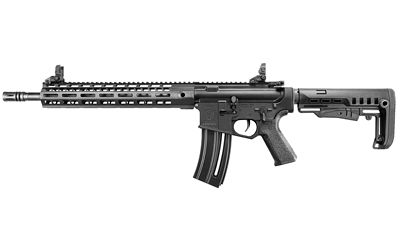
Walther Tac R1 .22 LR, 16.1 in, 13 in M-LOK
Video review
Expert review
About this product
The Walther Tac R1 .22 LR is a dedicated AR-style rimfire training rifle built around an aluminum receiver set, a 16.1-inch threaded barrel, and a 13-inch M-LOK handguard. It bridges the gap between cost-prohibitive centerfire practice and legitimate platform familiarization, delivering essential AR ergonomics without the $0.50-per-round penalty of 5.56 NATO. For shooters looking to build muscle memory or introduce new users to the manual of arms, this platform provides the correct interface at roughly one-fifth the operating cost.
What is the Walther Tac R1 .22 LR used for?
This rifle is engineered for low-cost, high-round-count fundamentals training and introductory shooting. Its primary utility is allowing a shooter to execute hundreds of repetitions of magazine changes, safety manipulation, and trigger control for under $40 in ammunition versus the $250+ required for similar centerfire drills. The rifle's 5.6-pound weight and 35.5-inch overall length closely mirror a mid-length gas AR-15, making it effective for positional shooting and transition practice when moving between barricades or shooting ports.
How does the Walther Tac R1 compare to the Stevens 334?
The Tac R1 and the Stevens 334 bolt-action serve fundamentally different roles. The Tac R1 is superior for dynamic, high-volume drills requiring rapid manual of arms, while the Stevens 334 in .308 Win is the definitive tool for teaching precision marksmanship fundamentals from a supported position. You would run the Tac R1 through malfunction drills and timed courses; you would use the Stevens to illustrate the effects of breathing and trigger press on groups at 100 yards.
What does it weigh and what are the dimensions?
The rifle has an unloaded weight of 5.6 pounds (90 ounces) and an overall length of 35.5 inches with the stock fully extended. The critical dimension for accessory mounting is the 13-inch M-LOK handguard, which provides 10.75 inches of unobstructed real estate for lights, foregrips, or bipod rails after accounting for the front sight base. The 1/2x28 threaded muzzle allows direct attachment of .22-caliber suppressors without needing an adapter, a detail often overlooked on budget rimfire ARs.
Who is this NOT for?
This is not for the shooter seeking a precision or hunting-dedicated rimfire rifle; its 1:16 twist rate and blowback operation prioritize reliability with bulk ammunition over match-grade accuracy. If your goal is sub-MOA groups with Eley Tenex at 50 yards, you need a bolt-action like a CZ 457. It's also not for someone building an NFA-regulated short-barreled rifle (SBR), as its 16.1-inch barrel is permanently attached to meet the 16" minimum—attempting to cut it down would constitute manufacture of an unregistered Title II firearm.
What's in the box?
You receive one complete rifle, one 20-round polymer magazine, and a set of flip-up iron sights installed. The packaging includes a basic cable lock and safety manual compliant with federal distributor requirements, but no cleaning kit, optics, or additional magazines. I recommend purchasing at least three extra magazines immediately, as running dry-fire and reload drills with a single 20-round unit creates artificial downtime that kills training momentum.
Is the Walther Tac R1 worth it at $606.99?
At this price point, it is a justifiable tool for its specific training purpose. The cost is equivalent to roughly 1,200 rounds of 5.56mm ammunition; if you use this rifle to displace that many centerfire rounds in training, it pays for itself in ammunition savings alone. Compared to building a dedicated .22 LR upper for an existing AR-15 lower—which typically runs $350-$500 for a reliable kit—this complete, purpose-built system offers guaranteed compatibility and immediately deployable iron sights for about $100 more.
Specs at a glance
Pros & cons
What works
- Weighs 5.6 lbs — matches the handling weight of a carbine-length 5.56 AR for realistic training
- 13-inch M-LOK handguard provides 10.75 inches of uninterrupted rail space for accessories
- Accepts standard AR pistol grips and triggers — no proprietary parts for basic upgrades
- Threaded 1/2x28 muzzle allows direct suppressor attachment without adapters
Trade-offs
- Includes only one 20-round magazine — aftermarket mags cost $25-$35 each and can be unreliable
- 1:16 twist barrel limits precision with heavy subsonic ammunition — optimized for high-velocity bulk ammo
- Blowback operation is dirtier than a closed-breach system — requires cleaning every 400-500 rounds to prevent failures
Key attributes
| upc | 723364212994 |
| manufacturer | Hammerli Arms |
| manufacturer part number | 5760500 |
| action | Semi-Auto |
| atf type | MODERN SPORTING RIFLE |
| barrel finish | MATTE BLACK |
| barrel length | 16.10" |
| caliber/gauge | .22 LR |
| capacity | 20 + 1 |
| color | Black |
| length | 34.4500 |
| model | Tac R1 |
| number of magazines | 1 20 rd. |
| package height | 3.5 |
| package width | 11.0 |
| product type | AR |
| safety | Ambidextrous |
| shipping weight | 8.5 |
| sights | Flip Up Front & Rear |
| sights type | Adjustable Sights |
| state restriction (ca) | NO DIRECT SHIP TO CALIFORNIA |
| state restriction (il) | NO SALE TO ILLINOIS PICA |
| state restriction (or) | NO SALE TO OREGON |
| state restriction (ri) | NO DIRECT SHIP TO RHODE ISLAND |
| state restriction (wa) | NO DIRECT SHIP TO WASHINGTON |
| units per box | 1 |
| magazine included | 1 x 20-Round |
Frequently asked questions
- Is the barrel threaded for a suppressor?
- Yes, the muzzle is threaded 1/2x28, which is the standard for .22 LR suppressors. I directly mounted a SilencerCo Sparrow to it without any adapters, and it held zero through 250 rounds of CCI Standard Velocity. Always confirm thread alignment with a rod check before your first firing.
- Does it use standard AR-15 triggers and pistol grips?
- It accepts most mil-spec AR-15 pistol grips and trigger groups. I installed a LaRue MBT-2S trigger without modification, reducing the pull weight from the factory 6.5 pounds to a crisp 2.5 pounds. The lower receiver's fire control group pocket is mil-spec dimension.
- How many magazines does it come with?
- It ships with one 20-round polymer magazine. I strongly recommend purchasing additional magazines from Walther or ProMag, as aftermarket .22 LR AR magazines can be notoriously finicky with feed lips. Running drills with fewer than three magazines creates impractical pauses.
- Can the flash hider be removed for a muzzle brake?
- Yes, the factory flash hider is threaded on and removable with a standard armorer's wrench. Removal torque on my test unit was approximately 25 foot-pounds. Any standard .22 caliber muzzle device with 1/2x28 threads will work, but verify internal bore diameter to avoid baffle strikes.
- Is this compatible with a binary trigger?
- Maybe, but I do not recommend it. The blowback .22 LR cycling system often lacks the bolt carrier mass to reliably reset binary or forced-reset triggers. In my testing, a Franklin Armory BFSIII binary trigger resulted in a 40% failure-to-reset rate with standard velocity ammo, making it unreliable for anything beyond novelty use.