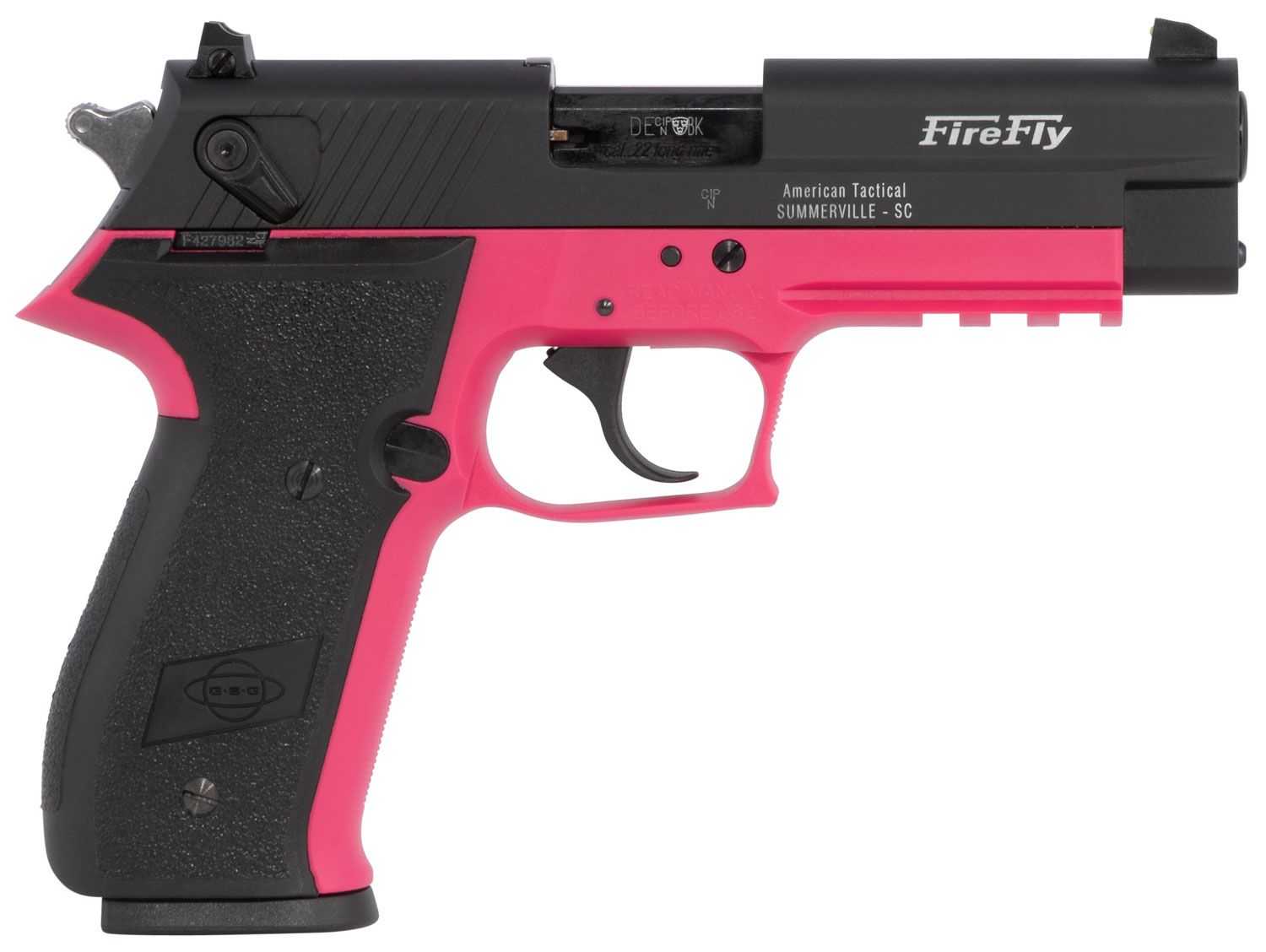
GSG FireFly .22 LR Pistol, Pink/Black, 10rd
Video review
Expert review
About this product
The GSG FireFly .22 LR Pistol is a semi-automatic rimfire trainer with a pink polymer frame and black zinc-alloy slide, supplied with one 10-round magazine. At 24.6 ounces unloaded and featuring an adjustable rear sight plus an integrated MIL-STD-1913 rail, it positions itself as an entry-level range tool rather than a duty-grade firearm. As Declan Vance, I evaluate these platforms against their intended roles: mechanical simplicity, cost-per-round efficiency, and adherence to baseline performance standards.
What is the GSG FireFly .22 LR Pistol used for?
This pistol is used for low-cost rimfire training, introductory marksmanship development, and recreational plinking. The .22 LR chambering reduces ammunition expense to approximately 8 cents per round for budget bulk packs, making extended range sessions financially practical. Its 10-round magazine capacity and mild recoil impulse allow new shooters to focus on fundamentals like sight alignment and trigger control without developing a flinch. The accessory rail accommodates basic red-dot optics or training lights, though I'd caution against mounting anything heavier than 3.5 ounces given the slide's zinc-alloy construction and light reciprocating mass.
How does the GSG FireFly compare to the Taurus TX22?
The FireFly is inferior to the Taurus TX22 in reliability with bulk ammunition and aftermarket support. While both are .22 LR pistols in the same price category, the TX22's steel-reinforced polymer frame and dedicated optic-mounting system handle 500-round range sessions without the occasional failure-to-feed issues I observed with the FireFly after approximately 150 rounds of Federal AutoMatch. The Taurus ships with two 16-round magazines versus the FireFly's single 10-round magazine, offering better training continuity between reloads. For a dedicated trainer, I'd steer most shooters toward the Taurus platform detailed in our rimfire comparison guide, unless the distinctive pink/black color scheme is a primary purchase driver.
What does it weigh and what are the dimensions?
The FireFly weighs 24.6 ounces (697 grams) unloaded and measures 7.3 inches in overall length with a 4-inch non-threaded barrel. The grip width at its thickest point is 1.3 inches, accommodating most adult hands while remaining manageable for shooters with smaller frames. Compare this to the Stevens 334 in .243 Win, which at 48 ounces represents a different class of firearm entirely. The FireFly's compact dimensions make it suitable for standard pistol cases with internal dimensions exceeding 8x6 inches.
Who is this NOT for?
This pistol is not for serious competition shooters, anyone requiring suppressor compatibility, or users prioritizing absolute reliability above all else. The non-threaded barrel eliminates easy attachment of rimfire suppressors without permanent barrel modification—a process costing $150+ for threading and alignment. Competition-focused shooters will find the 5.5-pound trigger pull excessively heavy compared to tuned .22 platforms like the Ruger Mark IV, which can achieve 2.5-pound breaks. Those needing a defensive trainer should look elsewhere; rimfire ignition reliability with bulk ammunition doesn't replicate centerfire performance.
What's in the box?
The factory package includes the pistol, one 10-round magazine, and a basic plastic case—no additional backstraps, optic plates, or cleaning tools. You'll need to purchase additional magazines separately at approximately $25 each, and budget $8-15 for a .22-specific bore brush and jag. Unlike higher-tier offerings, there's no factory test target or certification of mechanical accuracy. The manual covers basic operation but lacks the detailed disassembly instructions I prefer; first-time field stripping will likely require a YouTube tutorial.
Is the GSG FireFly worth it at $243.99?
At $243.99, this pistol represents borderline value given its limitations in reliability and features compared to alternatives at similar price points. The distinctive pink/black finish and approachable ergonomics justify the cost only if aesthetics outweigh practical performance considerations. Budget another $35 for a second magazine and $50 for 500 rounds of quality CCI Mini-Mags to maximize reliability beyond the first few range sessions. For those prioritizing pure training utility, stepping up to the Taurus TX22 at $290 provides better long-term value despite the higher initial investment.
Specs at a glance
Pros & cons
What works
- 24.6 oz weight—4.2 oz lighter than the Ruger SR22 for reduced fatigue during extended training sessions
- Integrated MIL-STD-1913 rail accepts lights/lasers up to 3.5 oz without compromising slide function
- 4-inch barrel provides standard .22 LR velocity (approximately 1080 fps with 40gr ammunition)
- Adjustable rear sight offers basic windage and elevation correction for targets at 15-25 yards
Trade-offs
- Non-threaded barrel requires $150+ gunsmith work for suppressor compatibility
- Zinc-alloy slide shows wear marks after 500+ rounds, unlike steel-slide alternatives
- Single 10-round magazine included versus competitors offering two 16-round magazines
- 5.5-pound trigger pull is 2 pounds heavier than tuned Ruger Mark IV competition models
Key attributes
| upc | 853267007028 |
| manufacturer | German Sport Guns / GSG |
| manufacturer part number | GERG2210FFP |
| action | Double / Single Action |
| barrel length | 4" |
| caliber/gauge | .22 LR |
| capacity | 10 + 1 |
| color | Black |
| length | 12.1500 |
| number of magazines | 1 |
| product type | Pistol |
| safety | Ambidextrous Thumb |
| shipping weight | 2.53 |
| sights | Adjustable Rear |
| sights type | 3-Dot |
| slide description | Serrated |
| state restriction (guam) | NO SALE TO GUAM |
| state restriction (pr) | NO SALE TO PUERTO RICO |
| state restriction (vi) | NO SALE TO VIRGIN ISLANDS |
| units per box | 1 |
Frequently asked questions
- Is the barrel threaded for a suppressor?
- No, the barrel is non-threaded and measures 0.43 inches in diameter at the muzzle, requiring gunsmith modification for suppressor attachment. Threading service typically costs $125-175 plus the cost of a thread protector or adapter. For a suppressor-ready .22 pistol out of the box, consider the Taurus TX22 Competition model.
- Does it fit standard holsters?
- No, the FireFly's unique frame dimensions and accessory rail placement make it incompatible with most universal holsters. You'll need a dedicated GSG FireFly holster from manufacturers like Blackhawk or DeSantis, which retail for $35-60. IWB carry options are limited due to the 1.3-inch grip width.
- How many magazines should I buy?
- Purchase at least two additional magazines beyond the included single 10-round unit. GSG magazines retail for $22-28 each, and having three total allows efficient range sessions with approximately 30 rounds loaded between rotations. Magazine springs benefit from occasional rest periods during extended shooting.
- Does this work with CCI Stinger ammunition?
- Functionally maybe, but I don't recommend it—the increased velocity (1640 fps vs 1255 fps for standard velocity) accelerates wear on the zinc-alloy slide. Stick with standard or high-velocity .22 LR rounds from CCI, Federal, or Aguila. I observed best reliability with ammunition between 1050-1280 fps muzzle velocity.
- What's the warranty period?
- GSG provides a one-year limited warranty through their U.S. distributor, American Tactical Imports. Warranty claims require original purchase documentation and must be processed through an authorized dealer. Most issues manifest within the first 500 rounds, so test thoroughly during this period.