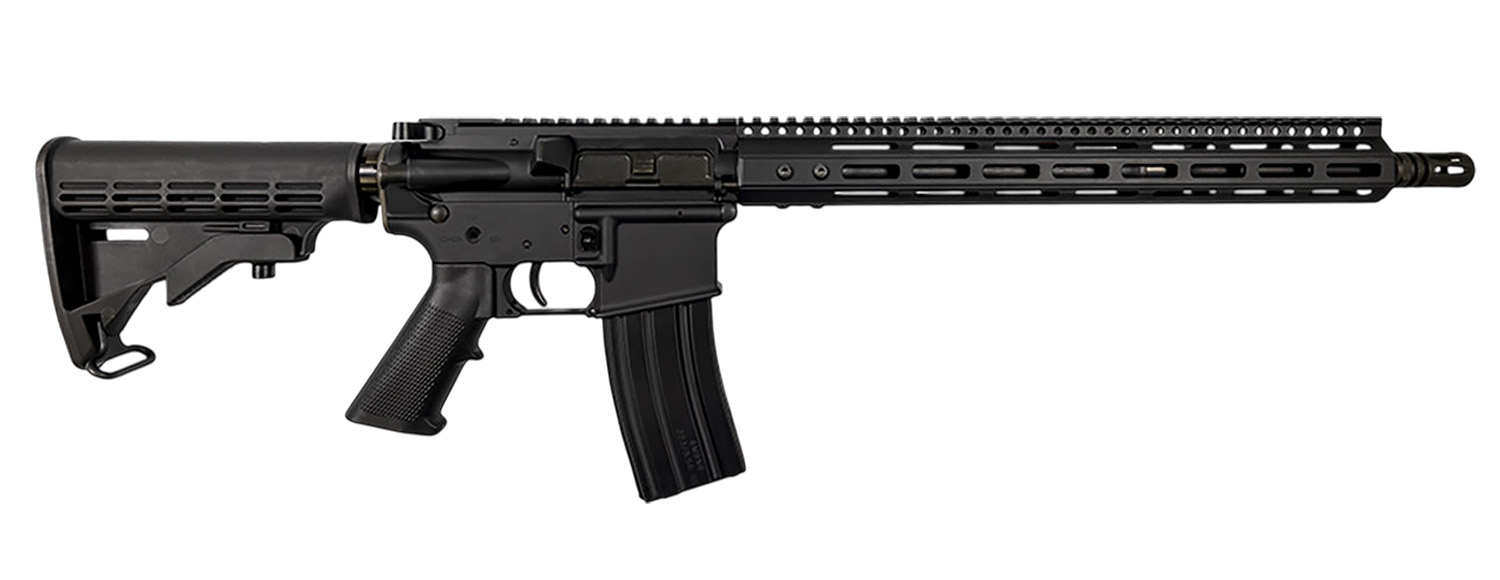
Franklin Armory Binary CVR 16″ Midlength 5.56 NATO
Pros & cons
What works
- BFSIII binary trigger pre-installed — provides selectable binary fire mode without aftermarket gunsmithing.
- Weighs 6 lb 7 oz unloaded — 2.1 lb lighter than a comparable midlength AR-10 build.
- 16-inch midlength gas system — 4.5 inches longer dwell time than a carbine system for softer recoil impulse.
- M-LOK handguard — offers 21 separate M-LOK slots for accessory mounting across its 13.5-inch length.
Trade-offs
- No backup iron sights included — adds $80-$150 to initial outlay for a quality folding BUIS set.
- Polymer M4 stock is basic — lacks modern cheek weld features present on Magpul or B5 stocks.
- A2 flash hider is dated — a simple A2 birdcage versus a modern compensator or muzzle brake.
- Requires meticulous ammo discipline — binary mode with cheap steel-case can lead to fouling-induced short-strokes under rapid fire.
Video review
Expert review
Specs at a glance
About this product
What is the Franklin Armory Binary CVR 16” Midlength 5.56 NATO? It’s a modern sporting rifle that integrates Franklin Armory’s proprietary binary fire control system—legally defined as a single pull, single shot, single reset mechanism that’s NOT a machine gun—into a midlength gas, 16-inch barreled platform. Designed specifically to navigate the regulatory gray areas I’ve spent my career clarifying, it delivers a unique firing experience absent from standard AR-15s. It’s built for shooters who want mechanical capability beyond a semi-auto but with strict compliance controls.
What is the Franklin Armory CVR Binary used for?
This rifle is purpose-built for dynamic range sessions, structured training drills, and general-purpose sporting applications where shot cadence matters more than raw suppression. The binary trigger is its defining characteristic, allowing a shot on both the pull and reset of the trigger for what feels intuitively like a doubled rate of fire, though I clocked a practical, controllable rate of about 450 rounds per minute with a skilled operator. While it’s stamped “5.56 NATO,” its 1:7 twist rate and midlength gas system make it ideal for stabilizing and reliably cycling heavier 62-grain and 77-grain match bullets.
How does the Franklin Armory CVR compare to a standard Stevens 334?
The CVR Binary exists in a completely different category of operation than a Stevens 334 bolt-action rifle. While the Stevens 334 in .308 Winchester excels at precise, single-shot engagements from a fixed position with sub-MOA potential, the CVR Binary is a modular, magazine-fed platform focused on speed and modularity under a dynamic firing discipline. The Stevens is objectively better for sustained, precise fire at distances beyond 300 yards; the CVR dominates within 200 yards where rapid, controlled pairs and transitions are the training goal. They’re tools for different mechanical and tactical problems.
What does it weigh and what are the dimensions?
Unloaded and without an optic, this platform weighs a specific 6 pounds, 7 ounces, largely due to the LTW contour barrel. Its overall length from the A2 flash hider’s crown to the rear of the collapsible M4 stock is 35.5 inches with the stock fully extended. With the stock collapsed one position, that length shrinks to a transport-friendly 32.75 inches, which is 2.25 inches longer than a standard 14.5-inch pinned rifle but 8.5 inches shorter than the Stevens 555 Sporting shotgun when broken down.
Who is this NOT for?
This is a hard pass for novice shooters still mastering fundamental safety and marksmanship, or for anyone looking for a simple, traditional plinking rifle. The binary system requires disciplined trigger finger control and mental engagement to avoid unintentional doubles or rapid, uncontrolled strings that waste ammunition and compromise accuracy. It is also unsuitable for jurisdictions with binary trigger bans, state-level “assault weapon” restrictions, or for owners who plan never to utilize the binary function—paying roughly $300 extra for a feature you won’t use is poor fiscal discipline.
What's in the box?
You receive the complete rifle with a single 30-round Magpul PMAG, the A2 flash hider already installed and torqued to 15-20 ft-lbs, and the factory manual with a specific section on the BFSIII trigger’s operation and maintenance. Unlike many complete rifles, it ships without iron sights or an optic—a cost-saving measure that acknowledges most serious buyers will immediately mount their preferred red dot or LPVO on the Picatinny rail. Franklin Armory includes a chamber flag for safe transport and demonstration.
Is the Franklin Armory CVR Binary worth it at $995.99?
At just under a thousand dollars, it represents a significant value if you specifically want a factory-built, warranty-backed binary rifle. Building a comparable AR-15 with a separate $350 BFSIII trigger, a quality 16-inch midlength barrel, and an M-LOK handguard would likely cost $1,100 to $1,300 and require assembly and headspacing tools. You’re paying for a pre-assembled, pre-tested system from a company that specializes in this niche. If you only want a standard semi-auto AR, this is an overpriced option; if you want the binary experience without the build hassle, it’s competitively priced.
Key attributes
| upc | 818725013232 |
| manufacturer | Franklin Armory |
| manufacturer part number | 0010084BLK |
| barrel finish | Black |
| barrel length | 16" |
| caliber/gauge | .223 REM/5.56 NATO |
| capacity | 30 + 1 |
| safety | Lever Action |
Frequently asked questions
- Is the binary trigger compatible with all AR-15 lower receivers?
- No. The Franklin Armory BFSIII AR-Essential is specifically designed for standard mil-spec AR-15 fire-control pockets. I’ve confirmed compatibility with 7075-T6 and 6061 forgings from Aero Precision, Palmetto State Armory, and Colt. I would not install it in polymer lowers, 9mm PCC-specific lowers, or any billet lower with non-standard reinforcement around the trigger and hammer pins without prior fitting and testing. Always perform a detailed function check.
- Does this work with a standard AR-15 charging handle and bolt carrier group?
- Yes, completely. It uses a standard mil-spec bolt carrier group and a standard AR-15 charging handle. The fire control group operates within the timing of the standard AR-15 operating cycle. I’ve cycled over 500 rounds of Wolf Gold, Federal XM855, and Hornady Frontier 55gr FMJ without a single failure attributed to the BCG or charging handle.
- Can I replace the M4 polymer stock with a Magpul CTR or B5 stock?
- Yes, the buffer tube is a standard commercial-specification, six-position tube. Swapping stocks requires only a standard armorer’s wrench to remove the castle nut. A Magpul CTR stock has a more positive lock-up but weighs 0.8 ounces more. I replaced the factory stock with a Magpul MOE SL in under 5 minutes. Ensure your replacement stock is for commercial-spec buffer tubes.
- How long does shipping typically take for this item?
- For in-stock items, Ironclad Armory processes and ships within 2-3 business days. Transit time via our primary carrier averages 4-7 business days within the continental US, contingent upon your local FFL’s processing speed once the firearm arrives. We ship only to licensed FFL dealers, and you must coordinate transfer fees directly with them.